
Skip links

Guides

MedTech Startups Guide: 6 Steps to Protect and Monetize Your IP

Get In Touch

651-256-9480

Table of Contents

The Gallium Law Guide for MedTech Startups

Launching a medical device company can be both thrilling and overwhelming. From prototype to FDA clearance to commercial launch, medtech startups face high regulatory scrutiny and intense competition. While most founders focus on product development and investor outreach, securing intellectual property (IP) early and aligning it with the company’s broader business goals is often overlooked.

At Gallium Law, we work with medical device startups across the United States and globally to help them strategically protect, manage, and monetize their IP. This guide outlines the six essential steps every medtech founder should follow to build a valuable and defensible IP portfolio. If you’re innovating in digital health, diagnostics, therapeutic devices, or wearable medical technologies, this guide was built with you in mind.

Step 1: Secure a Provisional Patent Application Early

One of the most common mistakes medtech founders make is waiting too long to file for IP protection. Whether you’re still iterating designs or preparing to pitch investors, you need to lock in a filing date as soon as your invention is described in enough detail to satisfy USPTO requirements. A provisional patent application (PPA) allows you to claim an early priority date without all the formalities of a non-provisional application.

At Gallium Law, we advise clients that you cannot go back in time to claim IP rights. If a competitor files before you or your own public disclosures predate your PPA filing, your opportunity may be jeopardized. Filing a PPA early buys you twelve months to refine your invention, gather clinical data, explore funding options, and evaluate commercial feasibility while preserving your priority date. A well-drafted PPA should include:

  • Technical drawings and embodiments.
  • Clear written descriptions of your device’s functionality.
  • Use cases or potential indications for use.
  • Experimental results or preliminary data if available.

Even if your product will evolve, capturing the core innovation now is the most important first move.

Step 2: Get to Know the Competitor IP Landscape

Once your provisional is filed, the next step is to look outward. Competitive intelligence around other patents in your space is crucial for strategic decision-making. A robust IP landscape analysis helps answer key questions like:

  • Who are the major players or incumbents in your device category?
  • Are there any “white space” opportunities where no patents currently exist?
  • Which patents could pose a risk of infringement down the road?
  • Are there expired patents that could inform your development?

Gallium Law conducts in-depth patent searches using our expertise and accepted industry tools to provide clients with a clear view of the current landscape. We go beyond basic keyword matching and perform classification code searches, forward and backward citation analysis, and look into examiner behavior patterns.

This analysis often uncovers opportunities to improve your device’s design while avoiding known IP hazards. It also arms you with data to help explain your IP strategy to investors, regulatory consultants, or potential acquirers.

Step 3: Fine-tune IP Strategy

Once you understand where your innovation stands in relation to competitors, it’s time to refine your overall strategy. Not every medtech innovation requires the same approach. Some companies need broad coverage across device architecture and method claims, while others may benefit from a narrower but still enforceable set of claims targeting their commercial value proposition. Gallium Law helps medtech startups evaluate:

  • What types of claims best protect your device (system, method, composition)?
  • Should you pursue multiple filings for different components or applications?
  • How will your claims stand up to challenges like inter partes review (IPR)?
  • Are there trade secrets that should not be disclosed in patent filings?

We also address downstream enforcement considerations. If a competitor were to copy your technology, would you be in a strong enough position to enforce? Do you want to create IP that can be licensed to strategic partners in the future? These considerations shape how your claims are written and how your portfolio evolves.

Step 4: Build a Strategic Global IP Portfolio

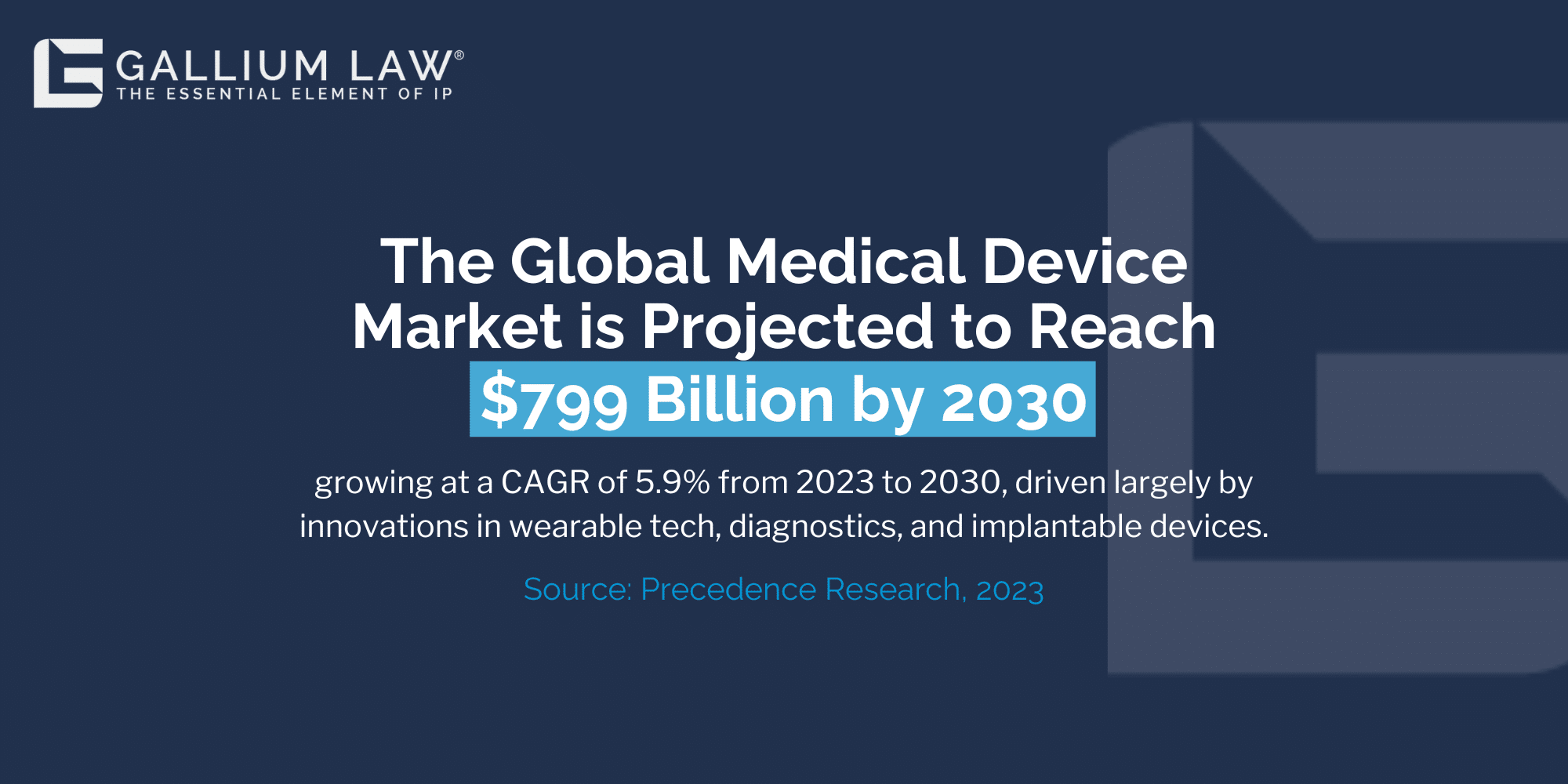
The global medtech market is rapidly expanding, with major growth in regions like the European Union, Canada, China, and India. If your device has international potential, a U.S.-only patent strategy may leave you vulnerable. Gallium Law works closely with international agents to build cost-effective, globally aligned patent portfolios. We assist with:

  • Patent Cooperation Treaty (PCT) filings to preserve options in over 150 countries.
  • Prioritizing countries based on market access, regulatory ease, and enforcement strength.
  • Navigating regional requirements such as EP validations, utility model options, and language-specific filings.
  • Budget planning for filing, translation, and maintenance costs.

Medical device innovators also face timing challenges when aligning IP filings with regulatory submissions. For example, disclosing device specifications in CE Mark documentation before filing can create problems in jurisdictions without grace periods. We ensure timing and filing strategies work together across your global roadmap.

Step 5: Align IP Strategy with FDA and Market Pathways

One of the most critical areas where medtech startups fall short is failing to connect their IP strategy with their FDA clearance or approval process. Every interaction with regulators, including 510(k) submissions or pre-sub meetings, may include technical information that can become public or scrutinized by competitors. Gallium Law helps companies:

  • Identify when to file new patent applications in relation to FDA submissions.
  • Draft claims that support the technical advantages being submitted to the FDA.
  • Avoid prematurely disclosing new iterations of the product that could limit patentability.
  • Leverage IP assets when preparing for reimbursement discussions, insurance coding, or clinical trials.

If your commercialization pathway involves software or AI-based devices, we also provide guidance on compliance with current USPTO examination guidelines around algorithmic claims, machine learning disclosures, and diagnostic methods.

The regulatory and patent tracks cannot operate in silos. Coordination between your FDA consultants and your patent counsel is key to long-term protection and success.

Step 6: Prepare for Monetization: Licensing, Enforcement, or Exit

Once your IP portfolio is established and your product is approaching the market, it’s time to look toward monetization. Whether you’re raising a Series A round, signing distribution deals, or preparing for acquisition, the value of your patent portfolio is a core component of your valuation. Gallium Law works with clients to prepare their IP assets for:

  • Licensing agreements with large device manufacturers or strategic partners.
  • Due diligence reviews by investors or buyers.
  • Patent enforcement actions in federal court or before the Patent Trial and Appeal Board (PTAB).

We help you avoid common pitfalls, such as securing overly broad claims that pose invalidity risks, securing overly narrow claims with limited enforceability, and not citing key prior art during prosecution. If licensing is a goal, we position your portfolio to clearly articulate the technology, its advantages, and its commercial use cases. If enforcement may be necessary, we identify which jurisdictions offer the best combination of speed, cost, and likelihood of success.

In some cases, Gallium Law’s clients opt to monetize patents via non-traditional channels, including royalty financing or structured settlements. No matter the route, the quality and structure of your IP portfolio must be aligned with your business exit strategy.

Why MedTech Startups Trust Gallium Law

Gallium Law was built to help innovators protect their most valuable assets: their ideas. We’re not a full-service business formation firm. Our focus is and always has been intellectual property. For medical device startups, that focus makes all the difference. Our clients rely on us for:

  • Deep understanding of medtech innovation and regulatory pathways.
  • Cost-effective strategies for early-stage companies.
  • Strong technical backgrounds across biotech, software, and device engineering.
  • Access to global agents and filing networks.
  • Practical, results-driven counsel that supports long-term value creation.

We are proud to be the IP legal partner of choice for medtech startups shaping the future of healthcare.

Bringing Your MedTech IP Strategy Full Circle

Your intellectual property is one of your company’s most valuable assets. Protecting it early and building a clear, market-aligned strategy can determine your success or failure. At Gallium Law, we help medtech startups move from idea to exit with confidence.

Whether you are filing your first provisional application or preparing for a cross-border licensing deal, we are here to guide you through every stage. Reach out today to schedule a consultation and learn how we can support your journey.