The IPR Process and Timeline
Understanding how IPR proceedings work helps both petitioners and patent owners prepare effective strategies.
Filing the IPR Petition
The petitioner files a petition with the PTAB identifying the challenged patent claims and presenting prior art and arguments demonstrating why those claims are unpatentable. The petition must include detailed claim charts comparing the prior art to each challenged claim element.
IPR petitions require substantial upfront work. Petitioners must conduct thorough prior art searches, analyze claim scope, prepare technical and legal arguments, and anticipate likely patent owner responses. Quality petition preparation significantly impacts institution rates and ultimate success.
Patent Owner Preliminary Response
After the petition is filed, the patent owner has an opportunity to file a preliminary response arguing why the PTAB should not institute the IPR. This preliminary response addresses whether the patent owner believes that the petitioner has demonstrated a reasonable likelihood of prevailing on at least one challenged claim.
Patent owners can also attempt to amend claims through a motion to amend, though historically, these motions have been unlikely to succeed. Recent PTAB guidance has made claim amendments more accessible, but they remain challenging and require careful strategy.
Institution Decision
Within three months of the preliminary response, the PTAB decides whether to institute the IPR. The PTAB will institute if the petitioner demonstrates a reasonable likelihood of prevailing on at least one challenged claim. This is a relatively low threshold, and institution rates historically range from 60-70% of filed petitions.
If the PTAB denies institution, the proceeding ends, and the petitioner cannot file another IPR petition based on the same prior art. If instituted, the proceeding moves forward to trial.
Discovery and Expert Testimony
IPR discovery is much more limited than federal court discovery. Parties can take depositions of expert witnesses and request specific documents, but there are no broad document productions or extensive interrogatories.
Both sides typically submit expert declarations supporting their positions on claim construction, prior art interpretation, and patentability. These expert declarations are crucial to presenting technical arguments effectively to the PTAB.
Oral Hearing and Final Decision
Approximately one year after institution, the PTAB holds an oral hearing where each side presents arguments and answers questions from the panel of judges. Unlike federal court trials with witnesses and cross-examination, IPR oral hearings focus on legal and technical arguments about patentability.
The PTAB issues a final written decision within 12 to 18 months of institution, determining whether the challenged claims are patentable or unpatentable. This decision can be appealed to the Federal Circuit Court of Appeals.
Defending Your Patents Against IPR Petitions
For patent owners, receiving an IPR petition can feel like an attack on your core intellectual property assets. Effective defense requires understanding your options and developing comprehensive strategies.
Immediate Steps After Receiving an IPR Petition
When you receive notice that an IPR petition has been filed against your patent, time is critical. You have only three months to file a preliminary response, and the work required is substantial.
Immediately engage experienced IPR counsel to evaluate the petition’s strength, identify weaknesses in the petitioner’s arguments, conduct prior art analysis to find art that distinguishes your invention, and develop a preliminary response strategy, including potential claim amendments.
This accelerated timeline means you cannot afford to delay. Patent owners who wait weeks before engaging counsel severely limit their strategic options.
Preliminary Response Strategies
Your preliminary response aims to convince the PTAB not to institute the IPR. Strong preliminary responses show why the prior art fails to anticipate or render obvious the challenged claims, explain technical distinctions that the petition overlooked, demonstrate that the petitioner’s combinations lack proper motivation, and identify procedural defects in the petition.
Even if you believe an institution is likely, the preliminary response frames issues for the entire proceeding. Arguments and positions taken here affect your ability to amend claims and present defenses later.
Claim Amendment Considerations
If IPR is instituted, patent owners can file motions to amend claims to avoid the prior art. Amendments must be narrowing (not broadening) and can include a reasonable number of substitute claims.
Recent PTAB guidance has improved patent owners’ success rates with claim amendments, but they remain challenging. Amendments must distinguish the prior art while maintaining commercially valuable claim scope. Working with counsel experienced in IPR claim amendments is essential to preserving patent value.
Parallel Litigation Management
Many IPR proceedings occur alongside federal court patent litigation. Patent owners must coordinate strategy across both forums, as developments in one forum impact the other.
Federal courts often stay litigation pending IPR outcomes, though stays are discretionary. Patent owners facing both IPR and litigation must develop comprehensive strategies addressing both proceedings and their interactions.
Cost Considerations for IPR Proceedings
IPR is often described as a less expensive alternative to federal court litigation, but it still represents a significant investment.
Typical IPR Costs
Filing and prosecuting an IPR petition typically costs $300,000 to $600,000 through final decision, depending on case complexity and whether the case settles before conclusion. Defending against an IPR petition typically costs $250,000 to $500,000.
These costs are substantially lower than federal court patent litigation, which typically costs $1.5 million to $4 million per side through trial. However, IPR costs are still high and require careful budgeting and strategic evaluation.
Cost-Benefit Analysis
Both petitioners and patent owners should conduct a thorough cost-benefit analysis before engaging in IPR. Consider the value at stake in the underlying dispute, likelihood of success based on prior art strength, potential settlement value, and costs of alternative strategies, including federal court litigation or licensing negotiations.
Our licensing and strategy services help clients evaluate whether IPR aligns with broader business objectives and intellectual property strategy.
IPR Success Rates and Outcomes
Understanding IPR statistics helps set realistic expectations and inform strategic decisions.
Historical Success Rates
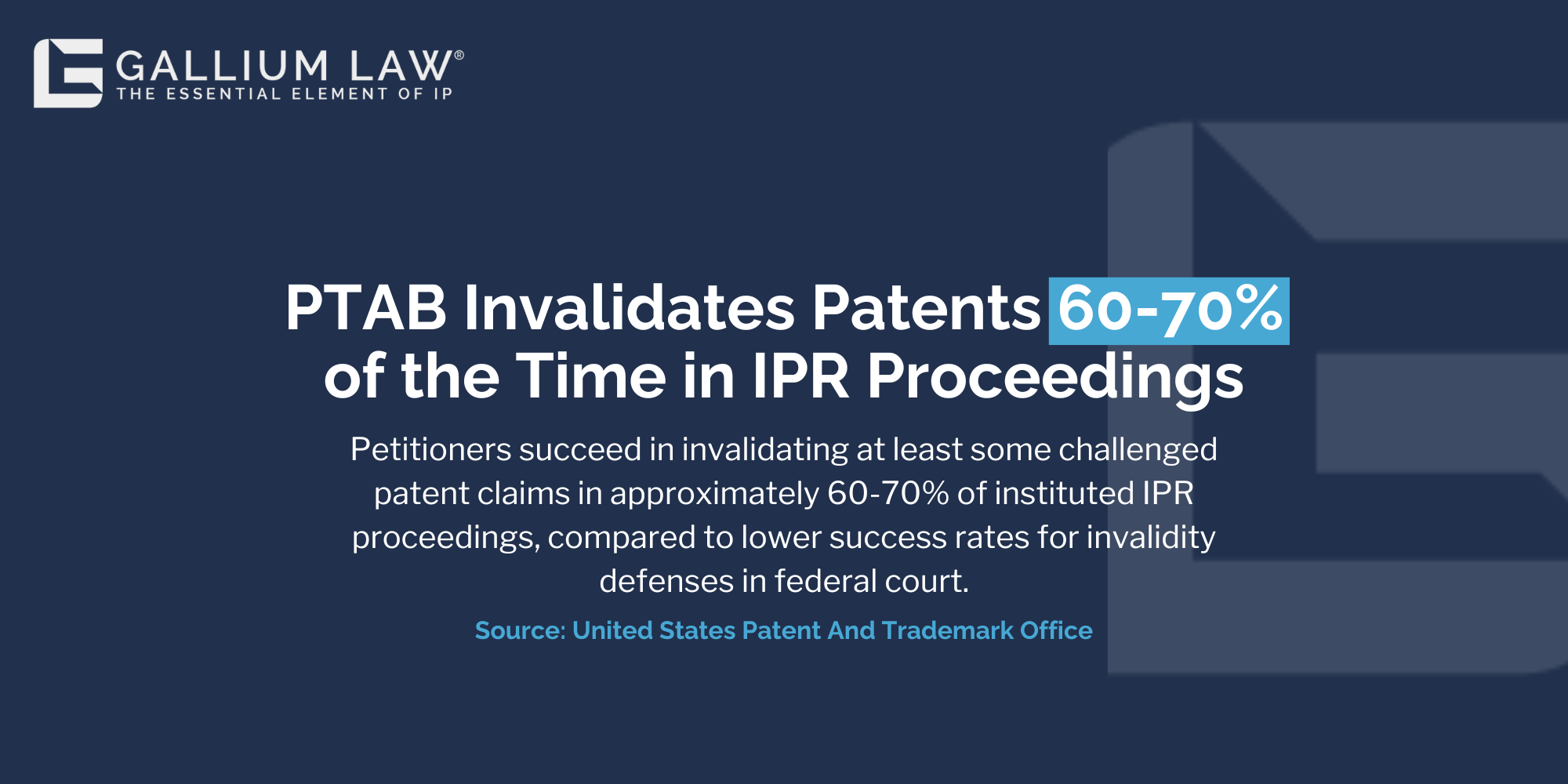
Historically, the PTAB institutes about 60-70% of filed IPR petitions. Of instituted cases, petitioners succeed in invalidating at least some challenged claims in approximately 60-70% of cases. This means petitioners achieve at least partial success in roughly 40-50% of all filed IPR petitions.
Patent owners fully defend all challenged claims in approximately 30-40% of instituted proceedings. These statistics vary by technology area and specific fact patterns, but they illustrate that IPR presents real risks for patent owners.
Impact on Parallel Litigation
IPR outcomes have a significant impact on parallel federal court litigation. When the PTAB invalidates patent claims, those claims cannot be enforced in federal court. Even partial claim invalidation can eliminate the strongest claims and shift settlement leverage dramatically.
Conversely, if the PTAB upholds challenged claims after rigorous examination, patent owners gain strong validation that enhances their litigation position and settlement leverage.
Why Experience Matters in IPR Proceedings
IPR requires specialized expertise distinct from general patent litigation or prosecution. The PTAB has unique rules, procedures, and strategic considerations that experienced counsel navigate more effectively.
Technical and Legal Expertise
Effective IPR representation requires a deep understanding of patent law, technical expertise in relevant technology areas, PTAB-specific procedures and strategies, and experience with PTAB judges’ approaches and preferences.
At Gallium Law, our team includes attorneys with extensive IPR experience representing both petitioners and patent owners across diverse technology areas. This dual perspective helps us anticipate opposing arguments and develop stronger strategies.
Strategic Positioning
IPR strategy extends beyond the proceeding itself to encompass parallel litigation, settlement negotiations, continuation application strategy, and broader intellectual property portfolio management.
We help clients integrate IPR decisions into comprehensive IP strategies that protect business objectives and maximize competitive advantages.
How Gallium Law Can Help
Whether you’re considering filing an IPR petition or defending your patents against IPR challenges, Gallium Law provides comprehensive representation tailored to your needs.
For IPR Petitioners
We help companies and individuals file strong IPR petitions by conducting thorough prior art searches and analysis, preparing detailed petitions with compelling technical and legal arguments, managing proceedings through final decision, and coordinating IPR strategy with parallel litigation or business objectives.
Our experience across multiple technology areas ensures we understand both the legal and technical aspects of your invalidity challenges.
For Patent Owners Defending Against IPR
If your patents face IPR challenges, we provide immediate response services to meet tight deadlines, strategic preliminary responses to prevent institution, claim amendment strategy to preserve patent value, comprehensive defense through oral hearing and final decision, and coordination with parallel federal court litigation.
We understand the threat IPR poses to patent owners and work aggressively to defend your intellectual property rights.
Comprehensive IP Services
Our IPR capabilities integrate with our broader services, including patent prosecution, litigation, licensing, and portfolio management. This comprehensive approach ensures the IPR strategy aligns with your overall intellectual property objectives.
Take Action to Protect Your Interests
Whether you need to challenge a competitor’s patent or defend your own patents against IPR attack, time is critical. IPR statutory deadlines and accelerated timelines require immediate action to preserve your options and protect your interests.
At Gallium Law, we provide experienced IPR representation that combines technical expertise, PTAB knowledge, and strategic thinking to achieve favorable outcomes. Don’t navigate these complex proceedings alone or with counsel unfamiliar with PTAB practice.
Contact us today to discuss your IPR needs and develop a strategy that protects your intellectual property and business objectives.