
Guides
Patenting Humanoid Robots and AI-Powered Machines
The Complete Inventor’s Guide
Table of Contents
Switched to Gallium from a larger firm and the difference has been massive. They offer much better service at much more manageable prices. If you are looking for fast efficient help with anything IP related, these are the guys for the job. Trademarks, Patents, Copyrights, these guys know what they are doing. They are my third lawyers I have worked with and the experience has been substantially better than the prior two.

Connor Hance
August 2025
Gallium law has been amazing to work with for our legal needs! They make things easy to understand, do a great job at keeping us informed, and are calm and confident in their communication. Highly recommend!!

Anna Wengreen
August 2025
I have worked with other firms and this is a rare one. It has truly been a pleasure working with Wes, Michael, and Jacob. They are the experts in IP Law and patent applications. I am grateful that they help me to understand things at my level. On top of that they are true gentlemen! It's been an amazing experience!

Nelson Lim
August 2025
Wes and the Gallium Law team have been a pleasure to work with. They guided us seamlessly through the provisional patent process for our product, providing expert advice and prompt communication at every step. I highly recommend them to any startup or business looking for strategic, dependable IP counsel. Looking forward to continuing our partnership!

Mike Lee
May 2025
I called several firms about assisting me with developing my patent and the Gallium Law firm was only one, nationwide, to return my phone call and consult with me. That is respect no matter what IP you have, or who you are. They are very professional and takes care of their customers. The work was thorough and detailed. I am very satisfied with the work they have done for me. I would recommend this law firm to anyone reading.

Shawn
May 2025
I highly recommend Gallium Law for your company's patent needs. Wes and crew are a stellar team that helped us get our product design utility patent successfully patented with the USPTO. After they drafted the patent application and materials, it was clear that having expert professionals craft the application was absolutely necessary. There are countless details in how they executed the application that we never would have been able to do ourselves. They did a tremendous job in taking the patent to the finish line.

Robert Paul
August 2024
The Gallium team have been and continue to be phenomenal partners to work with. They have been the most responsive, creative, engaging, and innovative IP counsel I have ever collaborated with. Gallium is happy to support early stage start-ups and provide the same attention and support you would typically only receive when working for large multi-nationals. I would recommend their team to anyone looking to generate and expand their IP portfolio.

Ryan Balko
September 2024
Great experience! The Gallium team did a great job filing my patent. They also did a great job of clearly explaining my options to protect my IP, and that made a big difference to me as a new inventor.

Daniel Bakke
August 2024
I have worked with Gallium law for many years. In my opinion they are unique in their approach of "winning" patents for customers like myself. I worked very close with their professional patent law attorneys, and turned obstacles and initial rejections to complete successful patent allowances. They are very reasonable with their budgets and willing to accommodate your personal needs and requests. It is the best patent law company I ever dealt with.

Gideon Eden
July 2023
Our publicly traded company has worked with Wes and his team at Gallium Law for about a decade. They are consummate IP professionals and highly organized - which is essential for coordinating dates, fees, etc. We trust Gallium Law with our most highly prized assets - our IP. You should, too.

David Morse
March 2024
Gallium Law is an incredible Intellectual Property Legal team! I am continually blown away with their ability to translate our medical device design ideas into patent claims and diagrams. They are very experienced in the interventional (catheters and generators) medical device space. My customers have had great experiences working with Gallium and I recommend them to all medical device innovators.

Brady Hatcher
April 2023
I have always been very happy with the great work of the Gallium team. They are patent experts who really take an interest in helping their clients succeed. Wes is particularly talented and results oriented. Not only is Wes an excellent patent attorney, he's also a great engineer with an MBA, so he understands legal issues from many useful perspectives.

Eric Wengreen
December 2022
I thoroughly enjoyed working with the Gallium Law team on my provisional patent application and intend to work with them on future filings. Wes and Isabel were knowledgeable and cared about understanding my intellectual property. I appreciated their advice on filing timelines and drafting strategy. I highly recommend their firm.

Ashley Mooneyham
February 2022
Humanoid robotics is no longer a research lab curiosity. It is a patent battleground. The industry recorded 2,592 patent families in 2025, more than double the number of filings from just two years earlier, and the companies leading the charge include some of the world’s largest technology firms alongside a growing cohort of specialized startups. From warehouse fulfillment and eldercare to surgical assistance and restaurant service, humanoid and service robots are entering commercial deployment across industries that were previously considered decades away from automation.
For inventors and companies developing robotic technology, the intellectual property (IP) decisions made in the next few years will define who controls this market. The technology is maturing rapidly, and the gap between “interesting research” and “issued patent” is closing fast. Innovations in actuator design, dexterous manipulation, tactile sensing, AI-driven motion planning, and human-robot interaction are all generating patent filings at an accelerating pace. This guide covers what is patentable in humanoid and service robot technology, the strategic considerations that separate strong portfolios from weak ones, and how to navigate a patent landscape that is both crowded and full of opportunity.
What Is Patentable in Humanoid and Service Robot Technology
Humanoid and service robots are complex systems that integrate mechanical engineering, electrical engineering, computer science, and materials science. That complexity means the number of independently patentable innovations within a single robot can be substantial.
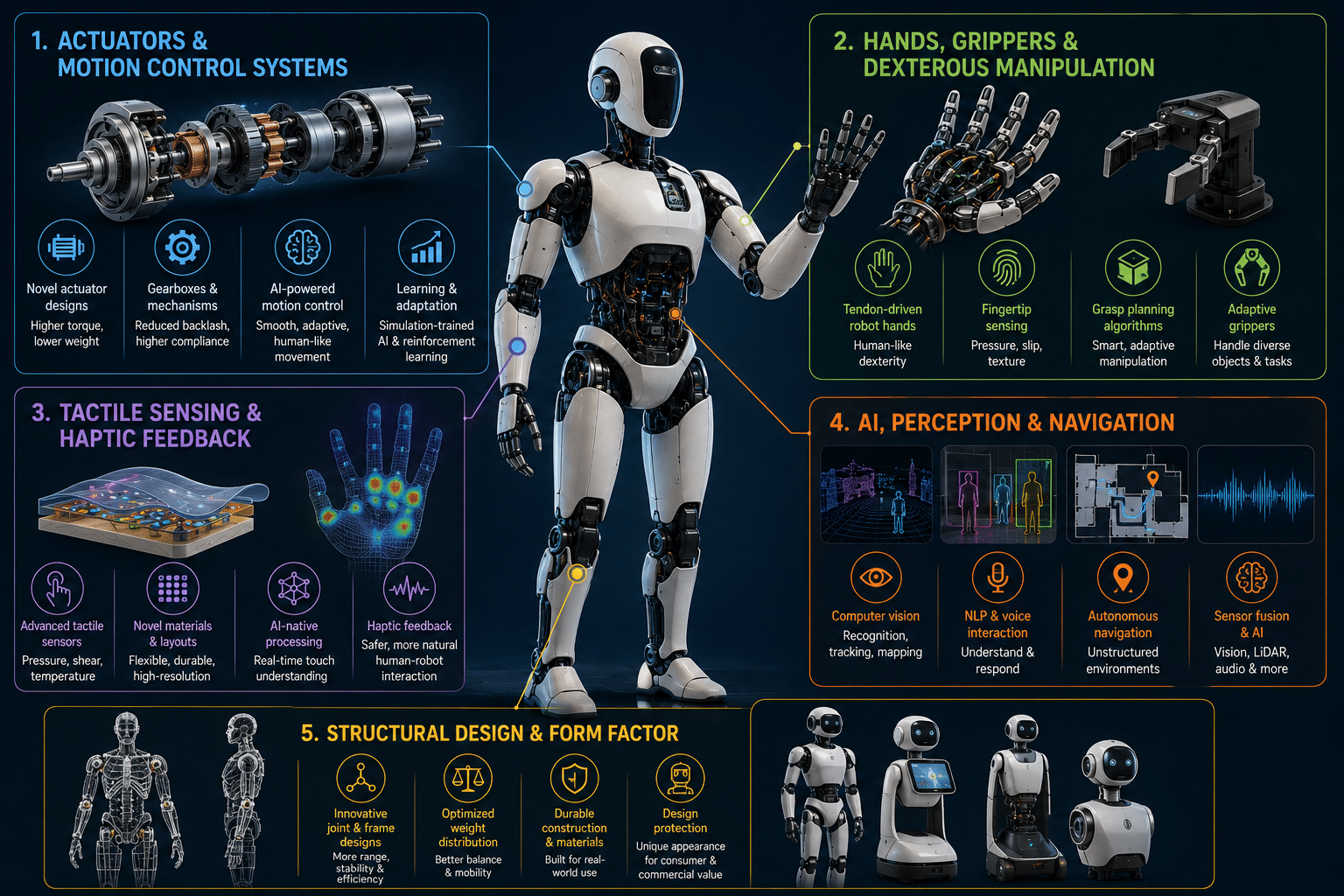
Actuators and Motion Control Systems
Actuators are the muscles of a humanoid robot, and innovation in actuator design is one of the most active patent areas in the field. The global patent corpus for humanoid robot actuators exceeds 530,000 patents, covering electric motors, hydraulic systems, pneumatic actuators, and emerging technologies like artificial muscles and shape-memory alloys. Patentable innovations include novel motor configurations that improve torque-to-weight ratios, gearbox designs that reduce backlash while maintaining compliance, and control algorithms that enable smooth, human-like joint movements.
The integration of AI and machine learning into motion control represents the defining frontier of the 2026 landscape. End-to-end learning systems, embodied AI models that learn movement patterns from simulation before transferring to physical hardware, and reinforcement learning approaches that allow robots to adapt their movements to new environments are all generating patent filings. For inventors working on motion control, conducting a thorough prior art search is essential, given the volume of existing patents. Our guide on finding the right patent search outlines how to approach that process.
Hands, Grippers, and Dexterous Manipulation
The ability to manipulate objects with human-like dexterity is one of the hardest engineering challenges in robotics, and it is producing some of the most valuable patents in the field. Tendon-driven robot hands, where flexible cables routed through the finger structure mimic the tendons of a human hand, are the subject of growing patent activity. Innovations in fingertip sensing, grasp planning algorithms, compliant joint mechanisms, and underactuated hand designs that achieve dexterity with fewer motors are all patentable.
Gripper designs for service robots are equally active. Adaptive grippers that handle objects of varying size, shape, and fragility without reprogramming have applications in warehouse picking, food service, and healthcare. The mechanical design, the control logic, and the sensor integration each represent separate patentable innovations.
Tactile Sensing and Haptic Feedback
For a robot to interact safely and effectively with humans and objects, it needs to feel. Tactile sensing technology that allows a robot to detect pressure, texture, slip, temperature, and shear forces is advancing rapidly, and patent filings reflect that acceleration. The period from 2021 to 2025 marks a decisive shift toward AI-native tactile sensing architectures, where raw touch data is processed by neural networks to enable real-time grasp adjustment and object recognition.
Innovations in sensor materials (flexible piezoresistive films, capacitive arrays, optical tactile sensors), sensor placement strategies, and the algorithms that interpret tactile data are all independently patentable. GelSight-style sensors that use camera-based deformation measurement to achieve high-resolution touch sensing represent one of the most actively filed subcategories.
AI, Perception, and Navigation
The software that enables a humanoid or service robot to perceive its environment, plan actions, navigate spaces, and interact with humans is a major source of patentable innovation. Computer vision systems for object recognition, person detection, and spatial mapping are well-established patent areas, but the integration of vision with other sensing modalities (LiDAR, depth cameras, audio) for robust environmental understanding continues to generate novel filings.
Natural language processing for voice commands, gesture recognition for intuitive human-robot interaction, and autonomous navigation systems that allow robots to operate in unstructured environments like homes, hospitals, and retail stores all represent active filing areas. Understanding how to structure these software-centric claims to survive patent examination is critical. The distinction between an abstract idea and a patentable technological improvement often comes down to how tightly the claim is tied to the specific robotic system it controls.
Structural Design and Form Factor
The physical structure of a humanoid robot, including its skeletal frame, joint configuration, weight distribution, and external housing, can be protected through both utility and design patents. Utility patents cover structural innovations that solve functional problems, like a joint mechanism that provides a wider range of motion or a frame design that lowers the center of gravity for stability. Design patents protect the ornamental appearance of the robot, which matters increasingly as service robots enter consumer-facing environments. Understanding the distinction between design patents and utility patents helps you determine which filing strategy matches your innovation.
The Humanoid Robot Patent Landscape in 2026
China has emerged as the dominant force in humanoid robotics patent volume, surging from 271 filings in 2015 to 2,426 in 2025. Japan, the United States, and South Korea follow as the next most active jurisdictions. This geographic distribution reflects where the manufacturing and deployment of humanoid robots is happening fastest, and it has direct implications for international filing strategy.
The most active patent categories in 2026 include actuator and motion control systems (the largest by volume), dexterous manipulation and robot hands (the fastest growing), tactile sensing (transitioning from research to commercial), and AI-integrated motion planning (the emerging frontier). Despite the overall density of filings, significant whitespace remains in areas like soft robotics for healthcare, modular reconfigurable robot architectures, and human-robot collaborative task planning. Our guide on starting the patent process walks through how to position your filing within this landscape.
Strategic Considerations for Robotics Patent Portfolios
File Early in a Fast-Moving Field
The pace of innovation in humanoid robotics means that delay carries real cost. A technical approach that is novel today may be independently developed and filed by a competitor within months. Provisional applications are a practical tool for securing an early filing date while your technology continues to develop. However, the provisional must contain sufficient technical detail to support the claims you plan to file in the non-provisional application. Filing a thin provisional just to get a date on record can backfire if it fails to support your eventual claims. Understanding what happens after filing your patent application helps you plan the transition from provisional to non-provisional.
Protect the Integration, Not Just the Components
Individual components of a humanoid robot, such as a motor, a sensor, or an algorithm, are often patentable on their own. But some of the most valuable patents in robotics cover the integration of multiple components into a system that produces capabilities none of the components achieve independently. A patent covering how a specific actuator, sensor, and control algorithm work together to enable a robot to walk on uneven terrain is harder to design around than three separate patents covering each component in isolation. System-level claims describing the interaction between hardware and software create broader protection.
Plan for Licensing and Partnerships
The humanoid robotics industry is likely to follow the pattern of other complex technology markets, where companies license patented subsystems from specialists rather than developing every component in-house. If your strength is in tactile sensing, your patent portfolio should be structured to support licensing to multiple robot manufacturers rather than covering only your own robot design. Conversely, if you are building a complete humanoid robot, your portfolio should include claims that give you leverage in cross-licensing negotiations with the companies whose subsystem patents you might need to access. Our licensing and IP strategy practice helps companies structure these strategies from the portfolio design stage.
International Filing Is Not Optional
With China, Japan, and South Korea leading in robotics patent volume, filing only in the United States leaves your technology unprotected in the markets where deployment is happening fastest. A PCT filing preserves your right to enter multiple national markets, and the additional cost is justified for any technology with global commercial potential. Your filing strategy should prioritize the jurisdictions where your technology is most likely to be manufactured, sold, or licensed.
Enforcing Robotics Patents
Patent enforcement in the robotics industry presents unique challenges. The complexity of robotic systems can make infringement analysis technically demanding, requiring a detailed comparison of mechanical designs, software architectures, and system behaviors. The cost of patent litigation reflects that complexity. Understanding patent infringement lawsuit costs before you need to enforce helps you build a portfolio that is practical to defend, not just impressive on paper.
If errors are discovered in an issued patent after the fact, such as claims that are too narrow to cover the commercial embodiment of your technology, patent reissue applications may offer a path to correct those issues. However, reissue is a limited remedy, and the better approach is to draft claims correctly the first time with patent counsel who understands the robotics space.
Secure Your Position in the Robotics Revolution
The humanoid and service robot market is at an inflection point. The technology is moving from demonstration to deployment, and the IP landscape is shifting from open territory to claimed ground. The companies and inventors that build strong patent portfolios now will have the leverage to compete, license, and negotiate from a position of strength as the industry scales.
At Gallium Law, our patent prosecution team works with robotics companies from early-stage startups to established manufacturers. We bring the technical depth to understand your innovation and the prosecution experience to turn it into enforceable patent protection. Contact us to discuss your robotics patent strategy.