
Skip links

Guides

Amazon IP Accelerator

Fast-Track Brand Registry With Pre-Vetted Attorneys

Get In Touch

651-256-9480

Table of Contents

Amazon ties its most valuable seller tools to Brand Registry, which requires at least a pending trademark application for registration. Without Brand Registry, sellers don’t have access to A+ Content, Sponsored Brands campaigns, Brand Store, or, critically, the enforcement tools that keep counterfeiters and hijackers off your listings.

Amazon built IP Accelerator to help sellers file trademark applications. Rather than spending valuable time researching and contacting law firms on their own, the program connects sellers with Amazon-vetted law firms, those firms file the trademark application, and Amazon grants Brand Registry access within roughly two weeks of filing. Not two weeks after the trademark registers. Two weeks after the application goes in. 

At Gallium Law, we work with Amazon sellers who are trying to figure out whether IP Accelerator makes sense for their brand, whether they should file through their own counsel instead, and how to avoid the pitfalls that catch sellers who rush through the process without thinking about trademark strategy. This guide covers all of it.

How the Program Actually Works

IP Accelerator is free to use, and the program gives you access to a curated list of trademark law firms that Amazon has vetted and approved. You pick one, consult with them about your mark, and they handle the filing. 

Here is what the process looks like in practice. You choose a firm from the IP Accelerator directory. That firm walks you through the basics: whether you need a wordmark or a design mark, which goods-and-services classes to cover, and whether there are any obvious conflicts in the existing trademark landscape that could trip you up. They run a search, prepare the application, and file it. 

Start to finish, you are looking at two to three weeks from your first conversation with the law firm to active Brand Registry enrollment. That is the pitch, and for sellers launching new brands, it is a compelling one.

What You Will Actually Pay

Amazon does not charge for the program. You pay the law firm and the government filing fee. Amazon has pre-negotiated rates with its partner firms, so the costs are relatively standardized.

A basic trademark search of USPTO records runs about $650. If you want a deeper search that also covers unregistered uses and common-law marks, expect closer to $1,800. Filing a single-class trademark application costs roughly $700 in attorney fees, plus the USPTO’s $350-per-class filing fee. Need additional classes? That adds $350 per class.

For a straightforward single-class filing, budget about $1,700 all in. That is roughly in line with what trademark attorneys charge outside the program. Understanding where and how to register a trademark helps you figure out which classes and jurisdictions matter for your specific products, so you are not paying for coverage you do not need or missing coverage you do.

Why Brand Registry Access Changes Everything

Sellers sometimes treat Brand Registry as a checkbox. File the trademark, get enrolled, move on. That undersells what the enrollment actually gives you. Brand Registry is not just a status. It is the key that unlocks two categories of tools that directly affect revenue: protection tools and growth tools.

Keeping Hijackers and Counterfeiters Off Your Listings

Once you are in Brand Registry, you get access to Report a Violation, Amazon’s system for filing IP complaints, including trademark, copyright, and patent infringement issues. You can report listings that use your trademark without permission, copy your product images, or sell counterfeit versions of your product. Amazon also turns on automated protections that scan the catalog for suspected infringements and remove them proactively. Our guide on combating copycat products through Brand Registry walks through how these tools work and what kind of documentation makes your reports stick.

Brand Registry is also the gateway to the heavier enforcement programs. Project Zero lets you remove counterfeit listings yourself in 24 to 48 hours, no waiting for Amazon to investigate. Amazon’s APEX program handles utility patent disputes through a streamlined evaluation process. Transparency puts serialized authentication codes on every unit, so counterfeits get caught at the warehouse. None of these are available without Brand Registry.

A+ Content, Brand Stores, and Sponsored Brands

On the growth side, Brand Registry unlocks A+ Content, which replaces the plain text product description with rich layouts, comparison charts, and lifestyle images. Amazon reports that A+ Content increases sales by an average of 5.6%. You also get Brand Stores, essentially a standalone storefront within Amazon, and Sponsored Brands campaigns that put your logo and product selection at the top of search results. Brand Analytics rounds it out with search term data, market basket analysis, and demographic insights.

Every month without Brand Registry is a month without these tools. For a seller launching into a competitive category, that gap is expensive. Protecting your IP on Amazon starts with trademark registration. IP Accelerator just gets you there faster by providing access to vetted law firms and saving you the time of finding a firm yourself.

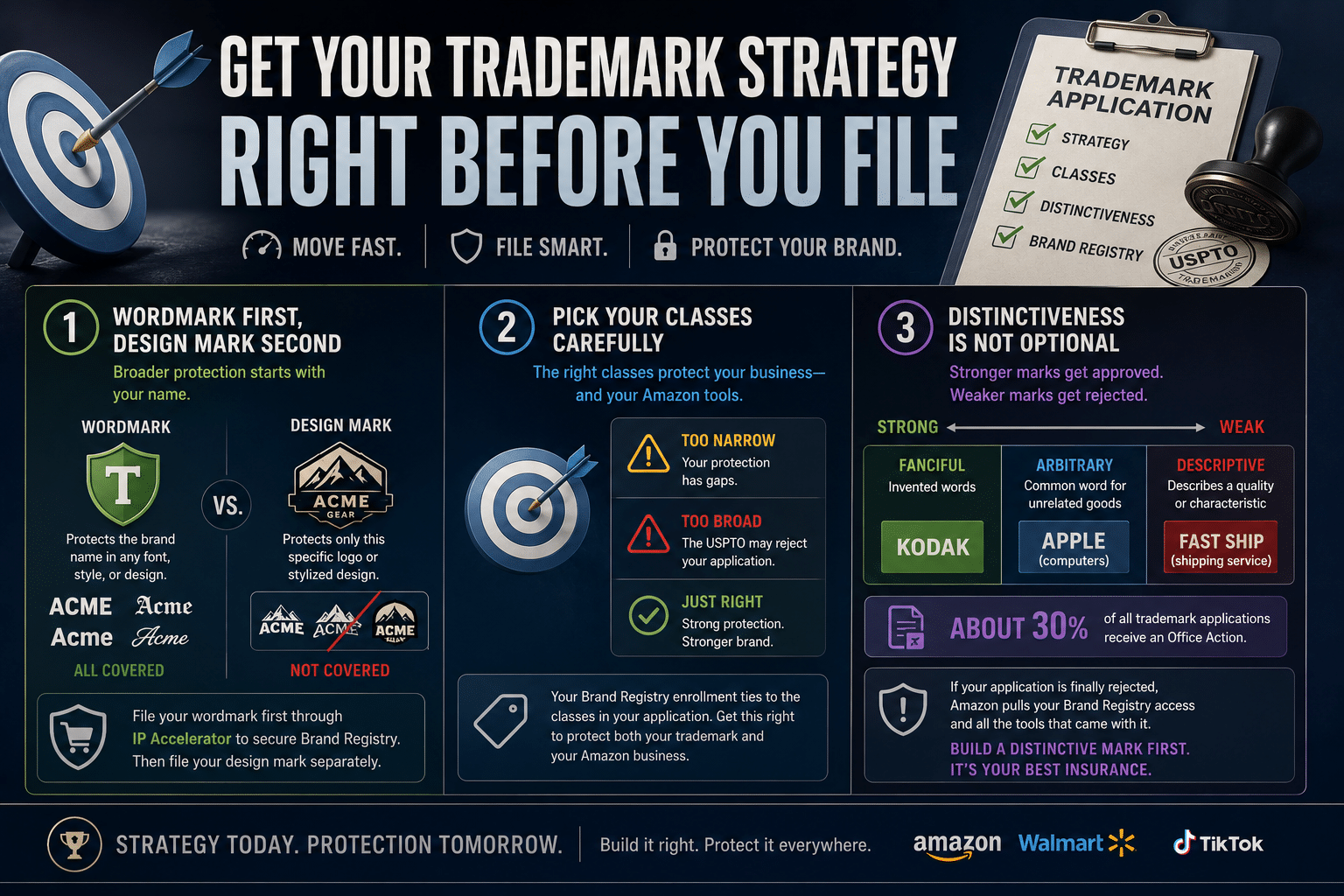
Get Your Trademark Strategy Right Before You File

Speed matters, but a bad filing is worse than a slow one. IP Accelerator gets you into Brand Registry quickly, but the underlying trademark application still has to survive USPTO examination. If it does not, Amazon pulls your Brand Registry access and all the tools that came with it. That makes the quality of your filing critically important.

Wordmark First, Design Mark Second

A wordmark protects the brand name in any visual format. A design mark only protects a specific logo or stylized rendering. For Amazon sellers, the wordmark should come first because it is broader. If someone uses your brand name in a completely different font, a wordmark still covers it. A design mark would not. Most sellers we work with file the wordmark through IP Accelerator to lock in Brand Registry, then pursue a design mark registration separately.

Pick Your Classes Carefully

Every trademark application has to specify which goods and services classes the mark will cover. Get this wrong, and you have problems. Too narrow, and your protection has gaps. Too broad or inaccurate, and the USPTO will issue an Office Action rejecting your proposed mark. Your Brand Registry enrollment ties to the classes in your application, so this decision affects both your trademark and your Amazon tools. Our breakdown of risks and the strategy behind Amazon trademarks covers the classification mistakes Amazon sellers most frequently make.

Distinctiveness Is Not Optional

The USPTO evaluates marks on a spectrum. Fanciful marks like “Kodak” (invented words) and arbitrary marks like “Apple” for computers sit at the strong end. Descriptive marks like “Fast Ship” for a shipping service sit at the weak end and face a much harder path to registration. About 30% of all trademark applications receive an Office Action, and descriptive marks are disproportionately represented in that number. If you are filing through IP Accelerator specifically to obtain Brand Registry access, a finally rejected application means you will lose that access. Spending time on making your trademark inherently distinctive before filing is not a nice-to-have. It is insurance against the worst-case scenario.

If Your Trademark Application Gets Denied

Here is the risk nobody talks about in the IP Accelerator marketing materials. If the USPTO ultimately refuses your trademark, Amazon revokes your Brand Registry enrollment for that mark. Gone. A+ Content, Brand Store, Sponsored Brands access, automated protections, all of it disappears.

An Office Action is not necessarily fatal. Many Office Actions are procedural and can be resolved by amending the application or providing additional evidence. But if the mark itself is the problem, if it is too descriptive or conflicts with an existing registration, that is a much harder fix. And the entire time you are fighting through the response process, your Brand Registry access may be in limbo.

This is why we consistently tell clients that the clearance search before filing matters more than the filing itself. A thorough search catches conflicts before they become Office Actions. The IP Accelerator firms are vetted by Amazon, but “vetted” means Amazon trusts the firms to file accurately, not that every application those firms file will be approved. The quality of your trademark strategy still rests on the quality of the legal advice you receive.

Do You Even Need IP Accelerator?

Here is something Amazon does not advertise heavily: you no longer strictly need IP Accelerator to get early access to Brand Registry. Amazon updated its requirements and now accepts pending trademark applications from any qualified attorney, not just IP Accelerator firms. If your attorney files a trademark application and you get a USPTO serial number, you can apply for Brand Registry with that pending application.

So why would anyone use IP Accelerator? Certainty. There is no ambiguity about whether Amazon will accept your Brand Registry application when it comes from an approved firm.

If you already work with a trademark attorney you trust, filing outside the IP Accelerator is perfectly viable. You may actually get better legal guidance from counsel who knows your industry well. For sellers who do not have existing trademark counsel, IP Accelerator removes the guesswork of finding a qualified firm. Our overview of Amazon intellectual property services covers the full range of protection options available to Amazon brand owners, regardless of how they enter Brand Registry.

Selling Globally? IP Accelerator Works Internationally

IP Accelerator supports trademark filings in over 20 countries, including the U.S., the UK, Germany, France, Japan, Australia, Canada, India, the UAE, and more. If you sell across multiple Amazon marketplaces, you can use the program to file in each jurisdiction and gain Brand Registry access in those storefronts.

The catch is that a mark that clears easily in the U.S. might run into conflicts in Europe or Japan. Filing in multiple countries multiplies both the cost and the risk of Office Actions. Our guide on international IP enforcement on Amazon breaks down how to coordinate trademark registrations across Amazon’s global marketplaces without creating enforcement gaps.

Brand Registry Is the Beginning, Not the End

IP Accelerator gets you into Brand Registry. That is valuable. But Brand Registry, with only a trademark, is like a toolbox with one wrench in it. Patents protect functional product innovations. Copyrights protect your listing photos and copy. Trade dress can protect distinctive packaging. Each of these rights is enforceable through Brand Registry’s reporting tools, but only if you own the rights first.

At Gallium Law, we help sellers move from initial Brand Registry enrollment into a layered IP portfolio that covers the full range of threats Amazon sellers face. We handle trademark filing, Brand Registry enrollment, and patent, copyright, and trade dress work that turn Brand Registry into a fully loaded enforcement platform. If you need Brand Registry access quickly or want to build a broader protection strategy around an existing enrollment, reach out and let us figure out the right path for your brand.