Skip links

Guides

How to Patent Solar Panel Technology

Protecting Innovation in the Fastest-Growing Energy Sector

Get In Touch

651-256-9480

Table of Contents

More than half of all renewable energy patents filed worldwide involve solar technology. That’s not a recent development. It’s been the case for over a decade, and the gap keeps widening. IRENA’s patent tracking platform shows solar patent applications growing 678% across a seventeen-year tracking window. The money follows the filings. Governments, manufacturers, and venture-backed startups are all pouring R&D dollars into pushing efficiency numbers higher and production costs lower, and each breakthrough generates a new wave of patent activity.

Consider where the technology sits right now. LONGi’s perovskite-silicon tandem cells hit 34.85% conversion efficiency in 2025, certified independently by NREL. Oxford PV shipped the first commercial perovskite tandem panels to a U.S. utility-scale project. Bifacial modules are standard on new installations. Heterojunction cells are eating into traditional PERC market share. And behind all of it, the patent offices are flooded.

We work with solar technology companies at Gallium Law, everyone from university labs commercializing novel cell designs to manufacturers locking down next-generation module architectures. Our patent prosecution and strategy services cover the full lifecycle, from provisional application filings through enforcement. This guide gets into the specifics: what’s actually patentable, where the whitespace is, and what mistakes we see costing solar companies their competitive edge.

So What Can You Actually Patent?

Not sunlight. Not the photoelectric effect. Everything in between the photon hitting the panel and the current reaching the grid, though? Fair game. And the patentable territory is wider than most solar engineers expect.

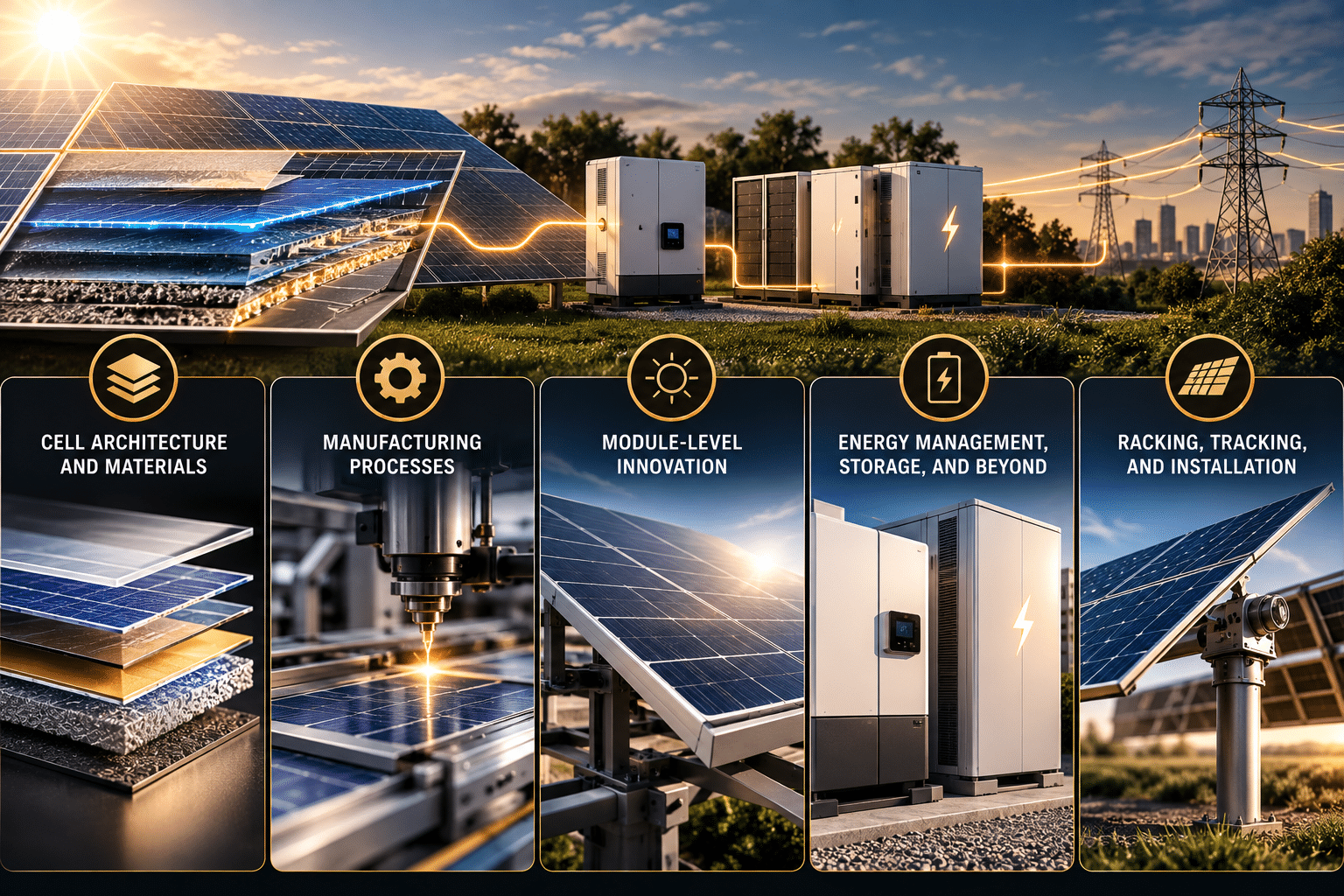
Cell Architecture and Materials

This is the high-value zone. If you’ve designed a cell architecture that converts light more efficiently, degrades more slowly, or costs less to manufacture, that’s patentable. We’re talking about novel semiconductor layer arrangements, junction geometries, passivation approaches, and material formulations. Perovskite cells are far and away the hottest filing area. According to CAS (a division of the American Chemical Society), global perovskite patent filings reached 43,835 by late 2025. Annual filings went from 196 in 2017 to over 1,700 in 2024. If you’ve developed a new perovskite composition or figured out a way to stabilize these materials against degradation (the industry’s biggest unsolved headache), you’re sitting on IP in one of the most competitive patent spaces in all of energy technology.

Manufacturing Processes

How you make the cell can be worth as much as the cell itself. Manufacturing steps that involve novel deposition methods, encapsulation techniques, laser processing steps, and roll-to-roll approaches for thin-film production can hold patentable value. Process patents punch above their weight in solar because they’re genuinely hard to design around. If your process delivers higher yields or tighter uniformity or gets the cost per watt down, protect it separately from the cell design it produces. Our walkthrough of the patent process from idea to application covers how the filing process works from concept through filing.

Module-Level Innovation

Bifacial modules that capture reflected light off the rear side are growing at 12 to 15% in annual patent filings, but it goes well beyond that. Other areas of novel aspects include cell interconnection methods, frameless module designs, integrated microinverters, bypass diode layouts, and anti-reflective coatings. All are actively filed in the patent space. And here’s something a lot of solar companies miss: module design can involve both utility patents (for the functional innovation) and design patents (for distinctive visual elements). Our breakdown of how design patents differ from utility patents explains when each applies.

Energy Management, Storage, and Everything Downstream

Panels don’t work in isolation. They feed into inverters, battery systems, charge controllers, and grid management software. Every piece of that chain generates patentable innovation: maximum power point tracking algorithms, smart inverter controls, DC-coupled storage architectures, and predictive generation forecasting that pulls weather data to anticipate output. Energy storage patents account for close to half of all global energy patent filings right now, and a big slice of that involves solar-storage integration.

Racking, Tracking, and Installation

Most solar companies don’t think about patents when it comes to mounting hardware, but they should. Single-axis and dual-axis trackers involve both mechanical and software innovations. Roof-integrated systems, floating solar platforms for reservoirs and lakes, and agrivoltaic designs where farming happens beneath elevated panels all generating active filings. How to mount the panels is a category that tends to get overlooked until a competitor files first.

solar panel patents

Perovskite: The Patent Race You Can’t Afford to Ignore

Perovskite deserves its own section because nothing else in solar looks like this. In 2015, about 2% of solar cell patent filings involved perovskite technology. By 2024, that number was 15%. Efficiency records keep getting broken. A 2025 Nature paper documented flexible perovskite-silicon tandems reaching 33.6% efficiency. LONGi then pushed it to 34.85% on rigid substrates, certified by NREL.

China files roughly 40 to 45% of all perovskite patents globally. The U.S., EPO, and South Korea follow. But here’s what matters for companies looking to file now: most perovskite IP is still academic. Still pre-competitive. The window for commercial entities to lock down patents on scalable manufacturing, stability solutions, and tandem integration is narrowing, but it hasn’t closed.

Stability is the problem everyone’s chasing. Perovskite degrades when it hits moisture, heat, or UV radiation. If your team has solved a piece of that puzzle through novel encapsulation, additive engineering, or interface passivation, file now. Not next quarter. Now. A provisional application locks in your priority date while you keep optimizing. Our comparison of provisional vs. non-provisional patent applications explains how that works.

One Patent Won’t Protect You. A Portfolio Will.

We see this constantly. A solar company files a single patent on its core innovation, assumes it’s protected, and then watches a competitor design around that one claim set in six months. One patent is a speed bump. A portfolio is a wall.

For a solar technology company, that portfolio should have multiple layers: material patents covering cell compositions and layer structures; process patents protecting manufacturing methods; device patents covering the assembled cell or module; system patents addressing energy management and storage integration; and method patents protecting the installation or operational techniques the technology enables.

And not everything should be in a patent application. Manufacturing recipes, yield optimization parameters, calibration settings, supplier-specific formulations? Those might be better as trade secrets, especially if reverse-engineering them from the finished product is impractical. Deciding what to patent and what to keep confidential is a strategic call.

Where Solar Companies Blow It on Patents

Presenting at a Conference Before Filing

This one kills more solar patent applications than any prior art rejection. A journal article, a conference talk at IEEE PVSC, even a poster session can count as public disclosure. In the U.S., you get a one-year grace period. Everywhere else? Nothing. Zero. A talk in San Diego can permanently destroy your patent rights in China, Europe, Japan, and Korea. That’s a devastating loss given that China alone accounts for over 40% of perovskite filings. Read our piece on public disclosure without IP protection before you present anything, anywhere.

Writing Claims Around the Lab Prototype

Solar technology often changes substantially as it moves from research prototype to commercial product. Cell sizes increase, material compositions adapt to manufacturing constraints, and module designs evolve to meet installation requirements. Patent claims that cover only the precise laboratory configuration may therefore fail to protect the commercial version. Strong solar patents anticipate scale-up and capture commercially relevant variations, not just the setup that achieved a record efficiency.

Skipping the Prior Art Search

Solar has one of the deepest prior art pools in any technology sector, with decades of published research, government-funded work, and corporate R&D. Filing blind risks rejection, wasted prosecution fees, and claims so narrow they’re useless. IP due diligence should be baked into any solar patent strategy, especially for companies entering the space or building portfolios for licensing or M&A.

Federally Funded Research: Know the Rules Before You File

A lot of solar innovation in the U.S. touches government money, whether from the DOE, ARPA-E, SETO grants, or national lab partnerships. Under the Bayh-Dole Act, if federal funding supported the invention, the government keeps a nonexclusive, royalty-free license. You can still patent and commercialize the technology, but the government rights are permanent. And if you don’t comply with Bayh-Dole reporting requirements, the government can take title to the invention outright.

For university spin-outs and startups built on federally funded research, the patent ownership chain has to be clean from day one, including inventorship, assignment, and government interest reporting. Get it right before filing, not after. Our startup consulting services help early-stage solar companies navigate the overlap between university IP policies, government obligations, and commercial strategy.

Using Efficiency Data to Strengthen Your Application

Every serious player in solar tracks NREL’s Best Research-Cell Efficiency Chart. If your cell or module beats the published efficiency record for its material system, that’s powerful evidence of non-obviousness, which is one of the core requirements for getting a patent granted. Document your data rigorously. Get third-party certification when you can. And make sure the application ties the efficiency improvement directly to the specific innovation you’re claiming.

Efficiency alone won’t get you a patent. But a demonstrated improvement over the state of the art makes the examiner’s job easier. You’re showing, with numbers, that your invention does something the prior art couldn’t. That matters.

The Companies Filing Now Will Own the Next Twenty Years

Solar is growing faster than any other electricity source on the planet, and the IP landscape is growing right alongside it. The companies that file strategically today will hold the patents that control licensing, manufacturing rights, and market access through the 2040s. The ones that wait, or file carelessly, will watch competitors adopt their innovations without paying a dime.

At Gallium Law, we work with solar innovators at every stage. Researchers filing their first provisional on a novel cell architecture. Established manufacturers building portfolios ahead of fundraising or acquisition. If you’re developing perovskite cells, advanced module designs, storage integration, or next-gen manufacturing processes, get in touch. Let’s build a patent strategy that matches the value of what you’re creating.