Skip links

Guides

How to Patent Generative AI Technology

Get In Touch

651-256-9480

Table of Contents

Generative Artificial Intelligence (“ generative AI”) is one of the fastest-moving technology sectors we have ever seen. Patent filings in this space have nearly tripled in just two years, according to WIPO’s 2026 Technology SPARK report, with more than 56,000 new patent families published in 2024 and 2025 alone. That is more than the entire preceding decade combined.

There is real value in patenting the work that you have carried out, such as the development of a generative AI system, a new method of training, or an application which makes use of large language models in a genuinely novel way. However, obtaining a patent for AI is far from straightforward, since the combination of software, abstract ideas, and machine learning creates a series of eligibility problems that can cause an examiner to reject an application.

We help inventors and startups navigate exactly these challenges. Here is what you need to know about patenting generative AI technology, from eligibility hurdles to claim drafting strategies that actually work.

Is Generative AI Actually Patentable?

Short answer: yes, but not every AI invention qualifies. The longer answer involves understanding a legal framework that trips up even experienced applicants.

The core issue is Section 101 of the Patent Act and the Supreme Court’s 2014 decision in Alice Corp. v. CLS Bank. Under Alice, claims directed to abstract ideas are not patent-eligible unless they contain an “inventive concept” that transforms them into something more. And the USPTO treats many AI-related claims as abstract ideas, specifically mathematical concepts and mental processes.

Consider it in this light: a patent claim that simply states “use a neural network to solve problem X” is likely to be rejected. The neural network by itself is not a novel invention, and merely applying it to a different dataset does not make the application patentable. The Federal Circuit made this clear in Recentive Analytics v. Fox Corp. (April 2025), one of the first major appellate decisions on machine learning patents. The court ruled that patents that claim the use of generic machine learning in a new data environment, without disclosing any actual improvements to the ML models, are ineligible for patent protection under Section 101.

The decision warned AI patent applicants; at the same time, it clarified the path forward by requiring claims to show a concrete technical improvement, not just a new way of using existing technology.

What the USPTO’s 2024 AI Guidance Actually Says

In July 2024, the USPTO published its most detailed guidance yet on AI patent eligibility. The 2024 Guidance Update on Patent Subject Matter Eligibility included three new examples (Examples 47 through 49) that walk through the eligibility analysis for AI-related claims. Then, in August 2025, the USPTO issued a follow-up memorandum to examiners, cautioning against overbroad Section 101 rejections and clarifying that examiners should reject claims only when it is more likely than not that a claim is ineligible. That is good news for AI patent applicants.

The examples illustrate a consistent theme. AI claims that demonstrate a specific, measurable improvement to a technology or technical process tend to clear the eligibility bar. Claims that simply apply AI to accomplish a known task in a new domain do not.

Example 47: Anomaly Detection with Neural Networks

This shows that a neural network developed for a specific anomaly detection task can be patent-eligible if the claim explains how the network’s architecture yields a tangible improvement, for example, faster or more accurate detection than existing methods.

Example 48: AI-Driven Speech Separation

The USPTO rejected one claim because it provided only an abstract description of the AI function, while accepting the other two claims because they connected the AI processing to specific hardware implementations and signal-processing steps, leading to a tangible improvement.

Example 49: Personalized Medical Treatment

This shows that AI systems that produce personalized treatment recommendations can be acceptable, as long as the claims describe how the model manages patient data and produces outputs that are clinically useful and improve on existing diagnostic methods.

What can be concluded from all three examples? It is specificity that succeeds. Applications that make only general references to ‘machine learning’ or ‘artificial intelligence’ without including any technical details will be rejected. 

Types of Generative AI Inventions You Can Patent

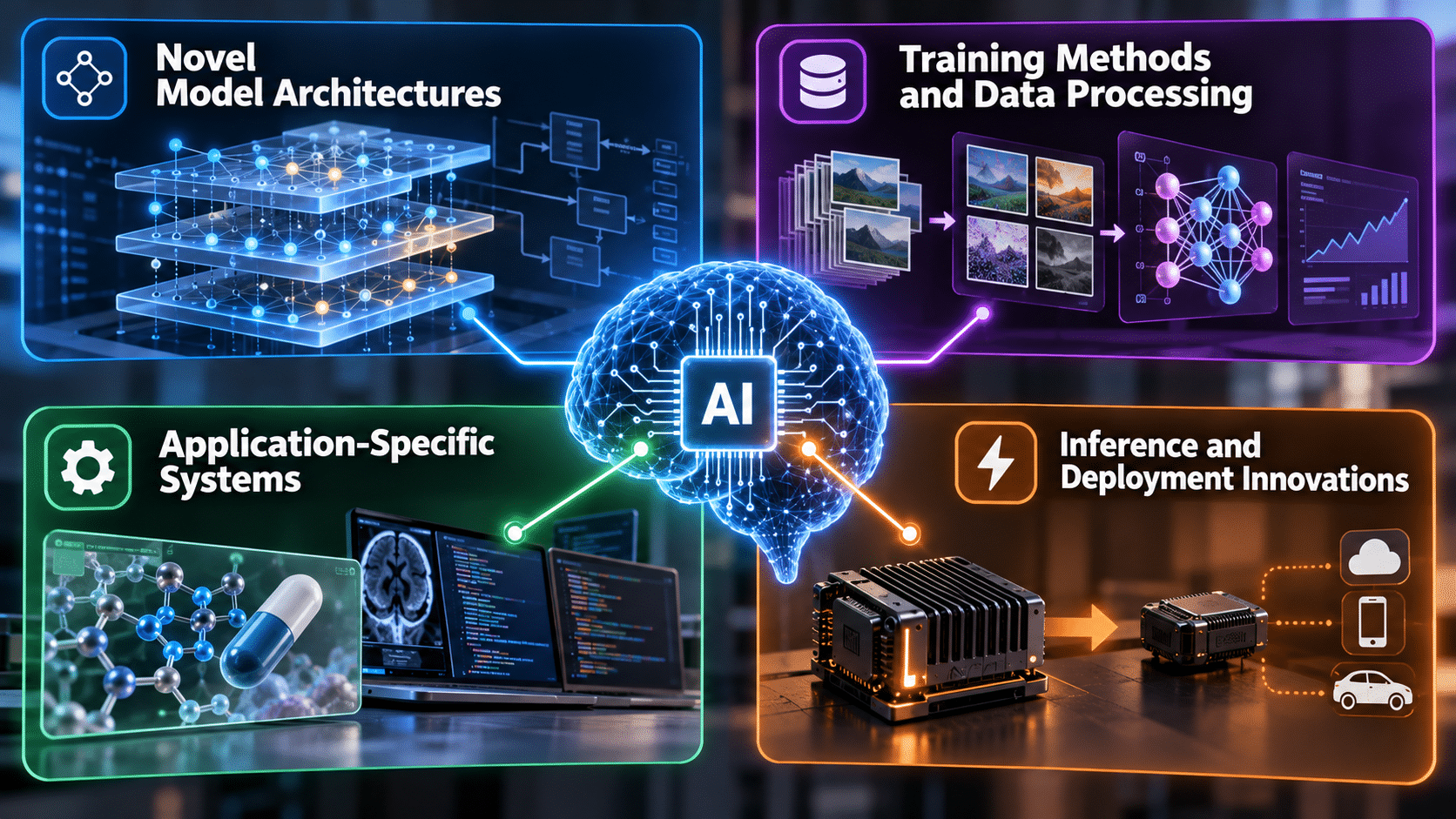
Not all generative AI innovations fall into the same bucket. Knowing where your invention fits helps you choose the right claim strategy. Here are the categories we see most often.

Novel Model Architectures

An architecture for a new kind of neural network, such as a variant of a transformer or a generative model, which gives measurable improvements in performance, may be patentable. This includes structural innovations such as new attention mechanisms, novel layer arrangements, or hybrid architectures that combine different kinds of models in a way not done before.

Training Methods and Data Processing

How you train your model matters as much as the model itself, and you should seek patent protection for any new training pipelines, data augmentation techniques, fine-tuning methods, and preprocessing approaches that deliver clearly better outcomes.

Application-Specific Systems

This is where things get interesting for startups. A generative AI system designed for a particular industry application, such as automated drug discovery, materials design, or code generation, can be patentable if the claims emphasize the technical implementation rather than the general idea of applying AI to that field. The essential point is to explain how your system achieves something that is technically different from what existed before.

Inference and Deployment Innovations

The various methods available for achieving efficient model inference, for compressing models, for quantizing them, or for deploying generative models on edge devices are very suitable for patenting; these inventions address specific technical problems, for example, by reducing latency, cutting down on power consumption, or allowing real-time generation on hardware with limited resources.

If you are unsure whether your invention falls into a patentable category, our guide on determining patentability walks through the analysis step by step.

AI Innovation_ Four Connected Frontiers

How to Draft Patent Claims That Survive Examination

Claim drafting for generative AI patents is where most applications succeed or fail. Based on what we have seen work and what we have seen rejected, here are the strategies that matter most.

Anchor Claims to Technical Improvements

Each independent claim should set out a specific technical improvement. Instead of saying ‘a method for generating text using AI’, it should say ‘a method for generating text using a modified attention mechanism which reduces computational complexity from O(n²) to O(n log n) while still keeping the output quality above a defined threshold’. This second version makes it clear to the examiner that the invention is not merely an abstract idea.

Include System and Method Claims

The file includes claims in various formats: a system claim relates to the hardware and software setup, a method claim relates to the process steps, and a computer-readable medium claim relates to the code itself. This multi-layer approach provides broader protection and alternative positions if one claim type faces eligibility challenges.

Describe the Technical Architecture in Detail

You have to go into considerable detail and should describe the model architecture, data flow, training process, and hardware environment. Include diagrams that show the various system components and the way they interact with each other. The more technical details you give, the more difficult it will be for the examiner to view your invention as an abstract idea.

Avoid Purely Functional Language

Claims that describe what the AI does without explaining how it does it are vulnerable to rejection. Replace functional language (“a module that generates…” ) with structural language (“a transformer-based generation module comprising N decoder layers, each including a self-attention sublayer configured to…” ). This distinction matters enormously in the examiner’s eligibility analysis.

The Human Inventor Requirement

There is a separate question that comes up constantly in generative AI patents: Who is the inventor?

In February 2024, the USPTO resolved this by issuing an inventorship guidance stating that inventions assisted by AI can be patented if at least one natural person made a significant contribution to the invention. An AI system must not be listed as an inventor. 

In practice, this matters whenever an AI system develops a new solution. If a human engineer prepared the prompts, understood the outputs, selected viable approaches, and then turned them into an actual invention, that human is the inventor. On the other hand, if the AI produces something interesting on its own and no one has meaningfully guided or improved the output, then you have a problem.

You must keep a thorough record of all contributions, specifying who provided each one, which decisions humans made, and how the inventive idea evolved. This documentation will help you if you ever have to go to court or face later legal action over inventorship.

Common Pitfalls We See in AI Patent Applications

After working with dozens of AI companies on their patent portfolios, we have spotted patterns in what goes wrong. Here are the mistakes that cost applicants the most time and money.

The most common mistake is filing too broadly. Applicants attempt to claim the whole concept of using AI in their area of the problem. Each such application is rejected under Alice. Instead, begin with narrow independent claims and then add breadth using the dependent claims.

Thin specifications are another killer. If your specification reads like a marketing whitepaper, describing the benefits of your AI system without explaining the technical implementation, the examiner will issue a Section 112 rejection for lack of enablement on top of the 101 rejection. Your specification should enable another skilled AI engineer to reproduce your system.

Ignoring the prior art landscape is surprisingly common, too. Generative AI patent activity has exploded, with published patent families jumping from roughly 14,000 in 2023 to over 37,800 in 2025. The odds that someone else has filed something similar to your invention are higher than ever. A thorough prior art search before filing saves you from wasting resources on claims that will be rejected over existing publications.

Finally, waiting too long to file. In AI, a six-month delay can mean your invention is no longer novel. The pace of publication in this field is staggering. File early, even if it means starting with a provisional application.

Building a Generative AI Patent Portfolio

One patent is rarely enough in this space. The companies getting the most value from their IP are building portfolios that cover multiple aspects of their technology stack.

Begin with your key innovation, the aspect that sets you apart technically, then consider the other inventions, such as new preprocessing steps, distinctive training configurations, specialized evaluation metrics, and deployment optimizations. Each of these could in itself form a separate patent and thus reinforce your overall position.

Consider filing continuation applications as your technology evolves. Generative AI moves fast, and a continuation lets you add claims covering new embodiments while maintaining the priority date of your original filing. Our startup consulting practice helps early-stage companies build portfolio strategies that grow with their technology.

International protection is worth considering, too. China filed over 43,000 Generative AI patent families in 2024 and 2025. Japan’s SoftBank alone published nearly 3,000 patent families in that period. If your technology has global commercial potential, a PCT application preserves your right to file in foreign jurisdictions within 30 months of your priority date.

Timeline and Costs: What to Expect

Typical generative AI patent applications follow the same timeline as other software patents, with a few exceptions.

As soon as the technical disclosure is ready, you can file a provisional application quickly, thereby obtaining “patent pending” status for a period of 12 months and setting your priority date. The non-provisional application, which includes formal claims and a full specification, generally takes 2 to 4 months to prepare.

USPTO examination timelines vary, since AI-related applications generally take 18 to 30 months after submission to reach the first office action. However, applications assigned to Track One priority examination can be handled in about six months, a timeframe that suits fast-moving AI startups that need patents they can enforce quickly.

Budget for at least one or two rounds of office actions responding to the examiner. Eligibility rejections under Section 101 are common for AI applications, and responding effectively often requires careful argument and potential claim amendments. Our patent guides cover what to expect at each stage of the process.

Why Work With a Patent Attorney Who Understands AI

Generative AI patents sit at the intersection of software engineering, machine learning theory, and patent law. An attorney who doesn’t understand transformer architectures, attention mechanisms, or training optimization will write claims that are either too broad to survive examination or too narrow to provide meaningful protection.

At Gallium Law, we combine technical depth with patent prosecution experience in AI and software. We draft claims that are technically precise, legally defensible, and strategically positioned for long-term value.

Whether you are an AI startup filing your first patent or an established company expanding your portfolio, we can help you protect what you have built. Contact us to discuss your generative AI invention and learn what protection is available.