
Skip links

Guides

How to Patent Drone Technology

Protecting Innovation in the Fastest-Moving Sector in Aerospace

Get In Touch

651-256-9480

Table of Contents

There are over 743,000 UAV patents filed globally. That number comes from PatSnap’s drone patent landscape report, and it’s growing fast, driven by the explosion of commercial drone applications unrelated to the technology’s military and hobbyist roots. Delivery. Agriculture. Infrastructure inspection. Search and rescue. Urban air mobility. Each of these markets is generating its own wave of patent filings, and the companies that control the foundational IP will dictate the terms for everyone else.

The regulatory side is moving just as quickly. Remote ID enforcement is live, with fines starting at $1,100 per violation. The FAA’s proposed Part 108 rule, which would create a standardized framework for beyond visual line of sight (BVLOS) operations, is sitting at the Office of Information and Regulatory Affairs. When that rule is finalized, it will unlock the most commercially valuable drone applications on the planet. And every new regulatory requirement generates new technical requirements, which generate new patent filings.

At Gallium Law, we work with drone technology companies. Startups building novel flight control systems. Manufacturers are assembling patent portfolios around autonomous navigation and delivery platforms. Our patent prosecution and strategy covers the full lifecycle of drone IP. This guide breaks down the patentable territory, where the biggest opportunities are right now, and the strategic mistakes we repeatedly see drone companies make.

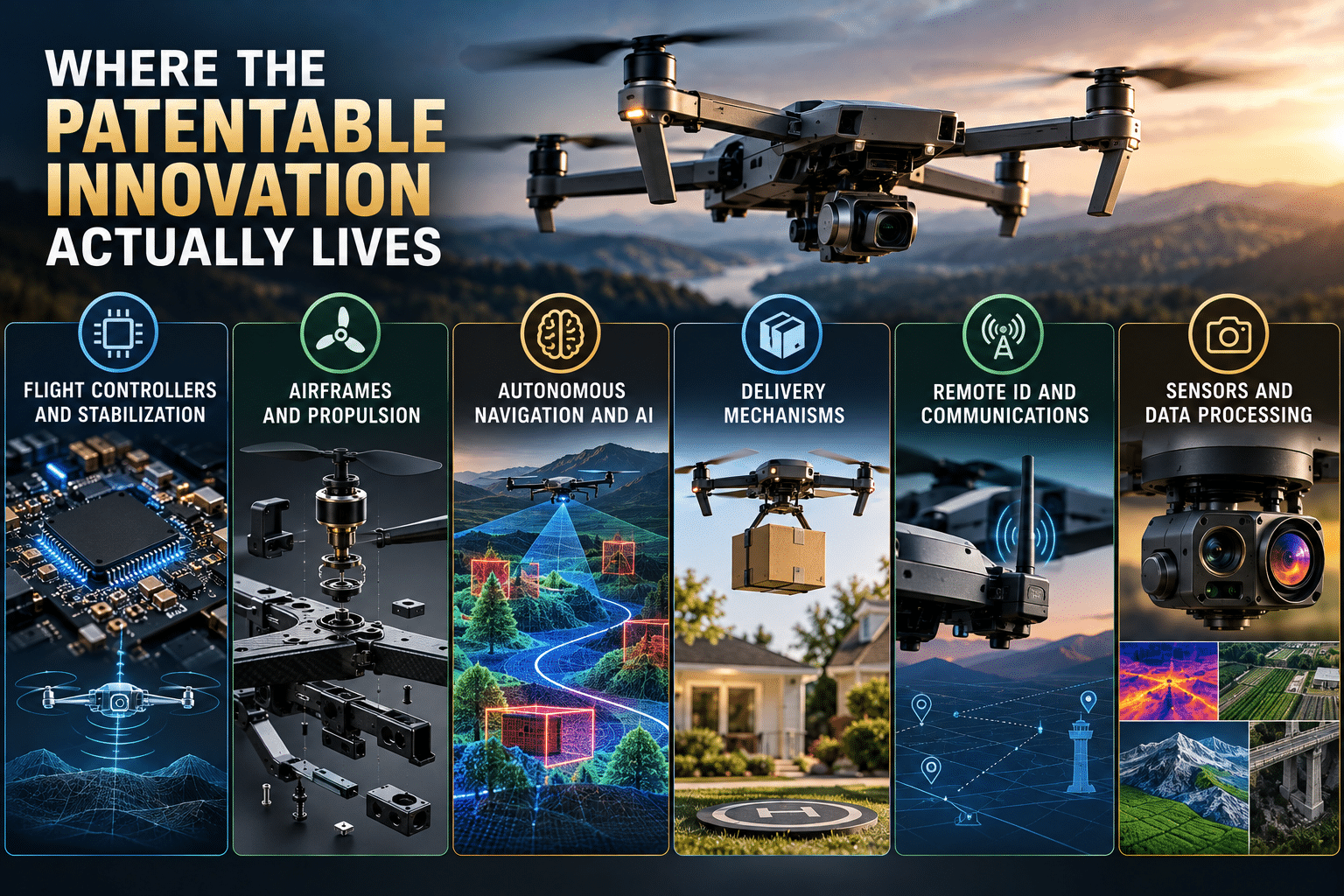
Where the Patentable Innovation Actually Lives

Drone technology touches mechanical engineering, electrical engineering, computer science, and aerospace all at once. That breadth creates an enormous patent opportunity. It also produces a deep pool of prior art. The trick is identifying where your innovation genuinely advances the state of the art, rather than just putting existing technology on a drone.

Flight Controllers and Stabilization

The flight controller is the brain. If yours does something the competition’s doesn’t, whether that’s tighter position hold in GPS-denied environments, better stability in 30-knot gusts, or smarter power management that extends flight time, that’s patentable. Sensor fusion is a particularly active area right now: combining IMU, barometric, optical flow, and LIDAR data into more robust state estimation. Our walkthrough of the patent process from idea to application covers the filing process from initial concept through prosecution.

Airframes and Propulsion

Novel rotor configurations. Ducted fan designs. Hybrid fixed-wing/multirotor platforms that transition between hover and forward flight. VTOL mechanisms. These are all actively filed categories. So are materials innovations: carbon fiber layup techniques, foldable arms for compact transport, quick-release motor mounts, and modular payload bays. DJI holds hundreds of design patents on drone form factors alone. Understanding how design patents differ from utility patents matters here because airframe work can involve both functional innovations (utility patents) and distinctive visual designs (design patents).

Autonomous Navigation and AI

This is where the highest-value filings are happening. Obstacle avoidance using deep learning on stereo camera feeds. Path planning that optimizes for battery life or delivery speed. Cooperative navigation for multi-drone swarm operations. A 2024 systematic review of 173 studies in the field found that deep learning approaches to autonomous UAV navigation are advancing so quickly that each new generation of algorithms opens fresh patentable territory.

BVLOS is especially rich. Operating beyond the visual line of sight requires detect-and-avoid systems, real-time airspace awareness, ground-based radar integration, and contingency protocols in the event that the communication link drops. Each of those subsystems contains independently patentable innovation, and commercial BVLOS is still early enough that significant claim space remains open.

Delivery Mechanisms

Follow the money. Amazon is pushing Prime Air to 500 cities (reported by CNBC). Zipline crossed two million medical deliveries in early 2026. The drone delivery market hit $4.2 billion this year and is growing at about 38% annually. All of that requires patentable technology such as precision drop mechanisms, package security during flight, automated handoff systems, weather-adaptive routing, customer notification integration,weight-sensing payload release, temperature-controlled cargo compartments, and tamper-evident containers. All of these technologies are being actively filed.

Remote ID and Communications

The FAA’s Remote ID mandate created a brand-new category of required technology. Every drone in U.S. airspace must broadcast identification and location data. Novel approaches to compliance that improve range, reduce power consumption, or integrate with airspace management systems are also patentable. Beyond Remote ID: command-and-control links, mesh networking for swarms, spectrum-efficient video transmission, and failsafe protocols for BVLOS are all patentable. The full FAA’s UAS page lays out the current requirements driving these innovation areas.

Sensors and Data Processing

Drones are flying sensor platforms. Multispectral cameras for crop analysis. Thermal imaging for infrastructure inspection. LIDAR for topographic mapping. Gas detection for industrial monitoring. The sensor itself might be off-the-shelf, but how it’s mounted, stabilized, calibrated for airborne use, and how its data gets processed in real time for actionable output often constitutes a patentable system. Gimbal stabilization alone is a heavily filed subcategory.

Drone patents

FAA Regulation Is Shaping Patent Strategy Whether You Like It or Not

In most tech sectors, regulation trails innovation by years. Drones are different. The regulatory environment directly controls which technical capabilities are commercially viable, which in turn determines what’s worth patenting.

Part 107 governs small UAS under 55 pounds, visual line-of-sight, and daylight operations below 400 feet. Waivers exist for some of these, but they’re on a case-by-case basis. Part 108, if finalized, creates the standardized pathway for BVLOS. That rule will require detect-and-avoid systems, enhanced communication links, real-time weather integration, and standardized airspace authorization. All of those requirements are already known. Filing patents on the technologies Part 108 will mandate, right now, while the rule is still under review, positions companies to hold essential IP when the commercial floodgates open. Our comparison of provisional vs. non-provisional applications explains how provisionals let you lock in a priority date while the regulatory landscape continues to evolve.

You Can’t Talk Drone Patents Without Talking About DJI

DJI holds thousands of patents worldwide in technologies such as flight control, gimbal stabilization, obstacle avoidance, image processing, and communication systems. It’s the most extensive portfolio in consumer and commercial drones, and every other company in the space has to navigate it.

That creates two problems for competitors. First, freedom-to-operate. Before you bring a product to market, you need to confirm you’re not stepping on DJI’s active claims. That requires a thorough FTO analysis. IP due diligence should be one of the first things any drone company does, not an afterthought.

Second, prior art density. DJI’s published applications and granted patents create a wall that examiners will cite against your filings. Claims that feel novel to you might be anticipated or rendered obvious by something DJI filed in 2018. Do a thorough search before you file, or you’re paying prosecution costs on claims that will never survive examination.

A Single Patent Covers Almost Nothing. Build a Portfolio.

One patent on a drone is a speed bump. A competitor changes the rotor count or swaps the sensor package, and they’re outside your claims. What actually defends a market position is a portfolio, a coordinated set of patents that covers the technology from enough angles that designing around all of them simultaneously becomes impractical.

Layer hardware patents on the airframe and propulsion with software patents on the flight controller and navigation algorithms. Add system-level patents on the integrated platform. Method patents on operational procedures your technology enables (i.e., a specific agricultural spraying approach, or a particular inspection workflow). Each layer makes it more expensive for someone to copy what you’ve built.

Trade secrets matter here too. Tuning parameters for flight controllers. Training datasets for ML models. Manufacturing calibration procedures. These are often better protected as confidential information, especially when reverse-engineering them from the finished product isn’t realistic. Our guide on protecting your idea before your patent is filed covers how to manage confidential information before and during filing.

Three Ways Drone Companies Lose Their Competitive Edge

Demoing Before Filing

Drone companies love showing off. Investor pitches, CES booths, pilot programs, YouTube videos of autonomous flight. Every single one of those can be a public disclosure. You get one year in the U.S. to file after disclosure. In China, Europe, Japan, and Korea? There is no grace period at all. A published flight test video can permanently kill your ability to patent that technology in every jurisdiction where DJI and the other major players manufacture and sell. Check our piece on public disclosure without IP protection before you demo anything publicly.

Assuming Software Can’t Be Patented

The Alice/Mayo decisions spooked many companies out of filing software patents. Assuming that software can’t be patented is a bad call, especially in drones. Flight control algorithms, obstacle avoidance, autonomous navigation, path planning, sensor fusion pipelines: these solve concrete technical problems. Keeping a drone stable in turbulence. Avoiding a collision with a power line. Optimizing a delivery route for battery constraints. These aren’t abstract ideas. They’re technical solutions, and they’re patentable when the claims are drafted right. Skipping software patents means handing your most defensible innovations to competitors for free.

Claims That Only Describe the Prototype

If your claims read on exactly the prototype drone sitting on your test bench and nothing else, a competitor who changes the rotor layout or swaps the sensor suite is already outside your IP protection. Good claims capture the functional principle and the problem-solving approach. They anticipate how a competitor might achieve the same result through different engineering approaches. The patent process from idea to application covers how we handle claim drafting from the earliest stages.

Export Controls: A Trap for Drone Companies with Defense Applications

Drone tech sits at the intersection of the commercial and military sectors, creating IP complications that most other tech sectors don’t deal with. If your technology has defense or dual-use applications, it may fall under the International Traffic in Arms Regulations (ITAR) or the Export Administration Regulations (EAR). Those regulations govern the export of defense-related technology and apply to patent applications, not just hardware.

Filing a patent in a foreign country is an export of technical data. ITAR-controlled technology needs a State Department license before international filing. Even a PCT application can trigger this because the filing routes through WIPO in Geneva. For drone companies developing technologies with defense applications, an export control review has to happen before the patent strategy is set. The duty of disclosure obligations covers related transparency obligations during prosecution.

Counter-Drone Tech Is Its Own Patent Gold Rush

The flip side of drone proliferation is counter-drone technology: systems for detecting, tracking, identifying, and neutralizing unauthorized drones. RF signal detection, radar-based tracking, acoustic detection arrays, electronic countermeasures for jamming or spoofing control links, kinetic intercept systems. Airports, military bases, critical infrastructure, and event venues. They all need this technology, and the companies building it are filing aggressively.

Counter-drone patents have a unique prosecution challenge. The underlying tech (radar, RF jamming, signal interception) has deep prior art in the military and telecom sectors. The novelty usually lies in applying it specifically to the drone threat: detecting the RF signatures of commercial control links or distinguishing a drone’s acoustic profile from that of a bird. Claims need that specificity to hold up.

The Window Is Open. It Won’t Stay Open.

Drone technology is in the middle of a commercialization wave. BVLOS rules are coming. Delivery is scaling. Agriculture, inspection, and emergency response are all growing fast. The companies building patent portfolios now will control licensing, manufacturing partnerships, and market access for the next twenty years. The ones treating patents as a post-launch checklist item will watch their competitors use their ideas without paying for them.

At Gallium Law, we work with drone companies building everything from autonomous navigation systems to counter-drone detection platforms. Whether you’re filing your first provisional on a novel flight controller or assembling a portfolio ahead of a licensing deal or acquisition, reach out, and we can help build a patent strategy that keeps pace with what you’re building.