
Guides
How to Patent EV Charging Infrastructure
What Inventors and Companies Need to Know
Table of Contents
Switched to Gallium from a larger firm and the difference has been massive. They offer much better service at much more manageable prices. If you are looking for fast efficient help with anything IP related, these are the guys for the job. Trademarks, Patents, Copyrights, these guys know what they are doing. They are my third lawyers I have worked with and the experience has been substantially better than the prior two.

Connor Hance
August 2025
Gallium law has been amazing to work with for our legal needs! They make things easy to understand, do a great job at keeping us informed, and are calm and confident in their communication. Highly recommend!!

Anna Wengreen
August 2025
I have worked with other firms and this is a rare one. It has truly been a pleasure working with Wes, Michael, and Jacob. They are the experts in IP Law and patent applications. I am grateful that they help me to understand things at my level. On top of that they are true gentlemen! It's been an amazing experience!

Nelson Lim
August 2025
Wes and the Gallium Law team have been a pleasure to work with. They guided us seamlessly through the provisional patent process for our product, providing expert advice and prompt communication at every step. I highly recommend them to any startup or business looking for strategic, dependable IP counsel. Looking forward to continuing our partnership!

Mike Lee
May 2025
I called several firms about assisting me with developing my patent and the Gallium Law firm was only one, nationwide, to return my phone call and consult with me. That is respect no matter what IP you have, or who you are. They are very professional and takes care of their customers. The work was thorough and detailed. I am very satisfied with the work they have done for me. I would recommend this law firm to anyone reading.

Shawn
May 2025
I highly recommend Gallium Law for your company's patent needs. Wes and crew are a stellar team that helped us get our product design utility patent successfully patented with the USPTO. After they drafted the patent application and materials, it was clear that having expert professionals craft the application was absolutely necessary. There are countless details in how they executed the application that we never would have been able to do ourselves. They did a tremendous job in taking the patent to the finish line.

Robert Paul
August 2024
The Gallium team have been and continue to be phenomenal partners to work with. They have been the most responsive, creative, engaging, and innovative IP counsel I have ever collaborated with. Gallium is happy to support early stage start-ups and provide the same attention and support you would typically only receive when working for large multi-nationals. I would recommend their team to anyone looking to generate and expand their IP portfolio.

Ryan Balko
September 2024
Great experience! The Gallium team did a great job filing my patent. They also did a great job of clearly explaining my options to protect my IP, and that made a big difference to me as a new inventor.

Daniel Bakke
August 2024
I have worked with Gallium law for many years. In my opinion they are unique in their approach of "winning" patents for customers like myself. I worked very close with their professional patent law attorneys, and turned obstacles and initial rejections to complete successful patent allowances. They are very reasonable with their budgets and willing to accommodate your personal needs and requests. It is the best patent law company I ever dealt with.

Gideon Eden
July 2023
Our publicly traded company has worked with Wes and his team at Gallium Law for about a decade. They are consummate IP professionals and highly organized - which is essential for coordinating dates, fees, etc. We trust Gallium Law with our most highly prized assets - our IP. You should, too.

David Morse
March 2024
Gallium Law is an incredible Intellectual Property Legal team! I am continually blown away with their ability to translate our medical device design ideas into patent claims and diagrams. They are very experienced in the interventional (catheters and generators) medical device space. My customers have had great experiences working with Gallium and I recommend them to all medical device innovators.

Brady Hatcher
April 2023
I have always been very happy with the great work of the Gallium team. They are patent experts who really take an interest in helping their clients succeed. Wes is particularly talented and results oriented. Not only is Wes an excellent patent attorney, he's also a great engineer with an MBA, so he understands legal issues from many useful perspectives.

Eric Wengreen
December 2022
I thoroughly enjoyed working with the Gallium Law team on my provisional patent application and intend to work with them on future filings. Wes and Isabel were knowledgeable and cared about understanding my intellectual property. I appreciated their advice on filing timelines and drafting strategy. I highly recommend their firm.

Ashley Mooneyham
February 2022
The electric vehicle (EV) charging industry is in the middle of a patent land grab. Billions of dollars in federal infrastructure funding, rapid EV adoption across consumer and commercial fleets, and a fragmented landscape of competing standards have created an environment where the companies that secure strong IP protection now will control the technology that powers transportation for decades. Patent filings in EV charging infrastructure have surged across every major category, from power electronics and connector design to software-driven energy management and wireless charging systems.
For inventors, startups, and established companies developing charging technology, this creates both opportunity and risk. The opportunity is that large portions of the technology stack remain patentable, particularly in areas such as bidirectional charging, AI-driven grid integration, and next-generation thermal management. The risk is that filing too late or drafting claims too narrowly can leave your technology exposed to competitors who move faster or file broader claims. This guide walks through what is patentable in EV charging infrastructure, how to approach the filing process, and what strategic decisions will determine whether your patent portfolio actually protects your competitive position.
What Is Patentable in EV Charging Technology
EV charging infrastructure is not a single technology. It is a stack of interconnected systems, each of which may contain patentable innovations. Understanding where your invention fits within that stack is the first step toward building meaningful patent protection.
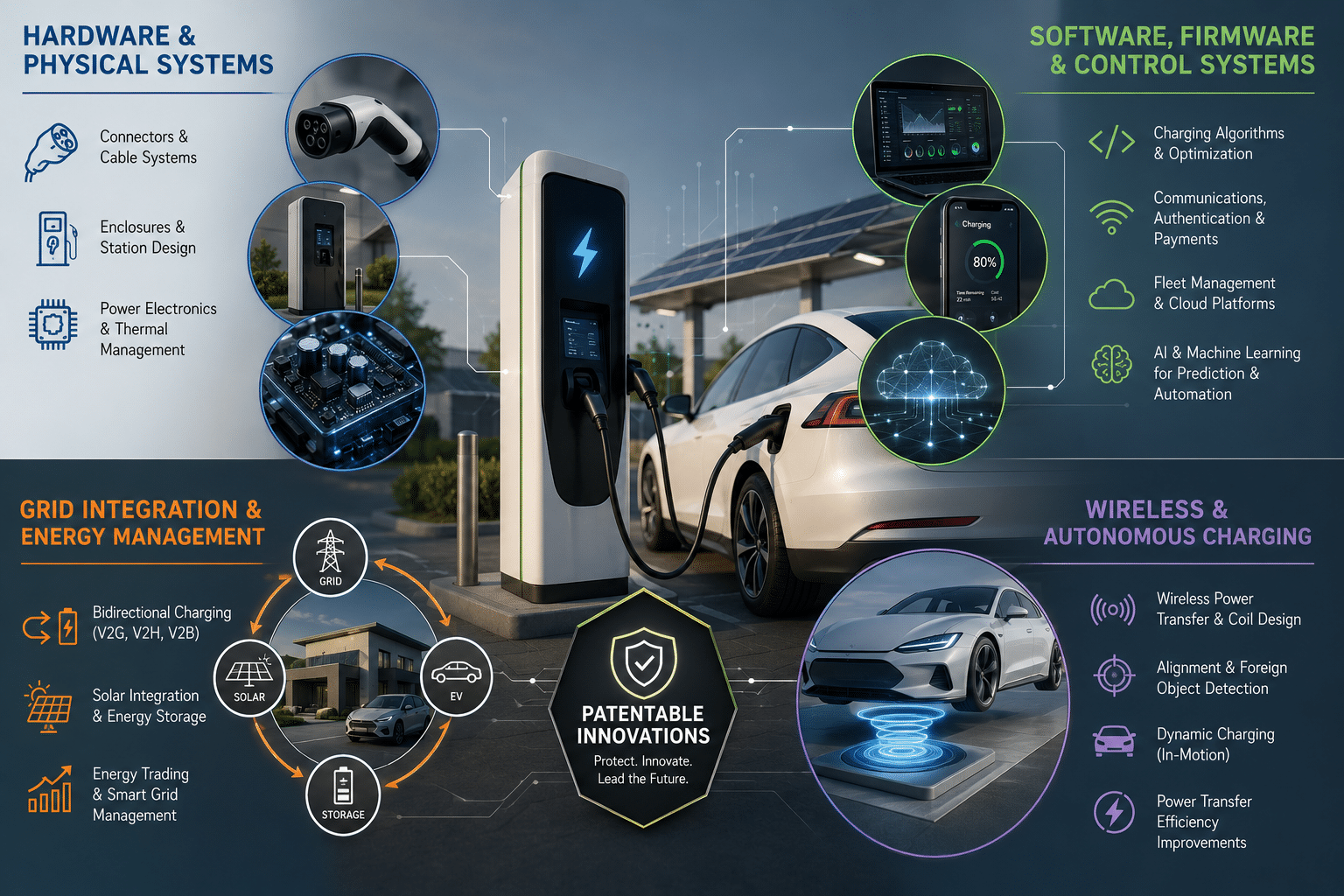
Hardware and Physical Systems
The physical components of charging infrastructure offer some of the most straightforward patent opportunities. Novel connector designs, plug mechanisms, cable management systems, and charging port configurations can qualify for utility patent protection if they solve a technical problem in a new way. Housing and enclosure designs for charging stations, particularly those engineered for outdoor durability, thermal regulation, or vandal resistance, may also be patentable. If your innovation is primarily aesthetic rather than functional, understanding the distinction between design patents and utility patents will help you determine the right filing strategy.
Power electronics represent another rich area for patent protection. Innovations in AC-to-DC conversion, power factor correction, transformer design, and semiconductor switching architectures are all patentable when they produce measurable improvements in efficiency, size, cost, or thermal performance. As charging speeds push beyond 350 kW, the engineering challenges in managing heat, voltage, and current flow at those power levels are generating novel solutions that did not exist even a few years ago.
Software, Firmware, and Control Systems
The software layer of EV charging is where some of the most valuable and defensible patents are being filed. Algorithms that manage charging sessions, optimize energy delivery based on battery state, balance grid load across multiple stations, or dynamically adjust pricing based on demand all represent patentable innovations if they produce specific, technical results.
Communication protocols between vehicles and chargers, authentication and payment processing systems, and fleet management platforms that coordinate charging schedules across hundreds of vehicles are all active filing areas. AI and machine learning systems that predict charging demand, optimize energy storage dispatch, or route drivers to available stations based on real-time data are particularly valuable because the underlying algorithms are often difficult for competitors to reverse-engineer, making patent protection essential for enforcement.
Grid Integration and Energy Management
Bidirectional charging, where vehicles can send power back to the grid or to a building, is one of the fastest-growing patent categories in the EV space. Vehicle-to-grid (V2G), vehicle-to-home (V2H), and vehicle-to-building (V2B) systems involve complex interactions between the vehicle’s battery management system, the charging hardware, grid interconnection standards, and utility billing systems. Patents covering the control logic, safety interlocks, and energy trading algorithms that make bidirectional charging practical are being filed aggressively by automakers, utilities, and startups alike.
Solar-integrated charging systems that combine photovoltaic generation with battery storage and EV charging represent another emerging patent area. Systems that use predictive analytics to determine how much solar-generated power to store, send to the grid, or deliver directly to a vehicle, based on weather forecasts and electricity pricing, are generating novel IP at the intersection of energy tech and automotive engineering.
Wireless and Autonomous Charging
Wireless EV charging, which uses inductive or resonant power transfer to charge vehicles without a physical cable connection, has produced nearly 2,000 patents globally as of 2026. The technology is particularly relevant for autonomous vehicles, fleet depots, and public transit systems where plug-in charging creates operational friction. Patentable innovations in this space include coil design and alignment systems, foreign object detection, dynamic charging for vehicles in motion, and improvements in power transfer efficiency. If you are exploring this area, conducting the right patent search is the critical first step to understanding what has already been filed.
The Current EV Charging Patent Landscape
The EV charging patent landscape in 2026 is defined by four simultaneous battles: connector standards, power electronics architectures, communication protocols, and wireless power transfer. Four major fast-charging connector standards are active globally (CCS1/CCS2 in North America and Europe, CHAdeMO in Japan, GB/T in China, and the emerging ChaoJi interface), and each standard carries its own ecosystem of patents covering physical design, communication handshakes, and power delivery profiles.
The different standards create both risk and opportunity. Companies developing cross-standard compatibility solutions, universal adapters, or software layers that abstract away hardware differences are finding patentable whitespace. At the same time, the integration of AI dispatch, blockchain-secured peer-to-peer energy trading, and IoT sensor networks into charging infrastructure remains in the early research stage with limited patent coverage, representing high-potential territory for new filings.
Before investing heavily in developing your technology, it may be wise to conduct a freedom-to-operate analysis to ensure it does not infringe existing patents and to identify the specific claims that differentiate your approach from what has already been filed.
How to Approach Filing an EV Charging Patent
The patent filing process for EV charging technology follows the same fundamental structure as any utility patent application, but the technical complexity and competitive density of this field demand a more strategic approach at every stage.
Conduct a Thorough Prior Art Search
EV charging patents span multiple USPTO classification codes, international patent offices, and industry standards bodies. A comprehensive prior art search needs to cover not just direct competitors but also adjacent technologies in power electronics, battery management, and grid infrastructure. The density of existing patents in this space means that your claims will need to be precisely targeted to survive examination. Our guide on starting the patent process covers how to lay this groundwork effectively.
Draft Claims That Capture Real Commercial Value
A common mistake in EV charging patent applications is drafting claims that are too narrow, covering only the specific implementation you have built rather than the broader inventive concept. A claim that covers a particular charging algorithm only when it uses a specific sensor input and a specific communication protocol may be easy to design around. A claim that covers the underlying method of optimizing energy delivery based on predictive demand modeling, regardless of the specific inputs or communication layer, may be far more valuable.
At the same time, claims that are too broad will be rejected during examination based on prior art. The goal is to find the boundary between what is genuinely novel about your approach and what is already known in the field. Experienced patent counsel can help navigate that boundary by analyzing the prosecution history of related patents and understanding how examiners in the relevant art units have interpreted similar claims. Understanding what happens after you file prepares you for the examination process that follows filing.
Consider Provisional Filing for Speed
In a fast-moving field like EV charging, securing an early filing date can be the difference between owning a technology and watching a competitor patent it first. A provisional patent application establishes your filing date and gives you 12 months to prepare the full non-provisional application. This is particularly useful when you have a working prototype or technical disclosure that you want to protect while you continue development. However, the provisional application must contain enough technical detail to support the claims you ultimately file, so cutting corners on the provisional specification can undermine your entire filing strategy.
One additional benefit of pursuing a provisional application first is that the 12 months prior to filing the non-provisional patent application do not count toward the patent term, or life of the non-provisional patent. In other words, the 20-year patent term starts the day the non-provisional patent application is filed.
Strategic Considerations for EV Charging Patents
Standard-Essential Patents and FRAND Licensing
If your invention becomes incorporated into an industry charging standard, it may qualify as a standard-essential patent (SEP). SEPs carry significant licensing value because every company that implements the standard must license the patented technology. However, SEPs are typically subject to fair, reasonable, and non-discriminatory (FRAND) licensing obligations, which limit the royalty rates you can charge. Filing patents with the intent to participate in standards development requires a deliberate strategy that balances broad claim coverage with FRAND commitments. Our team can help you evaluate the licensing and IP strategy implications of standards participation.
International Filing Strategy
EV charging infrastructure is a global market, and patent protection in the United States alone may not be sufficient. The European Union, China, Japan, and South Korea are all major markets for charging equipment, and each has its own patent system with different examination standards and timelines. A PCT (Patent Cooperation Treaty) filing can preserve your right to file in multiple countries while giving you additional time to evaluate which markets justify the cost of national-phase prosecution. Given the differences in connector standards across regions, your international filing strategy should align with the markets where your specific technology has the strongest commercial application.
Building a Portfolio, Not Just a Patent
A single patent rarely provides adequate protection in a field as complex as EV charging. The most defensible IP positions are built through portfolios that cover multiple aspects of your technology: hardware, software, control logic, user interface, and integration with broader energy systems. Filing a series of related patents that collectively make it difficult for competitors to replicate your system without licensing creates far more leverage than any individual patent. Understanding patent infringement lawsuit costs helps you appreciate why building a strong portfolio upfront is almost always more cost-effective than litigating a weak one later.
Protect Your EV Charging Innovation Before the Window Closes
The EV charging infrastructure market is moving from early-stage innovation to standardization and consolidation. The patents filed over the next two to three years will determine who controls the technology that charges hundreds of millions of vehicles for decades to come. Every month spent developing without filing is a month where competitors could be securing the claims that block your path to market.
At Gallium Law, we work with inventors and companies across the EV and clean energy space to build patent portfolios that protect real commercial value. From prior art searches and claim drafting through prosecution, licensing, and enforcement, our patent services team brings the technical depth and strategic experience to help you secure your position in this rapidly evolving market. Contact us to start the conversation.