
Skip links

Guides

How to Patent Surgical Robotics Technology

An IP Guide for the Most Competitive Space in MedTech

Get In Touch

651-256-9480

Table of Contents

Surgical robotics is experiencing a patent land rush. Over 4,700 surgical robotics patents were granted in 2024 alone, and the market is projected to grow from $12.9 billion to nearly $60 billion over the next decade, according to the Surgical Robots Patent Landscape Report 2026 Edition. For twenty years, Intuitive Surgical’s da Vinci system dominated the field with a fortress of over 1,200 patent families. Now those foundational patents are expiring, and competitors are pouring in. Medtronic received FDA clearance for its Hugo system in late 2025. Johnson & Johnson’s OTTAVA platform followed in mid-2026. CMR Surgical, Stryker, and a wave of startups are all pushing new platforms into regulatory review.

That changes everything about surgical robotics IP. When one company held most of the important patents, the landscape was relatively stable. Now it is fragmenting. Companies are racing to stake claims on the next generation of surgical robotics technology: haptic feedback systems, AI-driven navigation, autonomous surgical functions, and miniaturized instruments. The window to file is narrowing.

At Gallium Law, we work with surgical robotics companies and medical device inventors navigating this exact environment. Our medical device patent services cover the full spectrum of device innovation, from initial concept through prosecution and enforcement. This guide breaks down what you can patent in surgical robotics, where the biggest opportunities are, and the mistakes that cost companies their competitive position.

What You Can Patent in Surgical Robotics

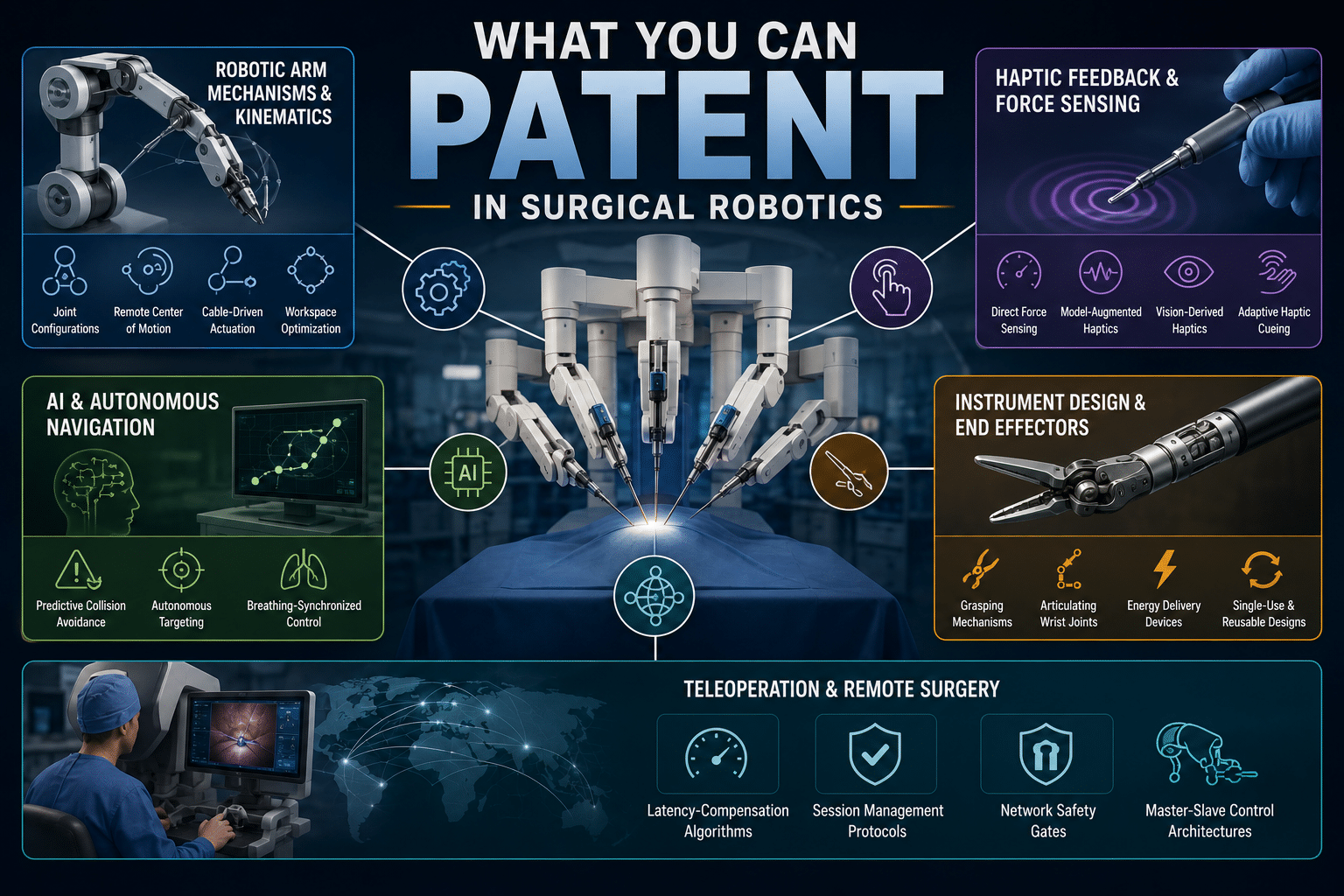
A surgical robot is not one invention; it is dozens of them working together. The robotic arm mechanism, the instrument tip, the control algorithm, the haptic feedback loop, the imaging integration, and the user interface at the surgeon console; each of these subsystems can contain independently patentable innovations. Companies that treat their robot as a single product and file a single patent are leaving enormous gaps in their protection.

Robotic Arm Mechanisms and Kinematics

The mechanical design of a surgical robotic arm involves joint configurations, remote-center-of-motion mechanisms, cable-driven actuation systems, and workspace optimization. If your arm achieves a wider range of motion in a smaller form factor, uses a novel linkage geometry, or solves a dexterity problem that existing platforms cannot, those mechanical innovations are each patentable. Many of the strongest surgical robotics patents in the field protect specific kinematic architectures rather than the robot as a whole.

Haptic Feedback and Force Sensing

This is one of the hottest areas in surgical robotics patenting right now. The da Vinci system famously lacked haptic feedback. Surgeons operated entirely by visual cues. The next generation of platforms is racing to solve that problem, and the patent filings reflect it. Four distinct approaches are generating heavy filing activity: direct force sensing using strain gauge or torque sensor arrays at the instrument tip, model-augmented predictive haptic rendering that simulates tissue resistance in real time, vision-derived haptic synthesis that uses machine learning on endoscopic video to infer force without physical sensors, and navigation-linked adaptive haptic cueing that creates virtual boundaries based on preoperative imaging. Each represents a different technical approach with its own claim landscape.

AI and Autonomous Navigation

The FDA is beginning to classify surgical autonomy on a spectrum: assistance, guidance, supervised autonomy, and conditional autonomy. Patent strategy needs to follow the same framework. An AI system that suggests an optimal instrument path is a different invention from one that autonomously executes a suturing sequence. Both are patentable, but the claims look very different. Recent filings cluster around predictive collision avoidance using machine learning, biomechanical model-driven autonomous targeting, and respiratory-cycle-synchronized instrument control that compensates for patient breathing during thoracic or abdominal procedures.

Instrument Design and End Effectors

The instruments that attach to the robotic arm are a patent category unto themselves. Novel grasping mechanisms, articulating wrist joints at the instrument tip, energy-delivery devices for cutting and cauterization, and single-use vs. reusable instrument architectures all lead to patent filings. Instrument patents are particularly valuable because they create recurring revenue through replacement sales, and a strong instrument patent can lock competitors out of an entire procedural category. Our walkthrough of how design patents differ from utility patents is relevant here because instrument design can involve both functional innovations (utility patents) and distinctive visual elements (design patents).

Teleoperation and Remote Surgery

5G-enabled remote surgery is no longer theoretical. Clinical demonstrations have been conducted across continents, and patent filings for teleoperated surgical systems are growing rapidly. Patentable innovations include latency-compensation algorithms, session-management protocols for initiating and maintaining a remote surgical connection, network safety gates that halt a procedure if connectivity degrades, and master-slave control architectures that translate surgeon hand movements into precise robotic motion across a network. Session management and connectivity verification are underprotected areas right now, which makes them particularly attractive filing opportunities for companies developing remote surgery capabilities.

Coordinating Patent Filings with FDA Clearance

Surgical robotics sits at the intersection of patent law and FDA regulation, and the two timelines interact in ways that catch companies off guard. A 510(k) submission or De Novo classification request puts your technology on the public record. Once the FDA publishes your clearance summary, the details of your device are available for anyone to read. If you have not filed patent applications covering the key innovations in that device before the submission goes public, you may be creating your own prior art problem.

The smarter approach is to begin patent prosecution well before your FDA submission. File provisional applications covering each major subsystem as the design matures. That locks in your priority dates while you are still iterating. Then convert to non-provisional applications before or alongside your regulatory filing. Our comparison of provisional vs. non-provisional patent applications explains how to use provisionals strategically without creating patent coverage gaps.

There is an additional wrinkle specific to medical devices. The FDA review process can take months or years. During that time, competitors are watching your regulatory filings, reading your published patent applications, and designing around both. A patent portfolio that only covers the exact embodiment in your FDA submission is easy to circumvent. Claims need to be broad enough to capture the competitive space around your device, not just the device itself.

Building a Portfolio, Not Just Filing Patents

A single patent on a surgical robot protects almost nothing. Competitors will design around a single claim set each time. What protects a competitive position is a portfolio: a coordinated set of patents that covers the core technology from multiple angles and makes simultaneous design around all of them impractical.

For a surgical robotics company, that portfolio should include mechanical patents on the arm architecture and kinematic design, software patents on the control algorithms and AI navigation systems, instrument patents on the end effectors and tool-change mechanisms, method patents on the surgical procedures enabled by the technology, and system-level patents that cover the integrated platform and its unique combination of subsystems.

Trade secrets play a role, too. Not everything belongs in a patent application. Manufacturing tolerances, calibration procedures, training data sets for machine learning models, and supplier-specific material specifications are often better protected as trade secrets. The key is knowing which innovations to patent and which to keep confidential. Our guide on protecting your idea before your patent is filed covers the practical rules for deciding whom you can share information with and what protections apply before filing.

What the da Vinci Patent Expirations Actually Mean

Intuitive Surgical built one of the most formidable patent portfolios in medical device history. At its peak, the company held over 1,200 patent families covering nearly every aspect of robotic-assisted surgery. That portfolio is what kept competitors on the sidelines for two decades. Now the foundational patents are expiring, and Intuitive has been filing continuation applications and new patents for incremental improvements to extend protection. But the core mechanical and control architectures are becoming more open.

For companies entering the surgical robotics market, this presents both opportunities and risks. The opportunity is obvious: technologies that were previously blocked are now available. The risk is more subtle. Intuitive still holds thousands of active patents on newer innovations, and the prior art landscape created by two decades of Intuitive’s filings is dense. Filing a patent on a “novel” robotic arm design that turns out to be anticipated by an Intuitive patent from 2012 wastes time and money during prosecution. A thorough freedom-to-operate analysis is not optional in this space. IP due diligence should be the first step for any company entering the surgical robotics market, not an afterthought.

Costly Mistakes in Surgical Robotics Patent Strategy

Filing Too Late in the Development Cycle

Surgical robotics companies burn through development time and investor capital before thinking about patents. By the time they file, the technology has been demonstrated at conferences, discussed in grant applications, and shown to potential partners. Each of those disclosures can create prior art issues. Under U.S. law, you have a one-year grace period after public disclosure, but most international jurisdictions have no grace period at all. A live demonstration at a medical device conference can compromise your ability to obtain patents on that technology in Europe, Japan, or China. Read our guide on public disclosure without IP protection to understand exactly where the lines are.

Treating Software as Unpatentable

After the Alice Supreme Court decision, many medical device companies assumed their software innovations could not be patented. That is not accurate. Software that controls a surgical robot, processes sensor data to generate haptic feedback, or uses machine learning to optimize instrument trajectories is tied to a specific, physical application. These are not abstract ideas. They are technical solutions to technical problems, and they are patentable when the claims are drafted correctly. The companies that skip software patents because they assume Alice kills them are giving away some of their most defensible IP.

Narrow Claims on a Single Embodiment

Patent claims that describe only the exact configuration of your prototype are easy for competitors to design around. A competitor changes the number of joints, substitutes a different sensor type, or rearranges the cable routing, and they are outside your claims. Strong surgical robotics patents protect the functional principle, not just one implementation. That requires understanding the competitive landscape well enough to anticipate how others might achieve the same surgical outcome through different mechanical or software means. How the patent process works from idea to application walks through how we approach claim drafting from the earliest stages of the process.

Protecting Innovation in the Operating Room

Surgical robotics is entering its most competitive era. The protective moat that da Vinci’s patents created is dissolving, and every major medical device company on the planet is building or acquiring robotic surgery platforms. In a market moving this fast, the companies that file early, file strategically, and build layered portfolios are the ones that will hold defensible positions. Those who treat patents as an afterthought will find their innovations copied before they reach commercial scale.

At Gallium Law, we work with surgical robotics companies at every stage, from university spinouts filing their first provisional applications to established device manufacturers building out portfolios ahead of acquisition or licensing. Our MedTech startup IP guide covers the foundational IP steps for early-stage medical device companies. Whether you are developing a new robotic platform, a next-generation haptic feedback system, or AI-driven surgical navigation, reach out and let us build a patent strategy that matches the complexity of what you are creating.