
Table of Contents
Switched to Gallium from a larger firm and the difference has been massive. They offer much better service at much more manageable prices. If you are looking for fast efficient help with anything IP related, these are the guys for the job. Trademarks, Patents, Copyrights, these guys know what they are doing. They are my third lawyers I have worked with and the experience has been substantially better than the prior two.

Connor Hance
August 2025
Gallium law has been amazing to work with for our legal needs! They make things easy to understand, do a great job at keeping us informed, and are calm and confident in their communication. Highly recommend!!

Anna Wengreen
August 2025
I have worked with other firms and this is a rare one. It has truly been a pleasure working with Wes, Michael, and Jacob. They are the experts in IP Law and patent applications. I am grateful that they help me to understand things at my level. On top of that they are true gentlemen! It's been an amazing experience!

Nelson Lim
August 2025
Wes and the Gallium Law team have been a pleasure to work with. They guided us seamlessly through the provisional patent process for our product, providing expert advice and prompt communication at every step. I highly recommend them to any startup or business looking for strategic, dependable IP counsel. Looking forward to continuing our partnership!

Mike Lee
May 2025
I called several firms about assisting me with developing my patent and the Gallium Law firm was only one, nationwide, to return my phone call and consult with me. That is respect no matter what IP you have, or who you are. They are very professional and takes care of their customers. The work was thorough and detailed. I am very satisfied with the work they have done for me. I would recommend this law firm to anyone reading.

Shawn
May 2025
I highly recommend Gallium Law for your company's patent needs. Wes and crew are a stellar team that helped us get our product design utility patent successfully patented with the USPTO. After they drafted the patent application and materials, it was clear that having expert professionals craft the application was absolutely necessary. There are countless details in how they executed the application that we never would have been able to do ourselves. They did a tremendous job in taking the patent to the finish line.

Robert Paul
August 2024
The Gallium team have been and continue to be phenomenal partners to work with. They have been the most responsive, creative, engaging, and innovative IP counsel I have ever collaborated with. Gallium is happy to support early stage start-ups and provide the same attention and support you would typically only receive when working for large multi-nationals. I would recommend their team to anyone looking to generate and expand their IP portfolio.

Ryan Balko
September 2024
Great experience! The Gallium team did a great job filing my patent. They also did a great job of clearly explaining my options to protect my IP, and that made a big difference to me as a new inventor.

Daniel Bakke
August 2024
I have worked with Gallium law for many years. In my opinion they are unique in their approach of "winning" patents for customers like myself. I worked very close with their professional patent law attorneys, and turned obstacles and initial rejections to complete successful patent allowances. They are very reasonable with their budgets and willing to accommodate your personal needs and requests. It is the best patent law company I ever dealt with.

Gideon Eden
July 2023
Our publicly traded company has worked with Wes and his team at Gallium Law for about a decade. They are consummate IP professionals and highly organized - which is essential for coordinating dates, fees, etc. We trust Gallium Law with our most highly prized assets - our IP. You should, too.

David Morse
March 2024
Gallium Law is an incredible Intellectual Property Legal team! I am continually blown away with their ability to translate our medical device design ideas into patent claims and diagrams. They are very experienced in the interventional (catheters and generators) medical device space. My customers have had great experiences working with Gallium and I recommend them to all medical device innovators.

Brady Hatcher
April 2023
I have always been very happy with the great work of the Gallium team. They are patent experts who really take an interest in helping their clients succeed. Wes is particularly talented and results oriented. Not only is Wes an excellent patent attorney, he's also a great engineer with an MBA, so he understands legal issues from many useful perspectives.

Eric Wengreen
December 2022
I thoroughly enjoyed working with the Gallium Law team on my provisional patent application and intend to work with them on future filings. Wes and Isabel were knowledgeable and cared about understanding my intellectual property. I appreciated their advice on filing timelines and drafting strategy. I highly recommend their firm.

Ashley Mooneyham
February 2022
Freedom to Operate in MedTech: Why a Freedom to Operate Search Is Essential Before Launch
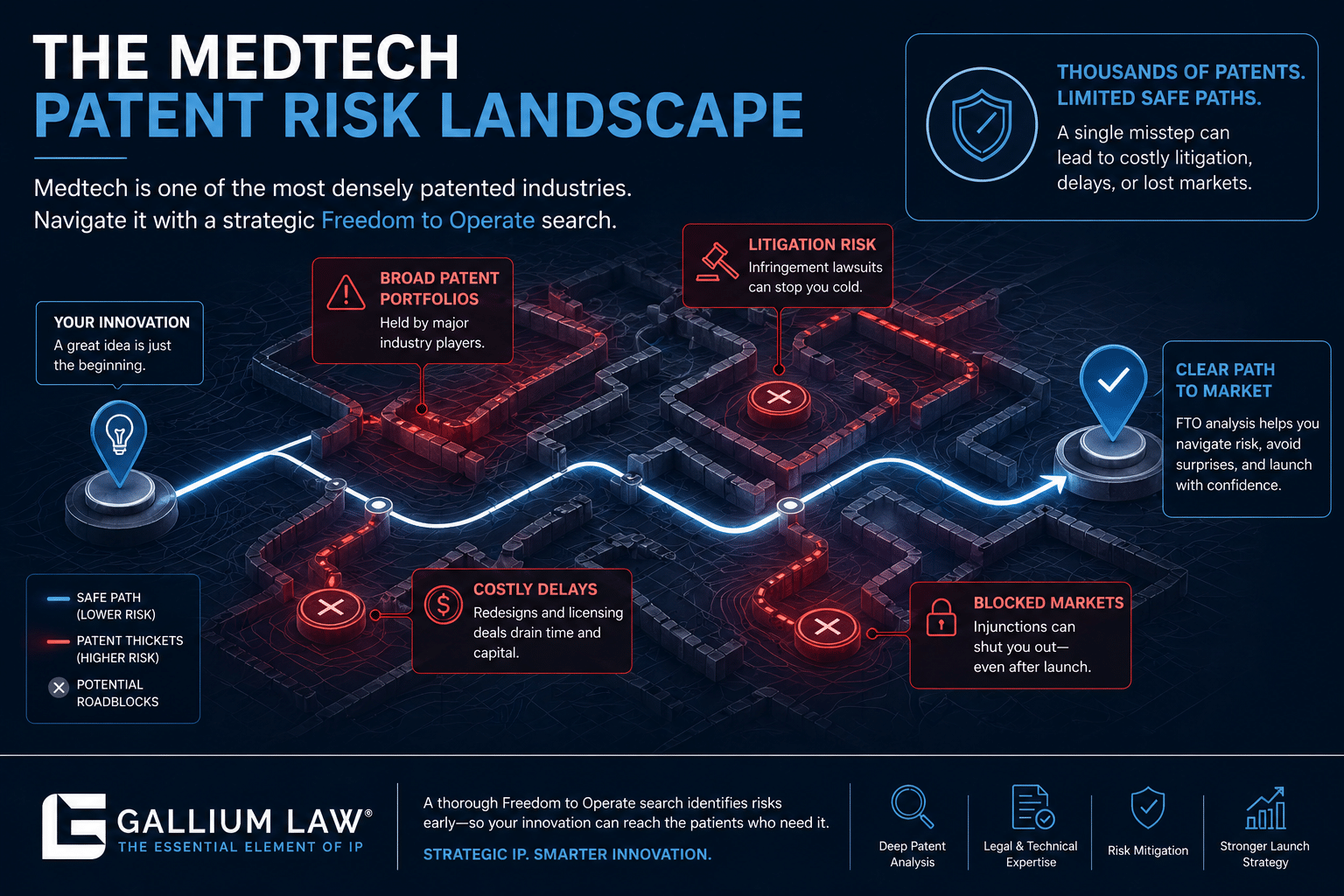
Medical device companies face a unique intersection of regulatory hurdles and intellectual property risk that few other industries experience. The FDA pathway alone can take years and cost millions of dollars, and the medtech IP landscape is among the most densely patented in the world. A new device that clears regulatory hurdles can still be derailed by a patent infringement lawsuit filed the day after launch.
That is why freedom to operate (FTO) in medtech is not just a checkbox during product development. It is a strategic discipline that determines whether your device can actually reach the market and stay there. This guide explains what a Freedom to Operate search for medical devices involves, why it matters more in medtech than almost any other field, and how to integrate FTO analysis into your overall product development and regulatory strategy.
What Freedom to Operate Means in MedTech
Freedom to operate refers to the ability to develop, manufacture, market, and sell a product without infringing the valid intellectual property rights of others. In medtech, FTO analysis typically focuses on patents, since patents are the dominant form of IP protection for medical devices, but it can also involve trademarks, copyrights, and trade secrets depending on the technology.
Freedom to Operate Is Not the Same as Patentability
One of the most common misconceptions among medtech founders is conflating freedom to operate with patentability. They are entirely different questions. Patentability asks whether your invention is novel and non-obvious enough to receive a patent. FTO asks whether your invention can be commercialized without infringing someone else’s existing patent. You can hold a valid patent on a medical device and still infringe another company’s patent when you bring that device to market. Our overview of patentability searching basics walks through how patentability searches work and how they differ from FTO analyses.
Why MedTech Is Especially Risky Without FTO Analysis
Medical device patent portfolios held by major manufacturers can include thousands of patents covering everything from materials and manufacturing processes to specific clinical use cases and software algorithms. The cost of patent litigation in medtech routinely runs into the millions of dollars, and damages awards in this sector are among the highest in any industry. For early-stage companies and startups, a single infringement suit can be company-ending. For established manufacturers, it can disrupt product lines and force costly redesigns mid-launch.
When to Conduct a Freedom to Operate Search for Medical Devices
Timing is critical for FTO analysis in medtech. Conducting a Freedom to Operate search too early may waste resources on a product design that will change significantly. Conducting it too late may mean you have already invested heavily in a product that infringes existing patents and cannot be easily redesigned.
Early Concept Stage
A high-level FTO landscape review during the concept stage helps identify dominant patent holders in your technology space and surface any obvious patent thickets that could block commercialization. This early-stage review does not need to be exhaustive, but it should be sufficiently informed to shape your design choices and investment decisions before significant capital is committed.
Pre-Clinical and Design Lock
By the time your device design is locked for pre-clinical testing, a comprehensive FTO search becomes essential. At this stage, the design is stable enough to map against patent claims with precision, and there is still time to engineer around problematic patents if necessary. This is also typically when investors and acquirers begin asking serious questions about your IP risk profile, which makes a documented FTO analysis a critical component of patent due diligence for medtech companies.
Pre-Submission and Pre-Launch
Before you submit your design to the FDA or commercialize your device, your FTO analysis should be updated to capture any newly issued patents in your space. The medtech patent landscape evolves quickly, and a patent that did not exist when you first conducted a Freedom to Operate search may be granted by the time you are ready to launch. Pre-launch FTO is also the point at which legal opinions become especially important, since a written FTO opinion can support a defense against willful infringement claims if a dispute later arises.
Inside a Freedom to Operate Search for Medical Devices
A Freedom to Operate search for a medical device is far more involved than a patentability search. It requires a structured methodology, expertise in both patent law and the relevant medical technology, and a willingness to dig deep into claim language that often spans hundreds of patents.
Defining the Search Scope
The first step in any FTO search is defining the scope. This means identifying the specific features, materials, manufacturing methods, and clinical use cases that require clearance. For a complex medical device, the scope can include dozens of distinct elements, each of which represents a potential infringement risk.
The scope should also be limited to relevant jurisdictions. A device launching only in the United States does not need clearance against European or Japanese patents, but a device with global commercial plans requires multi-jurisdictional analysis.
Searching Patent Databases
FTO searches draw on multiple patent databases, including the USPTO, the European Patent Office, the World Intellectual Property Organization, and country-specific repositories. Searches use a combination of keyword queries, classification codes such as the Cooperative Patent Classification (CPC), and citation analysis to surface relevant patents. The quality of these searches depends heavily on the searcher’s familiarity with the technology. A patent attorney who routinely works with cardiovascular devices will run a different search for a stent than someone unfamiliar with the field.
Analyzing Claims, Not Abstracts
Once relevant patents are identified, the analysis turns to the patent claims, which are the numbered paragraphs at the end of each patent that define exactly what the patent protects. Patent abstracts and titles can be misleading because they often describe broader concepts than what the claims actually cover. A rigorous claim analysis maps each element of your product against each element of each potentially relevant claim. Only when every element of a claim is found in your product does the patent represent an infringement risk. Our team’s deep experience in patent law is especially valuable here, as claim interpretation requires both legal training and technical fluency.
Producing a Written FTO Opinion
The deliverable from a thorough FTO analysis is a written opinion that summarizes the identified patents, evaluates the infringement risk for each, and recommends design-around options where appropriate. A formal written opinion from a qualified patent counsel can also serve as evidence of good faith if your company is later accused of willful infringement, which can mean the difference between standard damages and enhanced damages of up to three times the actual harm.
Common FTO Pitfalls in Medical Device Development
Even well-funded medtech companies make avoidable mistakes when conducting a Freedom to Operate. Recognizing these pitfalls is the first step towards avoiding them.
Treating FTO as a One-Time Event
FTO is not a single deliverable that gets filed away after a launch. Patents are issued every day, and product designs evolve over time. A Freedom to Operate analysis conducted three years ago may be dangerously outdated by the time your device hits the market. A continuous monitoring program that flags newly issued patents in your technology space is critical for ongoing risk management.
Skipping FTO to Save Costs
Many startups skip or underinvest in a Freedom to Operate analysis to conserve cash, only to later discover that a competitor’s patent blocks their entire product. The cost of a thorough FTO search is a fraction of the cost of patent litigation, redesign, or a forced licensing agreement. For early-stage companies, a well-executed FTO search is one of the highest-leverage investments you can make. Our startup IP consulting practice helps founders prioritize IP spending when budgets are tight.
Relying Solely on In-House Reviews
In-house engineers and product managers can do useful prior art searches, but they often lack the legal training to interpret patent claims correctly. FTO analyses without legal expertise can create a false sense of security. The combination of technical knowledge and legal interpretation is what makes FTO opinions reliable, and that combination typically requires experienced patent counsel familiar with medical device technology. Our medical device patent services team brings both perspectives to every engagement.
Integrating FTO with Your FDA and Commercial Strategy
In medtech, IP strategy and regulatory strategy cannot be siloed. The decisions you make for one have direct consequences for the other.
Coordinating FTO with FDA Submissions
Some medical device companies disclose detailed device specifications in FDA submissions or CE Mark documentation before filing a thorough patent application. While these disclosures are usually not public for some time, they can complicate IP strategy in jurisdictions without grace periods for published information. Thus, a Freedom to Operate analysis should be coordinated with regulatory timelines so that your patent protections and FTO clearances align with your submission schedule. This is particularly important as outlined in the MedTech startup IP guide, where regulatory and IP missteps can compound quickly.
Using FTO Insights to Strengthen Your Patent Strategy
A well-conducted FTO search is also a strategic intelligence tool. It reveals what your competitors are protecting, where the patent thickets in your space are densest, and where there are open lanes for your own patent filings. Strategic medtech companies use FTO insights not just to clear product launches, but also to inform their offensive patent strategy, thereby building portfolios that protect their innovations and creating cross-licensing leverage with competitors.
Preparing for Potential Disputes
Even with rigorous FTO, disputes can arise. Having a documented FTO analysis and a working relationship with experienced patent litigation counsel before a dispute arises puts your company in a far stronger position to respond. The companies that fare worst in patent litigation are usually the ones that scramble to assemble a defense team after a complaint is already filed.
Protect Your MedTech Launch with a Strategic FTO Analysis
Freedom to operate is not a luxury for medical device companies. It is a foundational requirement for any product entering a heavily regulated, highly patented market. The cost of doing it right is small compared to the cost of doing it wrong, and the strategic value of a thorough FTO analysis extends well beyond risk mitigation.
At Gallium Law, we work with medtech companies at every stage of development, from early concept through commercial launch and beyond. Our team combines deep medical device experience with the legal rigor required for high-stakes FTO work. Learn more about our IP due diligence services or contact us to discuss your device program.