
Table of Contents
Switched to Gallium from a larger firm and the difference has been massive. They offer much better service at much more manageable prices. If you are looking for fast efficient help with anything IP related, these are the guys for the job. Trademarks, Patents, Copyrights, these guys know what they are doing. They are my third lawyers I have worked with and the experience has been substantially better than the prior two.

Connor Hance
August 2025
Gallium law has been amazing to work with for our legal needs! They make things easy to understand, do a great job at keeping us informed, and are calm and confident in their communication. Highly recommend!!

Anna Wengreen
August 2025
I have worked with other firms and this is a rare one. It has truly been a pleasure working with Wes, Michael, and Jacob. They are the experts in IP Law and patent applications. I am grateful that they help me to understand things at my level. On top of that they are true gentlemen! It's been an amazing experience!

Nelson Lim
August 2025
Wes and the Gallium Law team have been a pleasure to work with. They guided us seamlessly through the provisional patent process for our product, providing expert advice and prompt communication at every step. I highly recommend them to any startup or business looking for strategic, dependable IP counsel. Looking forward to continuing our partnership!

Mike Lee
May 2025
I called several firms about assisting me with developing my patent and the Gallium Law firm was only one, nationwide, to return my phone call and consult with me. That is respect no matter what IP you have, or who you are. They are very professional and takes care of their customers. The work was thorough and detailed. I am very satisfied with the work they have done for me. I would recommend this law firm to anyone reading.

Shawn
May 2025
I highly recommend Gallium Law for your company's patent needs. Wes and crew are a stellar team that helped us get our product design utility patent successfully patented with the USPTO. After they drafted the patent application and materials, it was clear that having expert professionals craft the application was absolutely necessary. There are countless details in how they executed the application that we never would have been able to do ourselves. They did a tremendous job in taking the patent to the finish line.

Robert Paul
August 2024
The Gallium team have been and continue to be phenomenal partners to work with. They have been the most responsive, creative, engaging, and innovative IP counsel I have ever collaborated with. Gallium is happy to support early stage start-ups and provide the same attention and support you would typically only receive when working for large multi-nationals. I would recommend their team to anyone looking to generate and expand their IP portfolio.

Ryan Balko
September 2024
Great experience! The Gallium team did a great job filing my patent. They also did a great job of clearly explaining my options to protect my IP, and that made a big difference to me as a new inventor.

Daniel Bakke
August 2024
I have worked with Gallium law for many years. In my opinion they are unique in their approach of "winning" patents for customers like myself. I worked very close with their professional patent law attorneys, and turned obstacles and initial rejections to complete successful patent allowances. They are very reasonable with their budgets and willing to accommodate your personal needs and requests. It is the best patent law company I ever dealt with.

Gideon Eden
July 2023
Our publicly traded company has worked with Wes and his team at Gallium Law for about a decade. They are consummate IP professionals and highly organized - which is essential for coordinating dates, fees, etc. We trust Gallium Law with our most highly prized assets - our IP. You should, too.

David Morse
March 2024
Gallium Law is an incredible Intellectual Property Legal team! I am continually blown away with their ability to translate our medical device design ideas into patent claims and diagrams. They are very experienced in the interventional (catheters and generators) medical device space. My customers have had great experiences working with Gallium and I recommend them to all medical device innovators.

Brady Hatcher
April 2023
I have always been very happy with the great work of the Gallium team. They are patent experts who really take an interest in helping their clients succeed. Wes is particularly talented and results oriented. Not only is Wes an excellent patent attorney, he's also a great engineer with an MBA, so he understands legal issues from many useful perspectives.

Eric Wengreen
December 2022
I thoroughly enjoyed working with the Gallium Law team on my provisional patent application and intend to work with them on future filings. Wes and Isabel were knowledgeable and cared about understanding my intellectual property. I appreciated their advice on filing timelines and drafting strategy. I highly recommend their firm.

Ashley Mooneyham
February 2022
Being served a summons for patent infringement by a process server can feel overwhelming and frightening. Your mind races with questions: Is this real? What happens if I ignore it? How much will this cost? Can I lose my business?
First, take a deep breath and don’t panic. While being served with a patent infringement lawsuit is serious, you have time to respond and options to protect yourself. Understanding what the summons means, what deadlines you face, and what steps to take immediately can make the difference between a favorable outcome and a devastating default judgment.
At Gallium Law, we help individuals and businesses respond to patent infringement lawsuits and develop effective defense strategies. This comprehensive guide explains exactly what you need to do after being served with a patent infringement summons and how to protect your interests throughout the legal process.
Don’t Panic: You Have Time To Respond
The single most important thing to understand after being served is that you have a specific window of time to respond, and missing that deadline can result in serious consequences.
Understanding Your Response Deadline
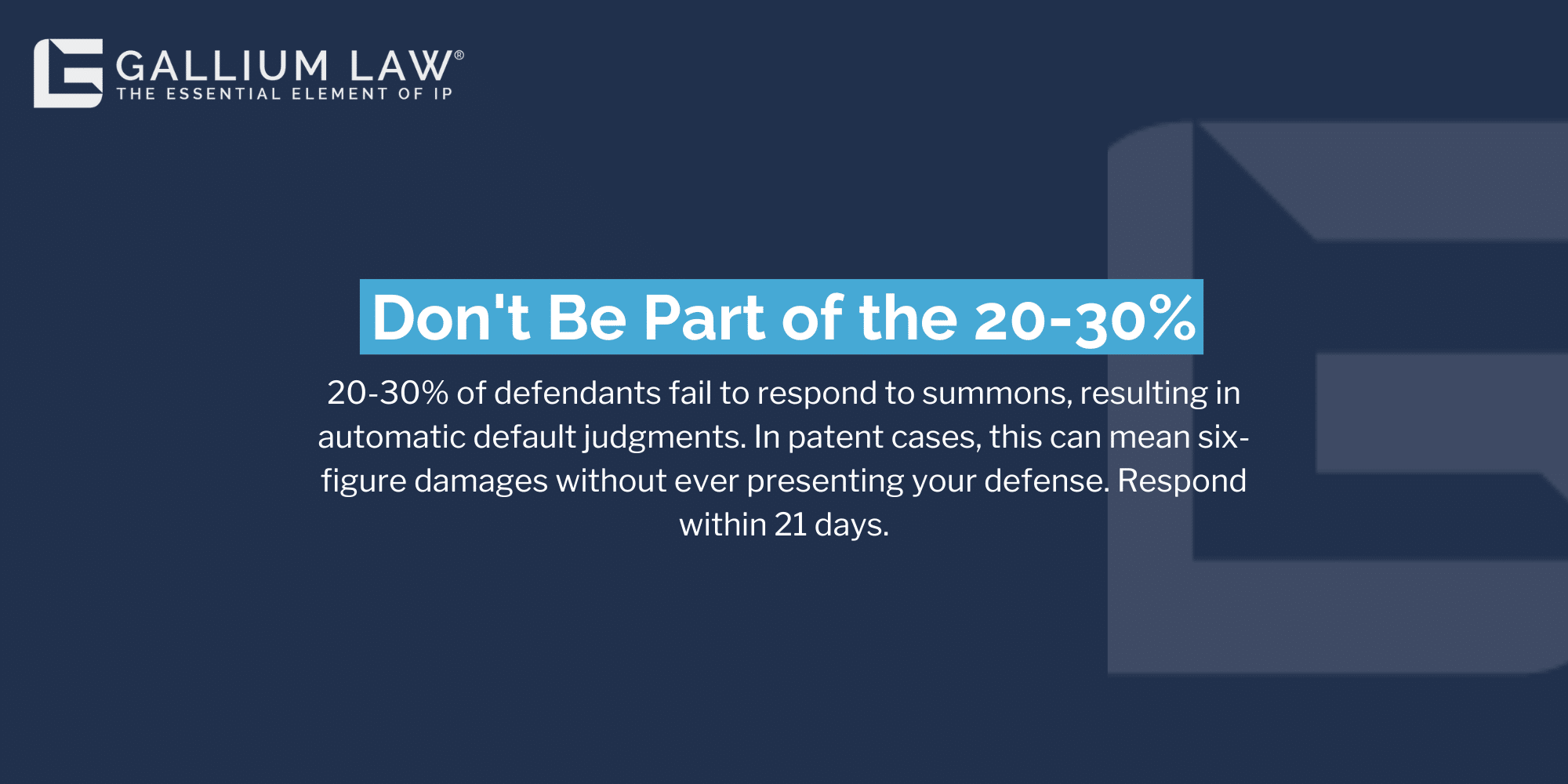
Under Rule 4 of the Federal Rules of Civil Procedure, you typically have 21 days from the date you were served to file a response with the court. However, if you waive formal service of the summons, you generally have 60 days to respond. The summons itself will specify your exact deadline.
This deadline is not a suggestion. It’s a hard deadline that the court will enforce. The 21-day or 60-day period gives you time to hire an attorney, review the complaint, and prepare an appropriate response. While this may seem like a short window, experienced litigation counsel can work efficiently to meet these deadlines.
Requesting Extensions
In some cases, you may need additional time beyond the initial deadline to prepare your response. Extensions are possible, but they require approval from the plaintiff or the court. Many plaintiffs will agree to reasonable extensions, particularly if you’re actively engaging with the lawsuit and working to retain counsel.
However, you cannot simply assume you’ll get an extension. You must formally request it before your deadline expires, and ideally with agreement from the plaintiff’s attorneys. Never let your deadline pass while hoping for an extension that hasn’t been granted.
The Risk of Not Responding
Ignoring a summons or missing your response deadline can lead to a default judgment against you. A default judgment means the court rules in favor of the plaintiff without hearing your side of the case. The plaintiff can obtain everything they asked for in their complaint, including monetary damages, injunctions preventing you from selling products, and attorney’s fees.
Default judgments can be extremely difficult and expensive to overturn. Even if you have strong defenses to the patent claims, you lose the opportunity to present them if you default. This is why responding to the summons, even if you ultimately plan to settle or believe the lawsuit is frivolous, is absolutely critical.
Understanding What A Patent Lawsuit Means
Patent infringement lawsuits are a specific type of federal litigation that follows particular rules and procedures. Understanding the basics helps you make informed decisions about your defense.
How Patent Infringement Claims Work
A patent infringement lawsuit alleges that you are making, using, selling, or offering to sell a product or service that falls within the scope of the plaintiff’s patent claims. Patent claims are the numbered paragraphs at the end of a patent document that define the legal boundaries of the patent owner’s rights.
The court will compare your product or service against these patent claims to determine whether infringement has occurred. This analysis is technical and requires careful interpretation of claim language, understanding of the technology involved, and consideration of how courts have interpreted similar claim terms in other cases.
Types of Patent Infringement
Patent infringement comes in several forms. Direct infringement occurs when you directly make, use, sell, or offer to sell the patented invention. This is the most straightforward type of infringement allegation.
Indirect infringement includes two categories: induced infringement and contributory infringement. Induced infringement occurs when you encourage or help others to infringe a patent (e.g., selling a guide with step-by-step instructions for how to build a patented device). Contributory infringement occurs when you sell a component that has no substantial non-infringing use and is specifically designed for use in a patented invention.
Understanding which type of infringement the plaintiff alleges helps frame your defense strategy.
Stages of Patent Litigation
Patent lawsuits proceed through several distinct stages, each with specific activities and strategic considerations.
Initial Pleadings and Response
After you receive the summons and complaint, your first step is filing an answer or other response. Your answer admits or denies each allegation in the complaint and asserts any defenses you have. This document sets the framework for your entire defense.
Discovery Phase
Discovery is the evidence-gathering phase where both sides exchange information, documents, and testimony. Discovery in patent cases often includes document production, interrogatories (written questions), depositions (oral testimony under oath), and expert witness reports. This phase can last many months and involves substantial legal work.
Claim Construction (Markman Hearing)
A unique feature of patent litigation is the claim construction or Markman hearing. At this hearing, the court determines the meaning of disputed terms in the patent claims. This interpretation significantly impacts whether infringement is found, making claim construction one of the most important stages in patent litigation.
Motion Practice and Trial
Before trial, parties often file motions for summary judgment asking the court to decide the case without a trial. If the case proceeds to trial, both sides present evidence and arguments to a judge or jury, who then decides whether infringement occurred and what damages, if any, should be awarded.
Defenses Available to You
Even if you’ve been sued for patent infringement, you likely have multiple defenses available. Understanding these defenses helps you evaluate your position and work with counsel to develop an effective strategy.
Challenging Patent Validity
One of the most powerful defenses is arguing that the patent itself is invalid. Patents can be invalid for several reasons, including that the invention was already known or obvious in light of prior art, that the patent specification doesn’t adequately describe the invention, or that the inventor failed to disclose material prior art during prosecution.
The duty of disclosure requires patent applicants to inform the USPTO of relevant prior art. If inventors or their attorneys failed to disclose material references, this can impact patent validity.
Non-Infringement Defenses
You can defend by showing your product or service doesn’t fall within the scope of the patent claims. This requires detailed comparison of your product against each element of the asserted patent claims. If even one element is missing or different, you don’t infringe under the “all elements” rule.
Affirmative Defenses
Several affirmative defenses may apply to your situation. These include patent exhaustion (the first sale doctrine), which provides that once a patented product is sold, the patent owner’s rights to control that specific product are exhausted. Other affirmative defenses include inequitable conduct, laches, and estoppel.
Safe harbors exist for certain activities. For example, making, using, or selling a patented invention solely for research purposes may be protected, though this exemption is narrow and doesn’t extend to commercial research.
Counterclaims
In some cases, defendants file counterclaims against the patent owner. These might include seeking a declaratory judgment of non-infringement or invalidity, or alleging that the patent owner violated antitrust laws through improper patent enforcement.
Possible Outcomes and What They Mean
Patent lawsuits can resolve in several ways, each with different implications for you as the defendant.
Winning Your Case
If you successfully defend the lawsuit, the court may find that you don’t infringe the patent or that the patent is invalid. This outcome means you can continue your business activities without restrictions from this particular patent. You may also be able to recover your attorney’s fees in exceptional cases.
Losing the Case
If the court finds you infringed a valid patent, consequences can include injunctions prohibiting you from making or selling the infringing products, monetary damages for past infringement, ongoing royalties for future sales, and potentially enhanced damages if the court finds willful infringement.
Damages in patent cases typically equal a reasonable royalty based on what you would have paid for a license, or the patent owner’s lost profits if they can prove them. In cases of willful infringement, courts can award up to three times the actual damages.
Settlement and Licensing
Many patent lawsuits settle before trial. Settlement agreements often include licensing terms allowing you to continue selling products in exchange for royalty payments. Settlement can avoid the cost and uncertainty of trial, though the terms depend heavily on the strength of each side’s position.
Some defendants choose to stop selling the accused products as part of settlement, particularly if licensing terms are unfavorable or if they can design around the patent claims.
Immediate Steps You Must Take
After being served with a patent infringement summons, take these immediate actions to protect yourself.
Preserve All Relevant Documents
Immediately implement a litigation hold to preserve all documents, emails, and other materials relevant to the lawsuit. This includes product designs, sales records, communications about the product, and any prior art or invalidity materials you’re aware of. Destroying or losing relevant evidence can result in severe sanctions.
Do Not Contact the Plaintiff Directly
While you may be tempted to call the plaintiff or their attorney to explain your position, avoid doing so without consulting an attorney first. Anything you say can be used against you, and you may inadvertently harm your defense.
Hire Experienced Patent Litigation Counsel
The complexity of patent litigation makes experienced legal representation essential. Patent litigation involves specialized federal rules, technical claim interpretation, and strategic considerations that general practice attorneys may not understand.
Look for attorneys with specific experience defending patent infringement cases in your technology area. At Gallium Law, our comprehensive services include all aspects of patent litigation defense, from initial response through trial or settlement.
Evaluate Your Insurance Coverage
Check whether you have insurance that might cover patent infringement claims. Some general liability or errors and omissions policies include intellectual property coverage, though patent infringement is often excluded. Specialized patent infringement insurance exists but is less common. Understanding your coverage early helps you plan for litigation costs.
Assess Your Strategic Options
Work with your attorney to conduct due diligence on the patent, the plaintiff, and your own position. This assessment helps you understand the strength of the claims against you, potential defenses, likely costs of litigation, and possibilities for settlement.
Consider whether the plaintiff is a practicing entity that competes with you or a non-practicing entity focused on licensing. This context significantly impacts litigation strategy and settlement dynamics.
Special Considerations for Different Defendants
The optimal response strategy can vary depending on your business type and situation.
Amazon and Marketplace Sellers
If you sell primarily through online marketplaces like Amazon, patent litigation may coincide with product takedowns on these platforms. Understanding how to respond both to the lawsuit and to marketplace complaints is crucial. Our experience with Amazon intellectual property issues helps marketplace sellers navigate both federal court and platform-specific procedures.
Medical Device Companies
Companies in the medical device space face unique challenges in patent litigation. Medical device patents often cover complex technologies, and litigation can impact regulatory approvals and clinical activities. Specialized counsel with medical device experience can better address these complications.
Small Businesses and Startups
Small businesses often face difficult decisions balancing litigation costs against business survival. While defending a lawsuit is expensive, default judgments can be even more costly. Exploring all options including settlement, licensing, and potential invalidity defenses helps small businesses make informed choices about how to proceed.
Moving Forward with Confidence
Being served with a patent infringement summons is stressful, but it’s certainly not the end of your business. With timely action, experienced legal counsel, and a strategic approach, you can defend your rights and achieve favorable outcomes.
The most critical step is acting immediately. Don’t let the 21-day deadline pass while you’re deciding what to do. Even if you’re still evaluating your options, ensure someone files a response to preserve your rights.
At Gallium Law, we help clients navigate patent disputes with comprehensive defense strategies tailored to their specific situation. Our team combines technical expertise with practical litigation experience to protect your business. Contact Gallium Law today to discuss your patent infringement lawsuit. Time is critical, so don’t delay in getting the help you need.