
Skip links

Guides

How to Patent Wearable Fitness Technology

Get In Touch

651-256-9480

Table of Contents

Apple is the most valuable company on the planet. It has more cash on hand than some countries. Yet, for much of late 2023 and into 2024, Apple couldn’t sell two of its most popular smartwatches in the United States. Not because of a supply chain issue. Not because of a product defect. Because a small medical device company named Masimo held patents on pulse oximetry technology that the Apple Watch used, and the International Trade Commission agreed those patents were being infringed.

The wearable fitness technology space has become one of the most aggressively litigated corners of the tech world. Companies like AliveCor, Masimo, Philips, and Samsung are using their patent portfolios not just defensively, but as real weapons. If you’re building wearable fitness or health monitoring technology, the question isn’t whether patents matter. It’s whether you can afford to launch without them.

At Gallium Law, we work with medical device innovators and fitness tech startups who are trying to carve out defensible space in this crowded market. We’ve seen firsthand what separates patents that hold up under pressure from those that get torn apart in post-grant review. This guide distills what we’ve learned from the biggest patent battles in wearable tech history.

What the Patent Wars Tell Us About Protecting Wearable Tech

You can learn a lot about patent strategy by studying the companies that got it right and the ones that didn’t. Let’s look at the three most significant wearable patent disputes in recent years.

AliveCor v. Apple: A Cautionary Tale

AliveCor makes the KardiaBand, a wristband accessory that turns the Apple Watch into an ECG monitor. When Apple launched its own built-in ECG feature with the Series 4 in 2018, AliveCor didn’t sit quietly. They filed a complaint with the ITC and pursued litigation in federal court, alleging that Apple’s heart rate analysis technology infringed AliveCor’s patents.

Here’s where it gets painful for AliveCor. Apple didn’t just fight the infringement claims. Apple went to the Patent Trial and Appeal Board (PTAB) and challenged the validity of AliveCor’s patents altogether. The PTAB agreed, finding key claims obvious in light of prior art. AliveCor appealed, but the Federal Circuit ruled in March 2025 that the PTAB’s invalidation was correct, with no import ban on Apple Watches. No injunction. AliveCor’s patents were effectively wiped out.

The lesson? Having a patent isn’t enough. If your claims are drafted too broadly, or if they don’t clearly distinguish over the prior art, a well-funded competitor will find a way to invalidate them. AliveCor’s claims covered heart rate analysis methods that the PTAB found were obvious combinations of existing techniques. More specificity in the original drafting could have changed the outcome.

Masimo v. Apple: How Strong Patents Win

Masimo’s story is the opposite of AliveCor’s, and it’s instructive. Masimo is a medical device company that pioneered pulse oximetry technology used in hospitals worldwide. When Apple incorporated blood oxygen monitoring into the Apple Watch, Masimo filed an ITC complaint.

The ITC sided with Masimo and issued an import ban on the Apple Watch Series 9 and Ultra 2 in late 2023. Apple had to pull those watches from U.S. shelves temporarily, then rushed to redesign the blood oxygen feature to resume sales. Apple reintroduced an updated version with the feature working again in August 2025. But the fight isn’t over. The ITC opened a new investigation in November 2025 to examine whether Apple’s redesigned version still infringes. Meanwhile, a jury awarded Masimo $634 million in damages.

Why did Masimo succeed where AliveCor failed? Their patents were tied to specific, novel hardware implementations of pulse oximetry. They weren’t claiming the abstract idea of measuring blood oxygen. They claimed specific sensor configurations, signal-processing methods, and algorithms that solved real engineering problems. That specificity made the patents much harder to invalidate.

Samsung v. Oura and the Ring Wars

When Samsung launched the Galaxy Ring, Oura (makers of the Oura Ring) brought patent infringement claims. Samsung counter-sued. The case was dismissed in early 2025, with no ruling for either side. It was a clear signal that the smart ring segment of wearable fitness tech is now a patent war zone. If you’re in the business of building any kind of wearable sensor device (be that a wristband, a finger device, a chest-worn device, or an ear-worn device), someone is almost certainly going to have patents in that space. You have to know what’s out there before you go and file your own.

We always recommend starting with a thorough prior art and due diligence search before investing in patent prosecution. It’s one of the smartest moves you can make.

Types of Wearable Fitness Innovations You Can Patent

Wearable fitness technology isn’t one thing. It’s a collection of different inventive categories, and each one has its own patenting considerations. According to WIPO’s analysis of wearable health monitoring patents, this sector has grown at a 24% average annual rate, meaning the patent landscape gets more crowded every year. Here’s how we typically break it down for our clients.

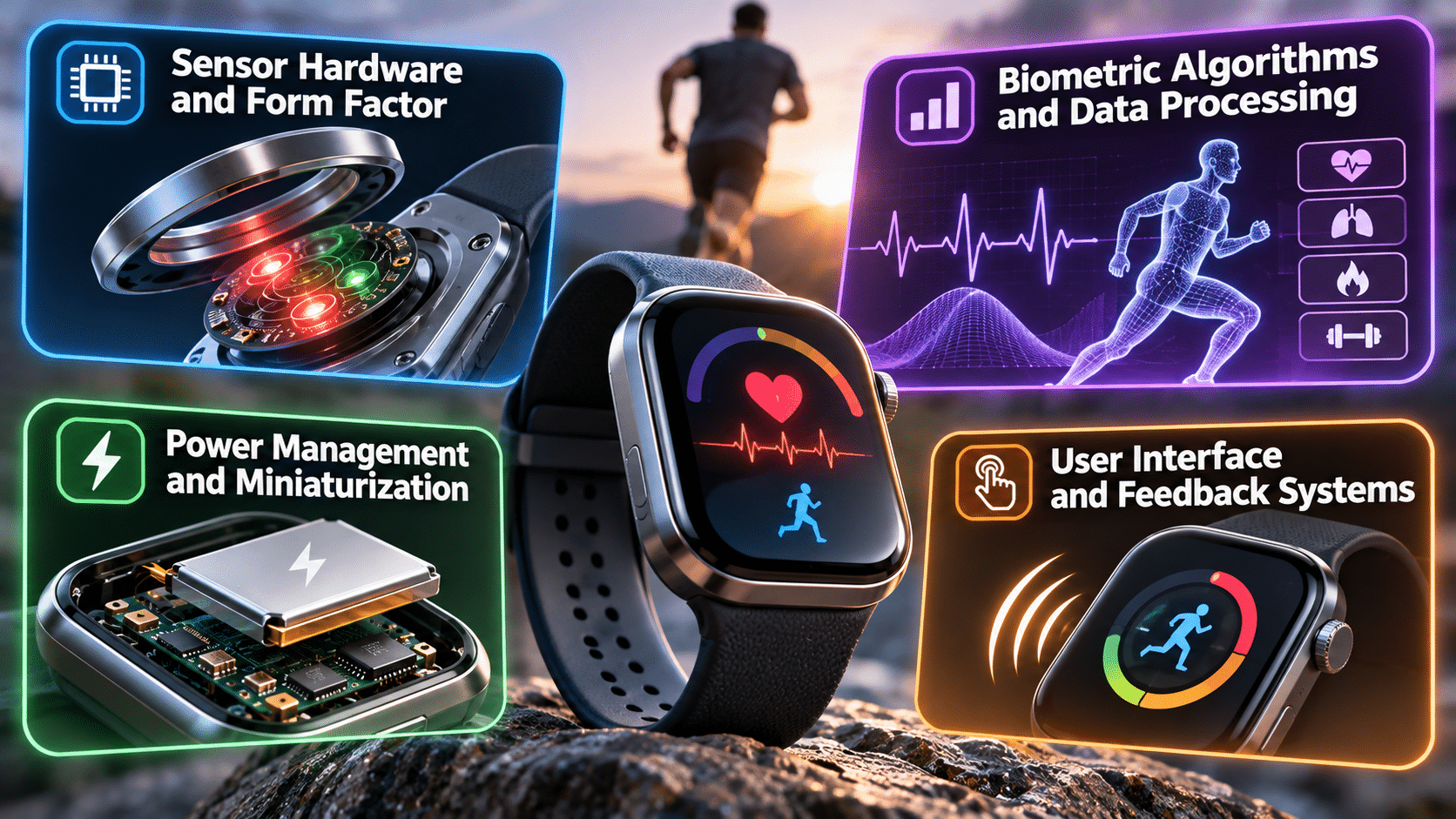
Sensor Hardware and Form Factor

This is the easiest category to get into. If you’ve invented a new type of optical sensor, a new electrode arrangement for ECGs, or a novel mechanical design that improves skin contact on a wristband, that’s patentable. Hardware claims are generally strongest in this area because they’re tangible and specific. The Masimo patents that beat Apple were essentially hardware claims relating to a particular sensor configuration.

Think about what makes your sensor physically different. Is it the layout of the LEDs and photodetectors? The materials? How is it designed to compensate for motion artifacts physically? All of that will make a massive difference.

Biometric Algorithms and Data Processing

This is where things get tricky. Can you patent an algorithm that estimates VO2 max from heart rate variability data? Maybe. Can you patent the general idea of using heart rate data to estimate fitness levels? Absolutely not. The line between patentable signal processing and unpatentable abstract ideas is one we spend a lot of time helping clients navigate.

We cover this in depth in our guide on medical device sensor technology. Still, the short version is this: your algorithm claims need to be anchored to specific technical steps that produce a concrete improvement. “Processing biometric data to generate a health score” won’t survive scrutiny. “Applying a multi-stage adaptive filter to PPG signals to isolate cardiac rhythm from motion artifacts using a specific windowing technique” has a much better shot.

Power Management and Miniaturization

Wearables live or die by battery life. If you’ve figured out how to run continuous heart rate monitoring while consuming 40% less power than existing approaches, that’s genuinely valuable and very patentable. Founders often overlook power-management innovations when they focus on the sensor itself, but these claims can be among the most commercially valuable in your portfolio. Every major wearable company wants better battery life. That makes your power management patent a potential licensing asset.

User Interface and Feedback Systems

How does your device communicate information back to the user? Haptic feedback patterns that convey workout intensity without requiring the user to look at a screen? A novel way of displaying real-time biometric data on a curved OLED? Adaptive coaching interfaces that change based on physiological state? These are all potentially patentable. Don’t ignore the experience layer of your technology.

Types of Wearable Fitness Innovations You Can Patent

The Section 101 Problem (and How to Solve It)

If you’ve spent any time researching software patents, you’ve probably heard of Alice Corp. v. CLS Bank. That 2012 Supreme Court decision created a two-part test for patent eligibility under Section 101. And it’s been causing headaches for wearable tech inventors ever since.

Here’s the core problem. Many wearable fitness devices collect biometric data, process it with an algorithm, and display the result. Under a broad reading of Alice, that can look like an “abstract idea” implemented on generic hardware. Sleep-tracking claims, step-counting algorithms, and generic heart rate zone calculations: these have all been challenged (sometimes successfully) as ineligible under Section 101.

But it’s not all bad news. The USPTO’s 2024 eligibility guidance update provides a clearer framework for how examiners should evaluate these claims. The key insight from that guidance, and from the cases we’ve seen succeed, is that claims tied to specific system architecture fare much better than generic health data collection claims.

What does that look like in practice? Rather than saying “a method for monitoring sleep quality,” you’d say “a method for determining sleep stage transitions using a combination of accelerometer data, PPG-derived heart rate variability, and skin temperature readings from a wrist-worn device, wherein the method applies a trained neural network model to the fused sensor outputs to classify the transitions between REM and non-REM sleep stages with a latency of less than 30 seconds.” That second version is much more specific, much more technical, and much more tied to a particular piece of hardware. It’s far less abstract.

The ITC fitness tracker cases reinforce this. When Philips investigated Garmin and Fitbit in 2024 over health monitoring patents, the claims at issue were specific implementations, not broad concepts. The ITC has consistently shown a willingness to enforce patents rooted in real technical solutions. For a deeper look into whether your innovation meets the eligibility threshold, check out our patentability guide.

Drafting Wearable Patent Claims That Survive

We’ve reviewed thousands of wearable tech patents. The ones that survive challenges, whether at the USPTO, in district court, or before the ITC, share a few common traits. Here’s what we tell every client who walks through our door with a wearable invention.

First, anchor your claims in the hardware. Even if the heart of your invention is an algorithm, you’ll have to describe the sensor, the processor architecture, the data bus, the memory. That kind of thing. It’s not just a Section 101 trick; it also narrows your claims in a way that makes them much harder to invalidate on prior-art grounds, because you’re claiming a specific combination rather than a general concept.

Secondly, you need to describe the full signal processing chain. You can’t just say what the output is. You need to describe what happens at each stage, from raw sensor data through filtering, feature extraction, classification, and output. The more technical detail you can provide, the more defensible your claims are. That’s what distinguished Masimo’s successful patents from AlAliveCor’s, which were all invalidated.

Thirdly, include system claims, method claims, and computer-readable medium (CRM) claims. System claims cover the device itself. Method claims cover the method. CRM claims cover the software as stored on a medium. Having all three gives you several angles from which to enforce your patent. If their product matches your system claim, that’s one thing. If they’re importing firmware that implements your method, you’ve got a claim there too.

This is the kind of strategic claim drafting we handle through our patent services. It’s not about making the broadest possible claims. It’s about writing claims that can actually withstand the pressure of inter partes review and litigation.

Navigating the Crowded Prior Art Landscape

Let’s be honest about the competitive reality. The wearable fitness patent landscape is absolutely packed. Samsung is the largest patent holder in that space, followed by Philips, Apple, Qualcomm, Fitbit (now Google), and Garmin. Together, they hold thousands of active patents covering the board from optical heart rate sensors to sleep-stage classification algorithms.

That doesn’t mean there’s no scope for new patents at all. It means you have to know precisely where the white space is before you even think about filing. A full prior art search is essential in this area. You need to know not just the granted patents but the published applications, the academic papers (university research into wearable biosensors is a huge source of prior art), and the international filings.

You also need to understand how companies enforce their patents. The ITC has become a preferred venue for enforcing wearable tech patents. Philips brought ITC investigations against Garmin and Fitbit in 2024. Masimo used the ITC against Apple. These actions can result in import bans that effectively shut competitors out of the U.S. market. If you’re planning to manufacture overseas (and most wearable companies do), an ITC complaint is one of the biggest threats you’ll face.

Published research is another trap. Wearable health monitoring is one of the most heavily published areas in biomedical engineering. If your invention is too close to a technique described in a published paper, even one from a university lab, that paper can be used as prior art against you. We regularly find that clients are surprised by how much relevant prior art exists in academic journals and conference proceedings.

For more on how we approach this analysis, explore our patent guides section.

Building a Wearable Fitness Patent Portfolio

One patent won’t protect your business in this space. You need a portfolio. Here’s how we advise clients to think about building one.

Start with your core innovation. What’s the one thing your product does that nobody else’s does? Maybe it’s a novel sensor fusion technique. Maybe it’s a form factor innovation. Maybe it’s a power management breakthrough. Whatever it is, that’s your first filing, and it should be your strongest.

Then build outward. File on the surrounding innovations that support and enhance the core. Your data processing pipeline. Your calibration method. Your user interface innovations. Your manufacturing process, if it’s novel. Each filing creates additional barriers a competitor has to design around. One patent is a speed bump. Ten related patents are a wall.

Don’t ignore international filings. Wearable devices are manufactured globally and sold globally. A U.S. patent only stops infringement in the United States. If your competitor manufactures in China and sells in Europe, your U.S. patent alone won’t help. PCT applications give you a window to file in multiple countries, and strategic filings in the EU, China, South Korea, and Japan are often critical for wearable tech companies. Our team helps clients develop licensing and IP strategy that accounts for global markets.

Finally, continuation applications. Wearable tech moves on so quickly. Your first product might use a PPG sensor; your next one might incorporate bioimpedance and/or skin conductance. Continuation applications allow you to file new claims based on the disclosure in your original application, covering those subsequent developments without having to go back to the drawing board. We tell every client this: your first application should be as detailed as possible in terms of the technical detail, even for features you haven’t actually built yet, so that you have the widest possible base from which to build continuation claims later on.

Protecting Your Wearable Innovation

The wearable fitness technology market will only get more competitive and more litigious. The Apple patent wars showed that even the biggest companies in the world are vulnerable to well-crafted patent claims, and that weak patents get destroyed. The difference between winning and losing in this space comes down to how well your patents are drafted, how strategically they’re positioned, and whether your portfolio covers enough ground to matter.

If you’re in the business of developing wearable fitness tech (smartwatch, fitness band, chest strap, or whatever else you’re coming up with), you need patent protection that’s actually going to survive. Not that broad, vague kind of patent that sounds great on the surface but falls apart under close examination. You need real, specific, technically sound patents that can survive an inter partes review, a district court fight, and an ITC investigation.

That’s what we do at Gallium Law. We work with wearable tech founders and engineering teams to build patent portfolios that protect what matters. From prior art searches to claim drafting to international filing strategy, we handle the full process so you can focus on building your product.

Contact our team to discuss your wearable fitness technology and figure out the best path forward for protecting it.