
Skip links

Guides

How to Patent Medical Device Sensor Technology

A Guide for Inventors and Companies

Get In Touch

651-256-9480

Table of Contents

Medical device sensors are at the center of one of the fastest-growing patent landscapes in healthcare. The global biosensor market was valued at over $28 billion in 2025 and is projected to more than double by 2035, driven by continuous glucose monitors, wearable cardiac sensors, implantable neural interfaces, and a wave of diagnostic devices that are moving clinical-grade measurement from hospitals to patients’ wrists. Behind every sensor that reaches the market is a portfolio of patents protecting the transduction mechanism, signal processing, biocompatible materials, and the algorithms that turn raw data into actionable clinical insights.

For inventors and companies developing sensor technology, patent protection is not optional. The R&D investment required to bring a medical sensor from concept to FDA clearance is substantial, and without strong IP, that investment is exposed to competitors who can replicate your approach without bearing the development cost. This guide covers what is patentable in medical device sensor technology, how to navigate the unique challenges of medtech patent prosecution, and how to build a portfolio that protects your innovation through commercialization and beyond.

What Is Patentable in Medical Device Sensor Technology

Medical device sensors involve multiple layers of innovation, and each layer can contain independently patentable inventions. Understanding these layers helps you identify where your strongest IP opportunities exist.

Sensing Mechanisms and Transduction Methods

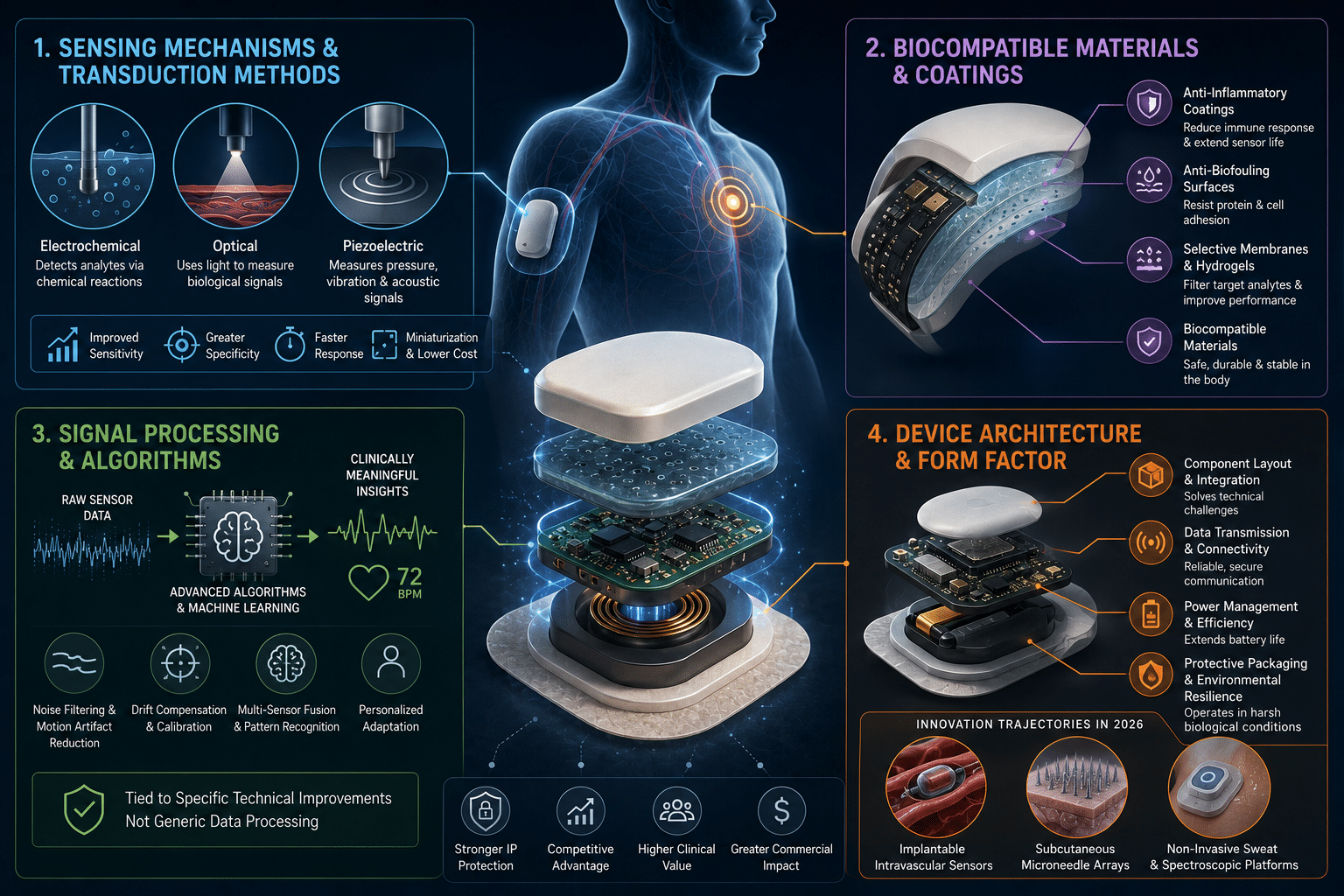
The core of any medical sensor is its transduction method: the physical or chemical process that converts a biological signal into a measurable electrical output. Electrochemical sensors that detect analytes such as glucose, lactate, or cortisol via oxidation-reduction reactions at an electrode surface constitute a major category. Optical sensors that use light absorption, fluorescence, or photoplethysmography to measure oxygen saturation, heart rate, or blood composition represent another. Piezoelectric sensors that detect pressure, vibration, or acoustic signals in the body occupy a third category.

Novel transduction methods, including new electrode materials, sensing chemistries, optical configurations, or mechanical structures that improve sensitivity, specificity, or response time, are strong candidates for utility patent protection. 

The key is to demonstrate that your approach produces a measurable improvement over existing methods, whether in accuracy, speed, miniaturization, cost, or the ability to detect a biomarker that was previously unmeasurable outside a lab setting.

Biocompatible Materials and Coatings

Sensors that contact the body, whether worn on the skin, inserted subcutaneously, or implanted internally, require materials that are biocompatible, durable, and functional in a biological environment.

Novel polymer coatings that resist biofouling, hydrogel interfaces that improve skin contact impedance, membrane compositions that selectively filter target analytes, and anti-inflammatory coatings that extend the functional life of implantable sensors are all patentable innovations. These material innovations often determine whether a sensor can operate for hours or weeks, making them critical to its commercial value.

Signal Processing and Algorithms

Raw sensor data is rarely useful in its native form. The algorithms that filter noise, compensate for motion artifacts, calibrate against drift, and extract clinically meaningful measurements from noisy biological signals are often the most valuable and defensible component of a medical device sensor system.

Machine learning models that improve diagnostic accuracy by analyzing patterns across multiple sensor inputs, or that adapt calibration in real time based on individual patient physiology, are generating significant patent activity.

Software patents in the medical device space require careful drafting to avoid abstract idea rejections under Alice Corp. v. CLS Bank. The claims must be tied to specific technical improvements, not generic data processing. A claim that covers ‘using machine learning to analyze sensor data’ is likely to be rejected. A claim that covers ‘a method for reducing motion artifact in a wrist-worn photoplethysmography sensor by applying a specific adaptive filtering algorithm trained on accelerometer-correlated noise patterns’ has a higher likelihood of becoming a patent. Understanding how medical device patents are written and interpreted is essential to avoid drafting mistakes that undermine medtech patent applications.

Device Architecture and Form Factor

The physical design of a medical sensor device, including how components are arranged, how the sensor interfaces with the body, how data is transmitted, and how the device is powered, can all be patented when the architecture solves a technical problem.

Miniaturization innovations that enable clinical-grade sensing in a wearable form factor, packaging designs that protect sensitive electronics in harsh biological environments, and power management systems that extend battery life in implantable devices are all active patent areas. The three dominant innovation trajectories in 2026 are implantable intravascular sensors, subcutaneous microneedle arrays, and non-invasive sweat or spectroscopic platforms.

Unique Challenges in Patenting Medical Device Sensors

Navigating the Alice/Mayo Framework for Software Claims

Medical device sensor patents frequently involve a combination of hardware and software, and the software components face heightened scrutiny under the Supreme Court’s Alice and Mayo decisions. Patent examiners will evaluate whether your software claims are directed to an abstract idea (like data collection or mathematical analysis) or to a specific technological improvement. The most successful medical device sensor patents frame software claims in terms of the concrete technical problem being solved and the specific sensor architecture used, rather than as general-purpose data-processing methods.

Drafting claims that integrate the software tightly with the physical sensor hardware, for example, describing how a specific algorithm interacts with a specific electrode configuration to produce improved measurement accuracy, creates a stronger patent position than separating the software and hardware into independent claims. Our guide to starting the patent process outlines how to address these considerations from the very beginning of your application.

The Duty of Disclosure in a Dense Prior Art Field

Medical sensor technology is heavily researched in both academic and commercial settings. The volume of prior art, including published patents, patent applications, scientific papers, FDA submissions, and clinical trial data, is enormous. Patent applicants have a legal duty to disclose to the USPTO all material prior art they are aware of. Failing to meet this obligation can render an issued patent unenforceable. In a field where inventors are often deeply embedded in the academic literature, the information disclosure statements and the duty of disclosure process require careful attention to ensure nothing is overlooked.

Coordinating Patent Strategy with FDA Regulatory Timelines

Medical devices go through regulatory review (e.g., 510(k), De Novo, or PMA) that can take months or years. Your patent strategy needs to account for this timeline. Filing too late means your patent may not issue until after competitors have entered the market. Filing too early, before your design is finalized, may result in claims that do not cover the product you actually commercialize.

An effective approach is to file a provisional application early to capture the broadest version of your invention, then file subsequent provisional applications to capture various changes made during development, and ultimately file the non-provisional application as your design stabilizes during the regulatory process, but most importantly, before 12 months have elapsed from your earliest provisional application filing. Understanding what happens after filing helps you coordinate these timelines.

Building a Medical Device Sensor Patent Portfolio

Layer Your Claims Across the Technology Stack

A single patent covering one aspect of your sensor technology is a starting point, not a strategy. Effective medtech patent portfolios layer claims across the sensing mechanism, materials, signal processing, device architecture, and clinical application. This layered approach creates multiple barriers to entry for competitors and ensures that your IP protection survives even if individual claims are narrowed during prosecution or challenged in litigation.

For companies with multiple sensor products or product generations, a disciplined approach to IP portfolio management ensures that each new development builds on and strengthens the existing portfolio rather than creating isolated patents with gaps between them.

File Continuation Applications Strategically

Continuation and continuation-in-part applications allow you to add new claims based on the original specification, which is particularly valuable in medical device development, where the technology evolves through clinical testing and iterative design. A sensor that begins as a research prototype and evolves into a commercial product over several years can be protected through a family of related patents that collectively cover each stage of development. This strategy keeps your patent protection current as your technology matures.

Conduct Freedom to Operate Before Commercialization

The medical device sensor landscape is crowded with patents from large incumbents, university research labs, and competing startups. Before committing to commercial production, a thorough freedom-to-operate analysis identifies existing patents that could block your path to market and gives you the opportunity to design around problematic claims, negotiate licenses, or challenge the validity of blocking patents before they become litigation risks.

How Sensor Patents Drive Investment and Commercialization

In the medical device industry, patents are not just legal protection. They’re an asset that drives investment, partnership, and acquisition decisions.

Venture capital and strategic investors evaluate medtech companies heavily on the strength of their IP portfolios. A startup with a novel continuous glucose monitoring sensor but no patent protection is a development-stage company. The same startup, with two or three well-drafted utility patents covering the sensing chemistry, signal processing, and wearable form factor, is an acquisition target. The patents transform technical innovation into a defensible competitive position that investors can underwrite.

Licensing revenue from medical device sensor patents can also become a significant business model, particularly for companies whose core strength is R&D rather than manufacturing and distribution. If your patented sensing technology has applications across multiple device categories, licensing it to companies serving different clinical markets can generate passive revenue without requiring you to build a sales organization for each. Thorough IP due diligence is the foundation that makes these transactions possible.

Protect the Sensor Technology That Powers the Next Generation of Healthcare

Medical device sensors are transforming how healthcare is delivered, moving from episodic clinical measurement to continuous, real-time patient monitoring. The companies and inventors that secure strong patent protection for their sensing innovations will control the technology that enables that transformation. The companies that do not will watch their R&D investments vanish to competitors who filed first.

At Gallium Law, our medical device patent services practice works with sensor developers from concept through commercialization, drafting claims that survive examination, building portfolios that attract investment, and enforcing rights when competitors infringe. Contact us to discuss how to protect your medical device sensor technology.