
Medical Device Patent Claims: How Drafting, Prosecution, and Construction Shape Their Value

Patent claims are the heart of any patent. They define the precise boundaries of what an inventor owns, and in medtech, those boundaries can be the difference between a defensible market position and a worthless piece of paper. A well-drafted claim survives examination, withstands invalidity challenges, and reads cleanly on competitor products. A poorly drafted claim invites office actions, narrowing amendments, and ultimately, claim construction rulings that gut its commercial value.
Medical device patents present a unique drafting and prosecution challenge. The technology spans mechanical, electrical, software, and biological elements. Examiners often have varying levels of familiarity with the specific subfield. Litigators looking at the patent years later will dissect every word in the claim against the backdrop of the prosecution history. This blog walks through how medical device patent claims should be approached at each stage, from initial drafting through prosecution and into the courtroom, where claim construction determines what the patent actually covers.
Why Medical Device Claims Demand Extra Care
Patent claims in any field need to balance breadth and defensibility, but medtech amplifies that tension. Medical devices often combine multiple disciplines in a single product, regulatory pathways limit how the device can be described, and competitors are highly motivated to design around any patent that blocks a lucrative market.
The Cost of Imprecision
In a low-stakes consumer product, a slightly ambiguous claim term might never matter. In medtech, a single ambiguous word can become the focal point of a multi-million dollar Markman ruling. Courts construing claim terms in medical device cases scrutinize the specification, prosecution history, and even the inventor’s contemporaneous notes to determine the meaning a person of ordinary skill in the art would have understood. Claims that were drafted casually rarely survive that level of scrutiny intact. Our team’s experience with medical device patents reflects our understanding on getting claim language right from day one.
Designing Around Is the Default
Major medical device manufacturers maintain dedicated teams whose job is to design around competitor patents. If your claim language can be sidestepped by swapping a material, repositioning a component, or adding an inert intermediate element, a competent design-around team will find the workaround. Strong medical device patent claims anticipate these tactics and use functional language, broad genus terms, and well-supported dependent claims to close off the most obvious avenues of escape.
Drafting Effective Medical Device Patent Claims
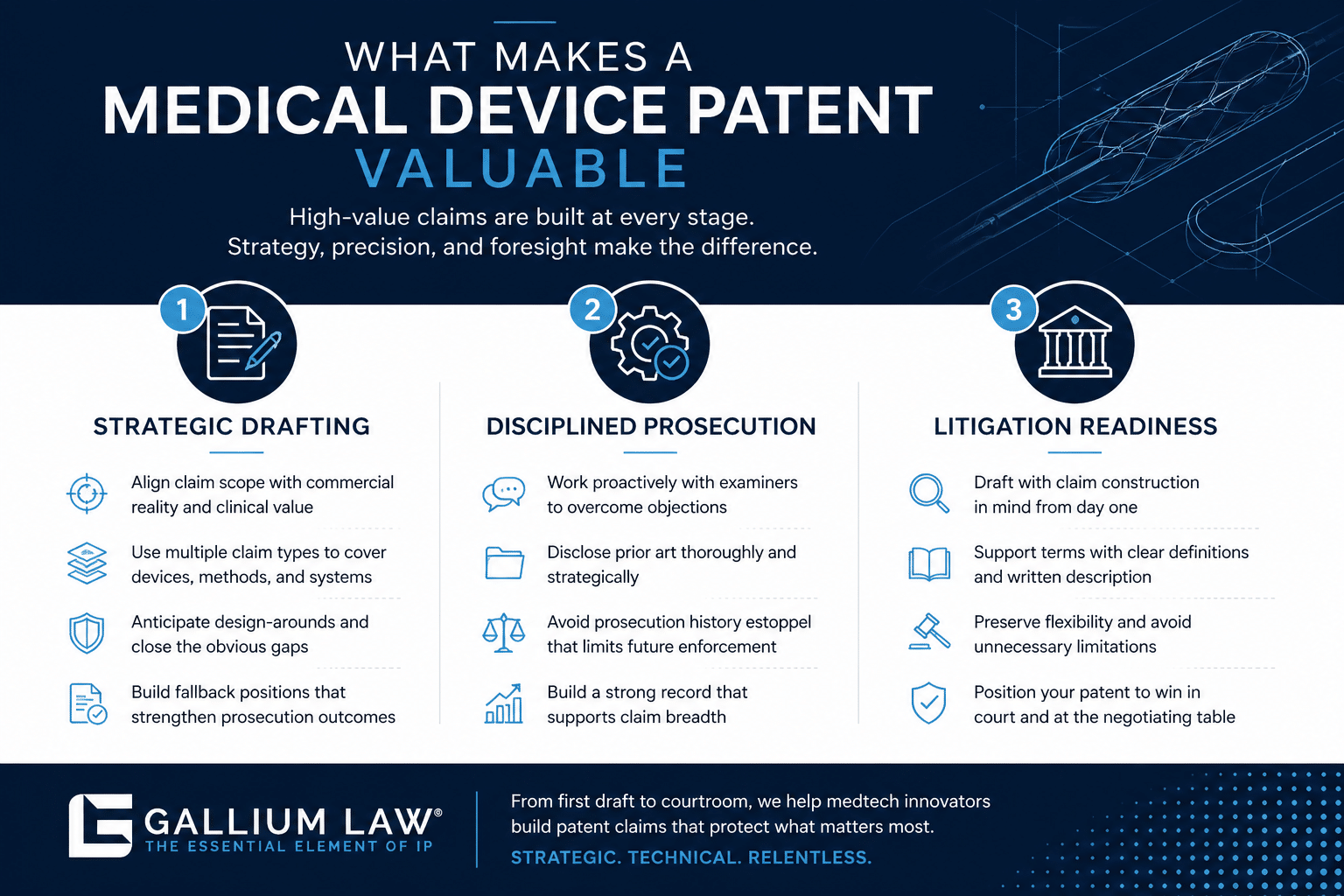
The drafting stage is where most of the real value is created or destroyed. Claims that are clear, well-supported by the specification, and structured to capture commercially meaningful embodiments are the foundation of a strong patent.
Match Claim Scope to Commercial Reality
A common mistake is drafting the broadest possible claim without thinking about what a competitor would actually build. The strongest claims protect what the market values, not what is theoretically possible. For a surgical instrument, that might mean focusing on the specific geometry that delivers the clinical advantage. For a diagnostic device, it might mean protecting the algorithm or the workflow that makes the device useful in practice. Strategic claim scope decisions should be informed by competitive intelligence and a clear understanding of the device’s clinical use case.
Use Multiple Claim Types
A strong medical device patent uses a mix of independent and dependent claims spanning apparatus, method, and system formats. Apparatus claims protect the physical device. Method claims safeguard how the device is used, including clinical methods where appropriate. System claims tie the device into broader workflows or infrastructure. Each claim type provides a different angle of protection and a different theory of infringement, which matters enormously when an accused infringer offers only one component of a multi-element system.
Anticipate the Examiner’s View
Effective drafting also means thinking like an examiner. What prior art will likely surface? What rejections are most predictable? What dependent claims can serve as fallback positions if the broader independent claims are to be narrowed? Building a claim set with an intentional fallback structure speeds up prosecution and reduces the risk of estoppel, which can limit future enforcement options. Our overview of the unwritten rules of patent law captures some of the practical wisdom that experienced patent attorneys bring to this work.
Prosecution Strategy for Medical Device Patents
Filing the application is just the beginning. The prosecution phase, during which the application moves through USPTO examination, often shapes the patent’s ultimate value as much as the originally filed application.
Working with the Examiner
Once a non-provisional application is filed, the USPTO assigns an examiner with expertise in the relevant technology area. The examiner reviews the application, conducts a prior art search, and issues office actions that may reject some or all of the claims. Successful prosecution depends on understanding how the examiner sees the invention and addressing concerns directly.
Examiner interviews, which allow attorneys to discuss the application by phone or video with the examiner, are often underused in medical device prosecution and can dramatically accelerate allowance. For a fuller picture of the post-filing process, see our overview of what happens after a patent application is filed.
Managing the Information Disclosure Statement
Medical device applicants have a duty to disclose all known prior art that is material to patentability. Failing to meet this duty can render an issued patent unenforceable through inequitable conduct. The challenge in medtech is that prior art often includes scientific publications, FDA submissions, conference posters, and clinical study protocols, as well as other patents. Building a disciplined disclosure process is essential. Our guide to information disclosure statements walks through how to fulfill this duty correctly.
Avoiding Prosecution History Estoppel
Every amendment and every argument made during prosecution becomes part of the patent’s prosecution history. Years later, when a court is construing the claims, that history can dramatically narrow what the patent covers. Statements that distinguish the invention from prior art, even when made strategically, can later be used to argue that certain accused products are outside the claim scope. A counsel experienced in patent prosecution knows how to navigate office actions without creating unnecessary estoppel.
Claim Construction in Medical Device Litigation
If a medical device patent ever ends up in litigation, the most important moment in the case is often the claim construction ruling, also known as the Markman hearing. This is where the court determines the legal meaning of disputed claim terms, which in turn determines whether the accused product infringes.
How Courts Construe Claims
Courts apply a structured methodology when construing patent claims. They start with the plain meaning of the claim language as it would be understood by a person of ordinary skill in the art. They then look to the specification for context, particularly any definitions or characterizations the inventor provided. Finally, they consider the prosecution history, including any amendments and arguments made during examination. Extrinsic evidence, such as expert testimony and dictionaries, is given less weight, though it can still influence the outcome.
Why Medtech Cases Often Turn on Claim Construction
In medical device litigation, claim construction frequently determines who wins and who loses. A favorable construction can mean the accused device clearly infringes a clean, broad claim. An unfavorable construction can require the patent owner to prove infringement under the doctrine of equivalents, which carries a much more difficult evidentiary burden. Many medtech cases are effectively decided at the Markman stage, with settlement following soon after. Companies preparing to assert or defend medical device patents should consider claim construction well before litigation begins. Our team’s patent litigation experience includes deep knowledge of claim construction in high-stakes medical device cases.
Practical Lessons for Medtech Inventors and Companies
Whether you are a startup founder filing your first patent or a portfolio manager at an established manufacturer, a few practical principles can dramatically improve the value of your medical device patent claims.
Invest in Specification Quality
The specification is the foundation that supports every claim. It should describe multiple embodiments, define key terms thoughtfully, and provide enough technical detail to support claim amendments later in prosecution, if needed. Skimping on the specification to save time at the drafting stage almost always costs more in the long run. For early-stage companies navigating these trade-offs, our MedTech startup IP guide provides a roadmap.
Document Inventor Contributions Carefully
Inventor declarations and contributions affect both ownership and the scope of admissible inventor testimony in litigation. Maintain clear records of who contributed what, when, and how. These records become critical during diligence, licensing discussions, and any future disputes. The same discipline applies in any patent due diligence in medtech exercise, where investors and acquirers expect well-documented inventor records.
Plan for Continuations
Smart medtech patent strategy treats every patent application as the start of a family. Filing continuations and continuations-in-part allows you to capture commercial embodiments that emerge over time and to draft claims that read on competitor products as the market evolves. A patent family with active continuations creates ongoing flexibility that a single isolated patent cannot match.
Build Stronger Medical Device Patent Claims with Gallium Law
Medical device patent claims are technical, legal, and strategic instruments all at once. Drafting them well requires fluency in the underlying technology, deep familiarity with USPTO practice, and a clear vision of how the patent might one day be tested in court. Prosecuting them well requires patience, judgment, and an understanding of the long-term consequences of every amendment and argument. Construing them well, when litigation comes, requires preparation that began years earlier with the very first claim draft.
At Gallium Law, our patent attorneys help medtech inventors and companies navigate every stage of this process. Whether you are filing your first medical device patent or managing a portfolio of hundreds, our team brings the technical depth and legal experience your innovations deserve. Contact us to talk through your patent strategy.