Table of Contents
Switched to Gallium from a larger firm and the difference has been massive. They offer much better service at much more manageable prices. If you are looking for fast efficient help with anything IP related, these are the guys for the job. Trademarks, Patents, Copyrights, these guys know what they are doing. They are my third lawyers I have worked with and the experience has been substantially better than the prior two.

Connor Hance
August 2025
Gallium law has been amazing to work with for our legal needs! They make things easy to understand, do a great job at keeping us informed, and are calm and confident in their communication. Highly recommend!!

Anna Wengreen
August 2025
I have worked with other firms and this is a rare one. It has truly been a pleasure working with Wes, Michael, and Jacob. They are the experts in IP Law and patent applications. I am grateful that they help me to understand things at my level. On top of that they are true gentlemen! It's been an amazing experience!

Nelson Lim
August 2025
Wes and the Gallium Law team have been a pleasure to work with. They guided us seamlessly through the provisional patent process for our product, providing expert advice and prompt communication at every step. I highly recommend them to any startup or business looking for strategic, dependable IP counsel. Looking forward to continuing our partnership!

Mike Lee
May 2025
I called several firms about assisting me with developing my patent and the Gallium Law firm was only one, nationwide, to return my phone call and consult with me. That is respect no matter what IP you have, or who you are. They are very professional and takes care of their customers. The work was thorough and detailed. I am very satisfied with the work they have done for me. I would recommend this law firm to anyone reading.

Shawn
May 2025
I highly recommend Gallium Law for your company's patent needs. Wes and crew are a stellar team that helped us get our product design utility patent successfully patented with the USPTO. After they drafted the patent application and materials, it was clear that having expert professionals craft the application was absolutely necessary. There are countless details in how they executed the application that we never would have been able to do ourselves. They did a tremendous job in taking the patent to the finish line.

Robert Paul
August 2024
The Gallium team have been and continue to be phenomenal partners to work with. They have been the most responsive, creative, engaging, and innovative IP counsel I have ever collaborated with. Gallium is happy to support early stage start-ups and provide the same attention and support you would typically only receive when working for large multi-nationals. I would recommend their team to anyone looking to generate and expand their IP portfolio.

Ryan Balko
September 2024
Great experience! The Gallium team did a great job filing my patent. They also did a great job of clearly explaining my options to protect my IP, and that made a big difference to me as a new inventor.

Daniel Bakke
August 2024
I have worked with Gallium law for many years. In my opinion they are unique in their approach of "winning" patents for customers like myself. I worked very close with their professional patent law attorneys, and turned obstacles and initial rejections to complete successful patent allowances. They are very reasonable with their budgets and willing to accommodate your personal needs and requests. It is the best patent law company I ever dealt with.

Gideon Eden
July 2023
Our publicly traded company has worked with Wes and his team at Gallium Law for about a decade. They are consummate IP professionals and highly organized - which is essential for coordinating dates, fees, etc. We trust Gallium Law with our most highly prized assets - our IP. You should, too.

David Morse
March 2024
Gallium Law is an incredible Intellectual Property Legal team! I am continually blown away with their ability to translate our medical device design ideas into patent claims and diagrams. They are very experienced in the interventional (catheters and generators) medical device space. My customers have had great experiences working with Gallium and I recommend them to all medical device innovators.

Brady Hatcher
April 2023
I have always been very happy with the great work of the Gallium team. They are patent experts who really take an interest in helping their clients succeed. Wes is particularly talented and results oriented. Not only is Wes an excellent patent attorney, he's also a great engineer with an MBA, so he understands legal issues from many useful perspectives.

Eric Wengreen
December 2022
I thoroughly enjoyed working with the Gallium Law team on my provisional patent application and intend to work with them on future filings. Wes and Isabel were knowledgeable and cared about understanding my intellectual property. I appreciated their advice on filing timelines and drafting strategy. I highly recommend their firm.

Ashley Mooneyham
February 2022
Here’s a number that caught our attention: over 130,000 patent filings in assistive technology between 1998 and 2019. That’s according to WIPO’s 2021 Technology Trends report, and the pace isn’t slowing down. The prosthetics and orthotics space, in particular, has turned into one of the most active corners of the patent landscape. And for good reason.
Over one billion people worldwide currently need some form of assistive technology. By 2050, that number is projected to hit two billion. An aging global population, advances in materials science, and breakthroughs in brain-computer interfaces are all colliding at the same time. If you’re developing prosthetic or orthotic technology, you have something valuable. The question is whether you’re protecting it.
At Gallium Law, we work with inventors and companies building the next generation of medical device patents. Prosthetics is a great area to work in because the technology is genuinely changing lives, and the patent strategy required is anything but cookie-cutter. Let’s walk through what you need to know.
Why Prosthetic Patents Are Booming Right Now
The numbers tell the story pretty clearly. Emerging mobility technology, which includes powered prosthetics and advanced orthotics, has been growing at an average annual rate of 24% in patent filings. That’s fast by any standard. But the really jaw-dropping stat? 3D-printed prosthetics and orthoses have the highest patent growth rate of any assistive technology category at 89% AAGR.
Several forces are at work here. All developed economies are aging, and that means a huge increase in the number of people needing mobility aids, joint replacements, and limb replacements. The technology itself has also advanced enormously. We’re not talking about the static, uncomfortable prosthetics of 20 years ago. We’re talking about myoelectric sensors, machine learning, adaptive gait control, and materials that were science fiction just a decade ago.
Moreover, the barrier to entry for innovation has plummeted. A small team with biomedical engineering expertise and a 3D printer can now go from concept to a working prosthetic prototype in weeks. That’s fantastic for the patient. It also means the field is quickly becoming crowded, making patenting more important than ever.
If you’re curious whether your specific innovation qualifies for protection, our patentability guide is a solid starting point.
What Types of Prosthetic Innovations Can You Patent?
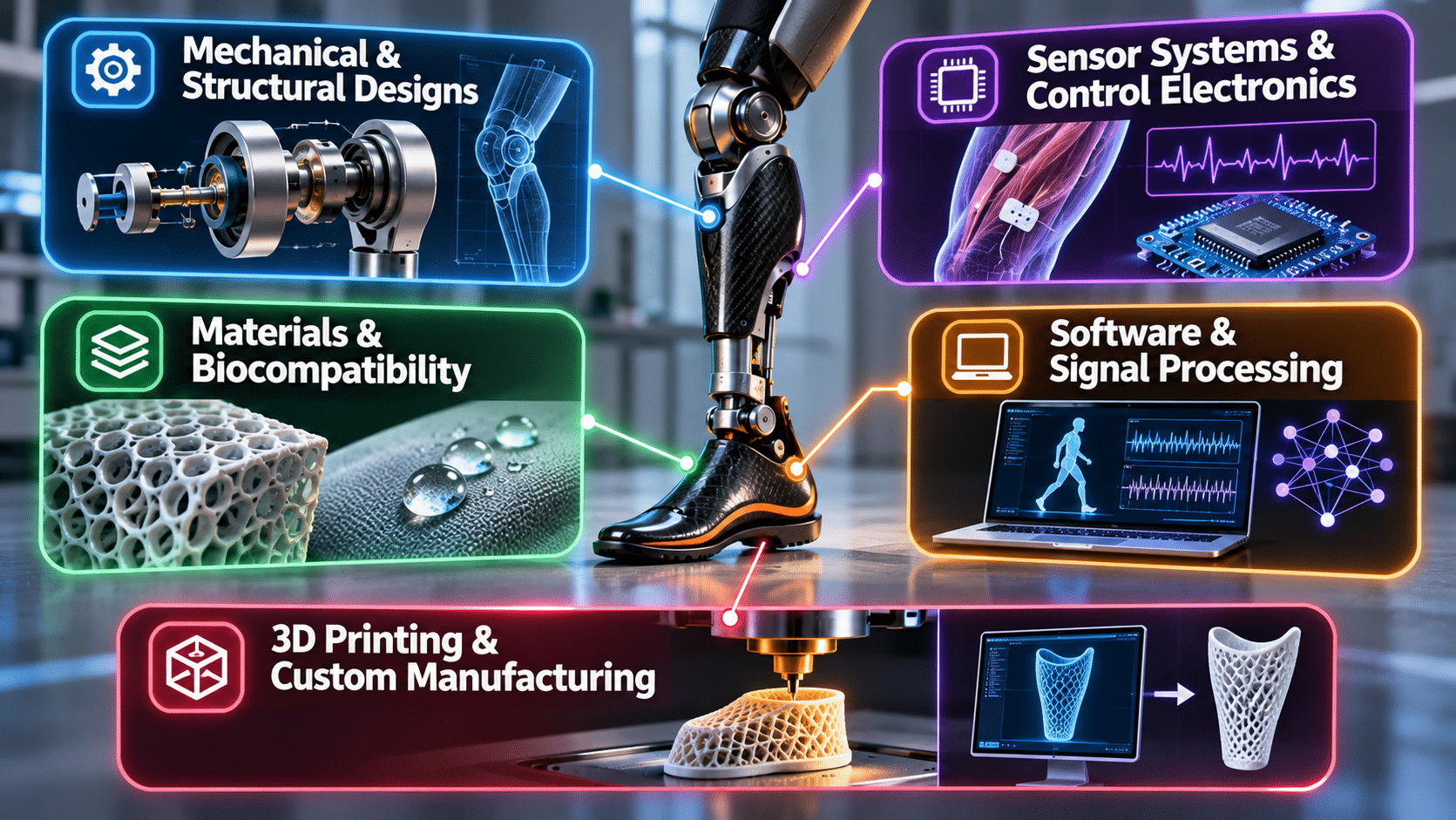
This is where things get interesting. Prosthetic and orthotic devices aren’t just one category of invention. They span mechanical engineering, electronics, software, materials science, and manufacturing processes. That breadth creates multiple angles for patent protection, but it also means you need to think carefully about where your real competitive advantage lives.
Mechanical and Structural Designs
The physical structure of a prosthesis is usually the easiest thing to patent. Novel joint mechanisms, locking mechanisms, suspension systems, socket shapes and geometries, and alignment adjustment mechanisms are all patentable. A new ankle joint that provides variable stiffness through the gait cycle is a good example. So is a new below-knee socket design that spreads pressure more evenly over the residual limb. These are concrete, tangible inventions that a patent examiner can compare to the prior art.
We’ve seen some very clever work in modular prosthetic systems, where you can swap components in and out depending on the activity. A leg optimized for running, as opposed to a leg optimized for normal walking, all on the same base platform. The modularity of that in itself can be patented.
Sensor Systems and Control Electronics
This is the fastest-moving area right now. Myoelectric prosthetics, those that detect electrical signals from residual muscles to control hand or arm movements, have gone from laboratory curiosities to commercially available products. But the field is far from mature. There’s enormous room for improvement in signal processing, electrode placement, noise filtering, and real-time response.
EMG (electromyography) sensors, force sensors, inertial measurement units, and even EEG-based brain-computer interfaces are all showing up in prosthetic patent applications. The American Chemical Society’s CAS division has documented the explosion of research into bioelectronic interfaces, and that research is translating directly into patent activity. If you’ve developed a better way to read, interpret, or act on biosignals, that’s patentable.
For a deeper look at related sensor-based innovations, check out our guide on medical device sensor patents.
Materials and Biocompatibility Innovations
Materials science is quietly revolutionizing what’s possible in prosthetics. We now have biocompatible polymers (PDMS – polydimethylsiloxane) and conductive polymers (PEDOT: PSS) that can be used to create flexible, skin-friendly sensor interfaces that can be worn for long periods of time. That’s absolutely critical, as comfort and wearability are certainly the most important factors in whether the patient actually uses their prosthesis.
Even more exciting are the biodegradable metals (molybdenum, zinc) coming in for implantable interfaces. You could have an electrode array that does its job during the healing and calibration phase, then dissolves safely in the body. No second surgery to remove it. Those material innovations are highly patentable because they are novel, solve a real clinical problem, and aren’t an obvious combination of the prior art.
Software and Signal Processing
Can you patent software in a prosthetic device? Yes, but you’ve got to be smart about how you frame it. We’ll get into the Section 101 analysis later, but the short version is that prosthetic software has a significant advantage over pure software patents. Why? Because it’s tied to a physical device interacting with a human body. That connection to hardware and biology gives you a much stronger position under current patent eligibility rules.
Algorithms for gait prediction, adaptive grip strength, terrain classification, and pattern recognition from EMG signals are all actively being patented. The key is drafting claims that anchor the software to the physical device and its interaction with the patient. Don’t describe an abstract algorithm. Describe a prosthetic limb that uses that algorithm to achieve a specific, tangible result.
3D Printing and Custom Manufacturing Methods
Remember that 89% growth rate? This category is absolutely blowing up. It’s not just the printed devices that are patentable. Manufacturing methods, scan-to-print workflows, lattice structures (for weight and strength), multi-material printing processes, etc., are all patentable.
What makes 3D printing patents in the prosthetics field so attractive is the customization aspect. Every patient is different, and 3D printing allows for truly bespoke devices. If you have a process that takes a 3D scan of the residual limb and automatically generates an optimized socket design from it, that process is worth patenting. It’s a real-world problem conventional manufacturing simply can’t address.
The FDA Factor: Regulatory Pathways You Need to Understand
Here’s something that surprises a lot of inventors: your FDA regulatory strategy and your patent strategy are deeply intertwined. You can’t treat them as separate tracks. Timing, classification, and the claims in your patent application all intersect with how the FDA views your device.
Prosthetic and orthotic devices generally fall under FDA 21 CFR Part 890, which covers physical medicine devices. But the specific pathway your device takes to market depends on its classification and novelty.
- The 510(k) clearance pathway is the most common route for prosthetic devices. If you can demonstrate that your device is substantially equivalent to a legally marketed predicate device, this is usually the fastest path. Most conventional prosthetic limbs, braces, and orthotic supports go through the 510(k) process. It’s relatively quick (often 3 to 6 months for review), and it doesn’t require the extensive clinical trials that other pathways demand.
- The De Novo classification is for novel devices that have no predicate. If your prosthetic technology is genuinely new (say, a brain-controlled prosthetic arm with a novel neural interface), there may not be an existing device to compare it to. De Novo creates a new regulatory classification for your device, which also means you become the predicate for future competitors. That’s a strategic advantage worth thinking about.
- For the highest-risk devices, the Premarket Approval (PMA) pathway applies. This involves clinical trials and extensive documentation. FDA’s guidance on premarket approval outlines the balancing act between pre-market and post-market data collection. PMA is expensive and time-consuming, but for certain implantable or high-risk prosthetic technologies, it’s the only option.
- There’s also the Custom Device Exemption, which exists specifically for highly personalized prosthetics. If you’re making devices tailored to individual patients in small quantities (no more than five units per year of a specific design), this exemption can bypass the standard clearance process. It won’t work for mass-market products, but for cutting-edge custom prosthetics, it’s a valuable pathway.
Here’s the timing tension we see all the time: your patent application’s one-year statutory bar starts ticking from any public disclosure or commercial offer for sale, but FDA submissions can take months or years. We generally advise clients to file provisional patent applications before submitting to the FDA. In some circumstances, the FDA submission itself can constitute a disclosure, and you don’t want to lose your patent rights because of a regulatory filing.
Drafting Claims That Actually Hold Up
This is where the real skill comes in. A granted patent is only as good as its claims, and in the prosthetics space, some strategies are better than others.
Start with the hardware/biology interface. Your claims need to describe the device’s interaction with the patient’s body. That’s not just good practice; it’s essential to satisfy the Section 101 patent eligibility requirement. Alice/Mayo has been a real pain for software and medical method patents, but prosthetics have a distinct advantage in that respect. You’ve got a physical device attached to a human body that produces a tangible result. That’s as tangible as it gets.
The USPTO’s 2024 patent eligibility guidance provides updated analysis on how examiners should evaluate subject matter eligibility, including for AI-related inventions. If your prosthetic device incorporates machine learning or AI (and increasingly does), this guidance is essential reading.
Second, don’t limit yourself to device claims. File method claims too. How is the device manufactured? How is it fitted to a patient? How does the control algorithm calibrate to a specific user’s muscle signals? Each of these processes can be a separate claim set, and they create different enforcement options later.
Third, think about claim breadth versus specificity. Your broadest independent claim should capture the core innovation at a high enough level that competitors can’t easily design around it. Your dependent claims should then layer in the specific technical details. We’ve seen too many prosthetic patents with claims so narrow that a competitor just changes one sensor type and walks right past the patent. Don’t let that happen to you.
Our team handles claim drafting as part of our patent services, bringing technical depth to every application we file.
Prior Art Traps in the Prosthetic Space
Prosthetics might be one of the most prior-art-dense fields we work in. And that’s saying something. The challenge isn’t just competitor patents. It’s the mountain of academic literature, conference papers, and published research that can sink your application if you’re not careful.
Major prosthetic manufacturers like Össur and Ottobock have extensive patent portfolios. Between them, they hold thousands of patents covering everything from socket designs to microprocessor-controlled knees. Before you file anything, you need to know what they’ve already claimed. A thorough prior art search may be essential.
But the bigger trap, in our experience, is university research. Prosthetics is a popular area in biomedical engineering departments worldwide. PhD dissertations, journal articles in IEEE and Nature Biomedical Engineering, and conference proceedings from events like the ISPO World Congress all count as prior art. A published paper describing your exact approach, even if the authors never filed a patent, can block your application.
We also see a lot of prior art coming from adjacent fields. Robotics, exoskeletons, haptic feedback systems, and even gaming controllers can be cited against prosthetic patent applications. That EMG signal processing technique you developed? An examiner might find similar signal processing in an industrial robotics patent from fifteen years ago. Knowing what’s out there before you file saves you time, money, and frustration.
Building a Patent Portfolio Around Your Prosthetic Technology
One patent is a start, but a portfolio is a strategy. If you’re serious about protecting your prosthetic innovation, think beyond a single application.
Start with your core innovation (that’s the patent that covers the fundamental innovation, the concept that actually makes your device different from all the others on the market). Then build out from there. What manufacturing methods will you use to make your device? What accessories or components can you patent separately? What are the improvements you’re already planning for the next version?
Continuation applications are your friend. You file your initial application, and then you can file continuations which claim different aspects of the same disclosure. That way, you can evolve your patent strategy as you learn more about the market, see what your competitors are doing, and refine your technology. It’s a process; it’s not a one-off filing.
International protection is relevant here. The prosthetics market is global, with major manufacturers across North America, Europe, and Asia. A PCT application lets you seek protection in multiple countries as you determine which markets matter most to your business. Don’t delay on this too long, though, as the PCT international filing deadline is 12 months from your earliest priority date.
For a broader view of how patent portfolios work, our patent guides cover the fundamentals, and our medical technology guides go deeper into the healthcare-specific considerations.
What Makes Prosthetic Patents Different from Other Medical Devices?
We get asked this a lot, so it’s worth addressing directly. Prosthetic and orthotic patents occupy a unique position compared to other medical device categories. Not harder, necessarily. Just different.
The biggest difference is the human-device interface. Unlike an imaging machine or a surgical instrument, a prosthetic device becomes part of the patient’s body in a very real sense. It needs to integrate with biological tissue, respond to physiological signals, and function reliably through thousands of movement cycles every day. That level of human integration creates patent claim opportunities that don’t exist in other device categories.
Another difference is the customization requirement. Most prosthetics require a very high degree of patient-specific adaptation. The manufacturing and fitting process is often as much an innovation as the device itself. In diagnostic imaging and drug delivery, you essentially have the same device for every patient. In prosthetics, the per-patient customization is often where the real IP lies.
There’s also the rehab aspect. Prosthetics are increasingly being designed with feedback, training modes, and other adaptive features to help users learn how to use them. Those are the kind of features that are patentable and are very often the ones that inventors don’t think about when they’re designing the device itself.
Protecting Your Prosthetic Innovation
If you’ve got this far, then you presumably have something you’d like to protect. It could be a novel mechanical design, a breakthrough in biocompatible materials, a much smarter control algorithm, or an entirely new manufacturing process. The prosthetics space is full of patentable innovation. It’s also full of traps for inventors who don’t properly navigate the interplay between patent law, FDA regulation, and the sheer volume of prior art.
That’s what we do at Gallium Law. We bring deep technical understanding of the technology, along with patent prosecution experience, to help prosthetic and orthotic innovators get real, enforceable IP protection. We know the regulatory world inside and out; we understand the technology, and we’ve seen what claims will and won’t stand up to competition.
Contact our team to discuss your prosthetic technology and how to protect it. We’ll give you an honest assessment of where your innovation stands and what a thorough patent strategy looks like for your specific situation.