

For most of trademark law’s history, the system has been about protecting brands in commerce. A name on a shoe. A logo on a coffee cup. A jingle in a commercial. The purpose was always to prevent consumer confusion in the marketplace, and for decades, the framework worked well within those boundaries.
But artificial intelligence is rewriting the rules. AI-generated deepfakes can now replicate a celebrity’s voice with startling accuracy, produce photorealistic video of someone who never appeared on camera, and flood the internet with synthetic content that is nearly impossible to distinguish from the real thing. The legal tools that exist to fight this kind of exploitation were never designed for a world where a convincing replica of someone’s identity can be manufactured in minutes.
Now, some of the most recognizable people in the world are turning to trademark law as a shield against AI misuse. Their filings represent a creative and aggressive use of IP protection that is stretching the boundaries of what trademarks were traditionally meant to do. Whether this strategy holds up in court remains an open question, but the trend is accelerating, and its implications extend far beyond Hollywood.
Taylor Swift’s Landmark Trademark Filings
In late April 2026, Taylor Swift filed three new trademark applications with the United States Patent and Trademark Office. As CNN reported, two of the applications are sound marks covering audio clips of Swift’s voice. One captures her saying “Hey, it’s Taylor Swift.” The other covers the shorter phrase, “Hey, it’s Taylor.” The third application is a visual mark described as a photograph of Swift holding a pink guitar, wearing a multicolored iridescent bodysuit with silver boots, standing on a pink stage.
According to the filings, these trademark applications were specifically designed to protect the pop superstar from threats posed by artificial intelligence. The move was not abstract or precautionary. Swift’s voice and likeness have already been exploited in numerous AI-generated fakes, including unauthorized use by Meta’s AI chatbots and in explicit deepfake images that circulated widely on social media platforms.
What makes these filings noteworthy is not just who filed them, but what they represent. Attempting to register a celebrity’s spoken voice as a trademark is a novel use of the registration system that has not been tested in court. If the USPTO grants these marks and they survive legal challenges, they could establish a powerful new template for how public figures defend their identities in the age of AI.
Swift Is Not the Only Celebrity Building an AI Defense with Trademarks
Matthew McConaughey’s Eight-Trademark Strategy
Months before Swift’s filing, Matthew McConaughey became the first major celebrity to use trademark law explicitly as an AI defense strategy. As NPR reported in January 2026, attorneys from an entertainment law firm secured eight trademarks from the USPTO on McConaughey’s behalf, registered through his company J.K. Livin Brands Inc.
The filings span Classes 9 and 41, covering electrical and scientific apparatus as well as education and entertainment. Among the registrations is a sound mark of McConaughey saying his iconic catchphrase from the 1993 film Dazed and Confused. The filing describes the mark with remarkable specificity, noting the tonal variation of each syllable in the phrase to establish its distinctiveness as a source identifier.
McConaughey himself framed the strategy plainly, telling the Wall Street Journal that the goal was to “create a clear perimeter around ownership with consent and attribution the norm in an AI world.” The breadth of his filings, covering his voice, image, and signature phrases across multiple trademark classes, reflects a comprehensive approach to locking down every recognizable element of his public persona. Understanding the international trademark classification system is essential for anyone considering a similarly broad filing strategy.
Scarlett Johansson’s Public Battles with AI
Scarlett Johansson’s experience illustrates both the urgency of the problem and the limitations of existing legal tools. In 2023, an AI app used her likeness in an advertisement without authorization, prompting her attorney to issue a cease-and-desist letter. Then in 2024, OpenAI released a voice for its GPT-4o chatbot that Johansson described as eerily similar to her own, despite the fact that she had explicitly declined the company’s request to provide her voice for the product.
Johansson did not have the trademark infrastructure in place that McConaughey and Swift have since built, and her recourse was limited to public statements and legal threats grounded in right-of-publicity law. Her experience arguably helped catalyze the movement toward proactive trademark protection that other celebrities are now pursuing.
Why Celebrities Are Choosing Trademark Law Over Other Legal Tools
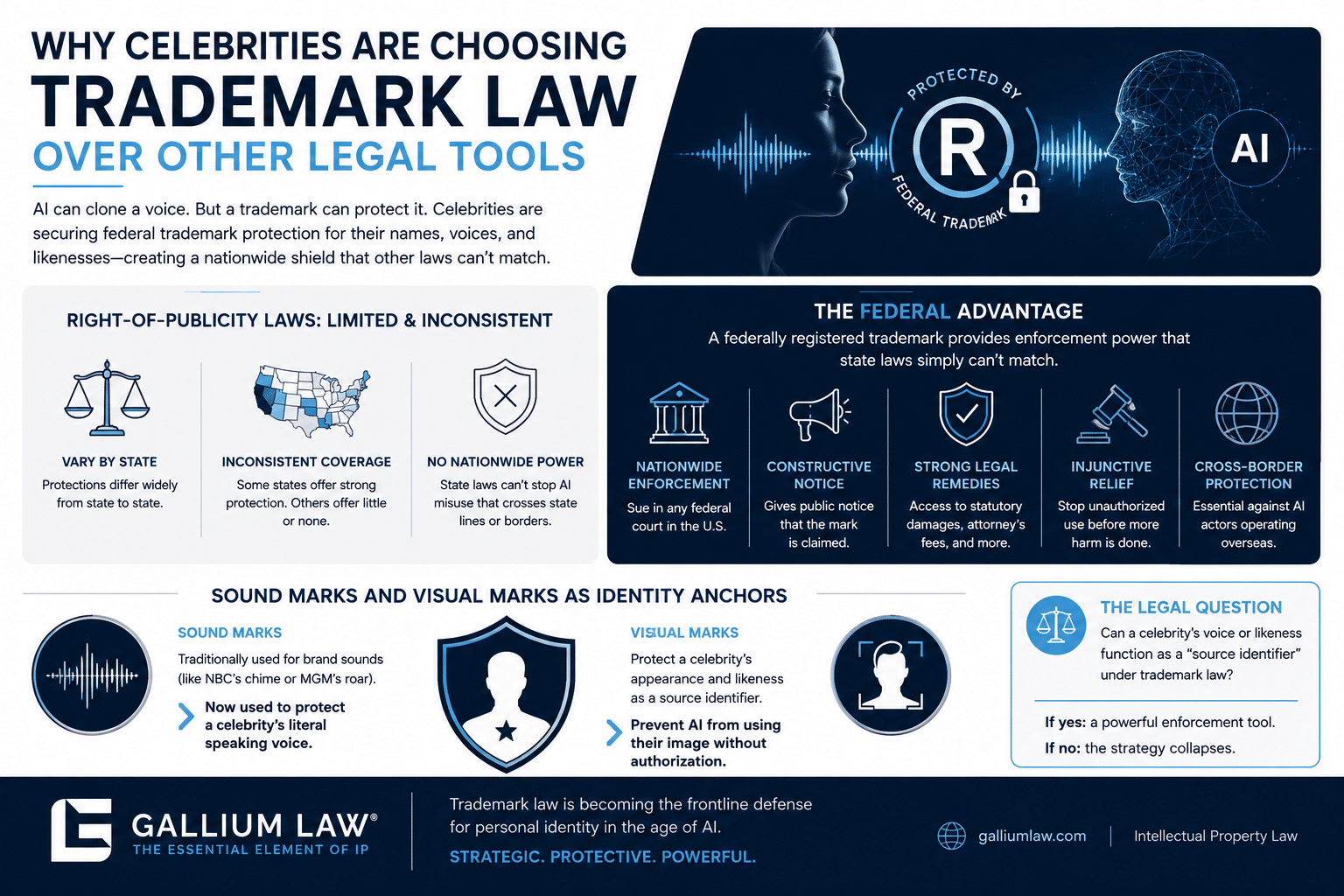
The legal landscape for protecting personal identity against AI exploitation is fragmented. Right-of-publicity laws, which traditionally govern the commercial use of a person’s name, image, and likeness, vary dramatically from state to state. Some states have robust statutes. Others offer minimal protection. And none of them provide the nationwide enforcement power that comes with federal trademark registration.
The Federal Advantage
This is where trademark law’s structural advantage becomes clear. A federally registered trademark allows the owner to bring an infringement action in any federal court in the country. It provides constructive notice to the entire marketplace that the mark is claimed. It opens the door to statutory damages, attorney’s fees, and injunctive relief. For a celebrity whose voice is being cloned by an AI company operating across state lines or overseas, a federal trademark creates an enforcement mechanism that state right-of-publicity laws simply cannot match. Our guide on where and how to register a trademark covers the practical advantages of federal registration.
Sound Marks and Visual Marks as Identity Anchors
The specific types of trademarks being filed are important. Sound marks have existed in trademark law for decades. Think of NBC’s three-note chime or the MGM lion’s roar. But these marks have historically been tied to commercial brands, not individual human voices used as personal identifiers. What Swift and McConaughey are doing is applying the sound mark framework to protect their literal speaking voices as trademarks. Visual marks depicting their physical appearance serve the same function for their likeness. The legal question is whether a celebrity’s voice can function as a “source identifier” in the way trademark law requires. If it can, these registrations become powerful enforcement tools. If courts determine otherwise, the strategy collapses. Making sure your mark is inherently distinctive when filing with the USPTO is a critical first step in any trademark filing, and it becomes even more important when the mark itself is a human voice.
How These Filings Are Stretching Traditional Trademark Boundaries
Trademark law has always been about preventing consumer confusion in the marketplace. The core question in any trademark case is whether consumers are likely to be confused about the source of a product or service. Applying that framework to AI-generated deepfakes requires some creative legal reasoning.
When an AI tool generates audio that sounds exactly like Taylor Swift endorsing a product she has never heard of, is the consumer confused about the “source” of the endorsement? Most people would say yes. But traditional trademark doctrine was built around logos, brand names, and slogans attached to goods and services, not around a person’s biological voice being replicated by a machine. The argument that a celebrity’s voice can serve as a trademark is plausible, but it requires courts to extend existing doctrine into territory it has never occupied.
There is also the question of scope. Trademarks are registered in connection with specific goods and services. McConaughey’s filings in Classes 9 and 41 cover specific categories, but AI-generated content does not always fit neatly into existing classification structures. A deepfake could be used for advertising, entertainment, political speech, or outright fraud, and each use implicates different legal standards. Companies and individuals evaluating whether to pursue simultaneous trademark, trade dress, and design patent protection should be thinking about these classification challenges now, before the case law develops.
The Legislative Backdrop: Why Celebrities Are Not Waiting for Congress
Running parallel to these trademark filings is the NO FAKES Act, a bipartisan federal bill formally known as the Nurture Originals, Foster Art, and Keep Entertainment Safe Act. The bill would create a federal private right of action for individuals whose voice, image, or likeness is replicated without authorization through AI-generated digital replicas. If passed, it would give celebrities and everyday people a direct cause of action in federal court without relying on the inconsistent patchwork of state right-of-publicity laws.
The bill was first introduced as a discussion draft in 2023, formally introduced in 2024, and reintroduced in 2025. It has bipartisan support and backing from major entertainment industry organizations. But it has not been signed into law, and legislative timelines are unpredictable. Celebrities like Swift and McConaughey are clearly not waiting for Congress to act. Their trademark filings represent a strategy for building legal protection right now, using tools that already exist within the IP system.
What This Means for IP Strategy Beyond Hollywood
The instinct to dismiss this trend as a celebrity issue would be a mistake. AI voice cloning technology is not limited to replicating famous singers and actors. The same tools can replicate the voice of a CEO making a product announcement, a physician delivering a diagnosis, or a public-facing influencer endorsing a brand. As synthetic media becomes more accessible, the universe of people who need to think about protecting their voice and likeness is expanding rapidly.
For brands and public figures outside of entertainment, the strategic takeaway is clear: proactive IP protection is no longer optional. Trademark filings, copyright protection, and right-of-publicity strategies should all be evaluated as part of a comprehensive approach to defending personal and brand identity against AI-generated exploitation. Waiting until a deepfake surfaces is already too late. The legal groundwork needs to be in place before the threat materializes.
This is also a moment for IP attorneys and brand strategists to think creatively about the tools available under existing law. The Swift and McConaughey filings show that trademark law, while traditionally designed for a different purpose, can be adapted to address new threats. The firms and practitioners who understand how to navigate these novel applications of trademark protection services will be best positioned to serve clients in the AI era.
Navigate the Intersection of Trademark Law and AI with Gallium Law
The trademark filings from Taylor Swift, Matthew McConaughey, and other public figures represent more than celebrity legal strategy. They signal a fundamental shift in how intellectual property law is being applied to address threats that did not exist a few years ago. Whether these filings ultimately succeed in court will shape the future of trademark doctrine, but the underlying reality is already clear: AI is forcing the IP system to evolve, and the people and companies that move first will have the strongest legal footing.
At Gallium Law, we help clients navigate the full spectrum of trademark, patent, and IP strategy, including emerging challenges at the intersection of intellectual property and artificial intelligence. If you are thinking about how to protect your brand, your voice, or your identity in an AI-driven world, contact Gallium Law today to explore your options.