

Most patent owners discover infringement on Amazon the same way: sales start declining, and they cannot figure out why. Advertising costs climb. Conversion rates drop. The Buy Box starts rotating to unfamiliar sellers. By the time they dig into the data and identify a copycat listing as the cause, the infringing seller has been operating for weeks or months, collecting reviews, building search ranking, and siphoning revenue that should have gone to the patent holder.
The damage during that blind spot is not recoverable. Amazon does not offer retroactive compensation for sales lost to infringers. The APEX program can remove a listing going forward, but it cannot refund the revenue you missed while the knockoff was live. The only way to minimize the loss is to catch the infringement early, which requires a deliberate monitoring system rather than occasional spot checks.
Why Waiting for Problems to Surface Is the Most Expensive Approach
Patent owners who rely on organic discovery of infringement are always reacting. They find a copycat listing after it has gained traction, after it has started pulling customers away, and after the damage has compounded. That reactive posture creates three specific problems.
The Revenue Bleed Is Silent
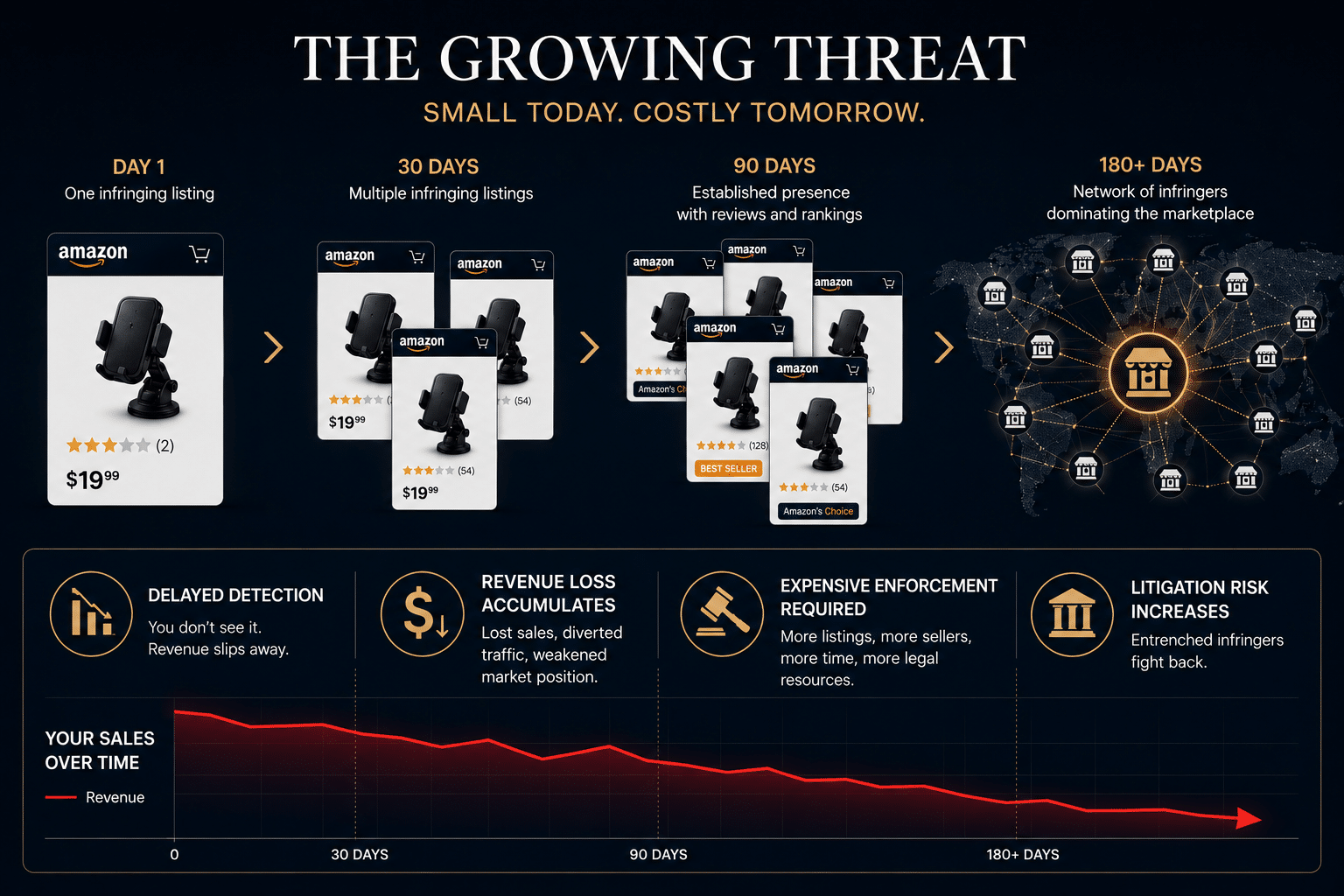
Amazon does not notify you when a competing seller launches a product that infringes your patent. There is no alert, no signal, no dashboard warning. The sales data tells you something is wrong, but it does not tell you why. A 15% drop in unit sales over six weeks could be a seasonal fluctuation, an advertising issue, or a copycat listing that appeared on page one for your primary keywords. Without active monitoring, you are guessing.
Infringers Build Momentum Fast
Every day an infringing listing stays active, it accumulates reviews, organic search ranking, and sales history. That momentum makes the listing harder to displace even after you successfully enforce your patent. A copycat that has been live for three months with 50 reviews and strong keyword rankings does not simply disappear from the customer’s memory when the listing is removed. Some of those customers are lost permanently.
Late Detection Weakens Your Enforcement Position
Timing matters in enforcement. An APEX filing against a seller who listed yesterday is straightforward. An APEX filing against a seller who has been operating for six months, generating revenue, and potentially filing their own IP protections is more complicated. The longer you wait, the more entrenched the infringer becomes and the more resources you need to dislodge them.
Building a Patent Infringement Monitoring System for Amazon
Effective monitoring is not about checking your listings once a week. It is a structured process that combines Amazon’s built-in tools, third-party resources, and regular human review to find infringement as soon as it appears.
Start with Brand Registry and Its Detection Tools
Amazon Brand Registry is the baseline. Enrollment unlocks proprietary search tools that use image recognition and text matching to identify listings that may infringe your intellectual property. The automated detection system flags suspect listings based on patterns it learns from your reports over time, meaning it becomes more effective the more you use it. If you have not yet enrolled, our guide on Amazon trademark registration covers the prerequisites.
But Amazon Brand Registry’s automated tools are designed primarily for trademark and copyright violations. Patent infringement requires a different kind of analysis because it depends on functional similarity, not visual or textual copying. A product can look completely different from yours and still infringe your utility patent. That is why Brand Registry should be your starting point, not your entire monitoring strategy.
Run Targeted Keyword and ASIN Searches
The most reliable way to find patent-infringing products is to search Amazon the way a customer would. Identify the 10 to 15 keywords that are most closely associated with your patented product’s function. Search those keywords weekly and review the results for new listings. Pay attention to products that describe the same functional mechanism your patent covers, even if the branding, images, and price point are completely different from yours.
ASIN tracking adds another layer. If you know the ASINs of previously removed infringers, monitor those sellers’ storefronts for new listings. Sellers who have been removed through APEX or Brand Registry complaints frequently reappear with modified listings, slightly altered product names, or entirely new ASINs that cover the same infringing product. Understanding the broader landscape of trademark risks and strategy on Amazon helps you anticipate these tactics.
Set Up Reverse Image and Product Alerts
Third-party monitoring tools can automate portions of your surveillance. Services that track Amazon listings by keyword, image similarity, or product category can send daily or weekly alerts when new listings match your criteria. These tools are not perfect, and they generate false positives, but they dramatically reduce the amount of manual searching required and ensure that nothing slips through during busy periods when you might otherwise skip a weekly check.
Order and Inspect Suspect Products
A listing alone does not tell you whether a product infringes your patent. The listing might describe a feature that your patent covers, but the actual product could be implemented differently. The only way to know for certain is to purchase the suspect product and examine it. Test buys are a standard practice in patent enforcement, and the evidence they produce, including photographs, measurements, and functional comparisons, strengthens your APEX submission or litigation claim significantly. This physical evidence is the backbone of any serious enforcement action through the APEX program in detail.
What to Do the Moment You Identify an Infringing Listing
Speed matters once you have confirmed infringement. The goal is to move from detection to enforcement action as quickly as your evidence allows.
Document Everything Before the Seller Can React
Capture screenshots of the infringing listing with timestamps. Save the product title, bullet points, images, seller name, seller storefront URL, and ASIN. Download the listing’s full product description. If you ordered a test buy, photograph the product, its packaging, and any inserts. Preserve the order confirmation and shipping information. Infringers who suspect they are being watched will sometimes modify or remove their listings, so comprehensive documentation at the moment of discovery protects your enforcement options.
Decide Between APEX, Licensing, or Litigation
Your response should match the situation. For a single infringing seller on Amazon, APEX is typically the fastest and most cost-effective path to removal. For a seller with significant revenue, a licensing conversation might generate more long-term value than removal. For large-scale infringement across multiple sellers or platforms, federal litigation may be the only way to send a definitive message. Our comparison of patent licensing versus product removal can help you evaluate the trade-offs.
Act Quickly, but Act Correctly
Rushing an APEX filing with a weak claim chart or insufficient evidence wastes your $4,000 deposit and gives the infringer confidence. Take the time to build a strong submission, but do not sit on confirmed infringement for weeks. The sweet spot is measured preparation, typically a few days to assemble a thorough claim chart and supporting evidence, followed by an immediate filing. If you have already been through this process, our guide on what to do after winning an APEX proceeding covers the next steps after a successful outcome.
Creating a Monitoring Calendar That Runs on Autopilot
One-off monitoring catches problems after the fact. A structured monitoring calendar catches them consistently. Here is a framework that balances thoroughness with sustainability.
Weekly: Keyword Searches and Alert Review
Dedicate at least 30 minutes each week to running your core keyword searches on Amazon and reviewing any alerts from third-party monitoring tools. This is the minimum frequency needed to catch new listings before they build significant traction. Assign this task to a specific person on your team so it does not fall through the cracks during busy weeks.
Monthly: Seller Storefront Audits and ASIN Tracking
Once a month, review the storefronts of sellers you have previously flagged or removed. Check whether they have launched new products that might infringe your patent. Review your ASIN tracking list for any changes in seller count or pricing that might indicate new unauthorized offers. This monthly review catches the re-entry tactics that weekly keyword searches sometimes miss.
Quarterly: Full Patent Coverage Review
Every quarter, revisit your monitoring scope. Are there new product categories where your patent might be infringed? Have competitors launched products in adjacent categories that warrant investigation? Has your patent portfolio changed in ways that expand or narrow what you should be monitoring? This quarterly review keeps your monitoring system aligned with your evolving business and IP landscape. A well-maintained monitoring discipline is foundational to any serious Amazon IP enforcement and defense strategy.
When Monitoring Needs Professional Support
Small patent portfolios with one or two products in a narrow category can often be monitored effectively in-house. But as your product line grows, your patent portfolio expands, or the number of infringers increases, the monitoring burden can outpace what an internal team can handle.
IP counsel experienced in Amazon enforcement can take over the monitoring function entirely, combining legal analysis with marketplace surveillance. They can evaluate whether a suspect listing actually infringes your patent claims (a legal judgment that requires claim interpretation), prepare enforcement actions immediately upon discovery, and manage the entire lifecycle from detection through resolution. For patent owners dealing with repeat infringers or large-scale copying, professional monitoring pays for itself by compressing the window between infringement and enforcement. Understanding how combating copycat products through Brand Registry works gives you a clearer picture of what that partnership looks like in practice.
Stop Losing Sales to Infringers You Have Not Found Yet
Every day an infringing listing operates undetected on Amazon is a day of lost revenue, damaged brand equity, and strengthened competition. The patent owners who protect their market share most effectively are not the ones with the strongest patents. They are the ones who find infringement first and act on it fastest.
At Gallium Law, we help patent owners build and execute monitoring and enforcement programs that catches infringement early and resolves it efficiently. Whether you need help setting up a monitoring framework, filing an IP complaint, initiating an APEX proceeding, or pursuing a licensing strategy with infringing sellers, our team brings the Amazon IP experience to get it done. Contact us to protect your sales before the next copycat shows up.