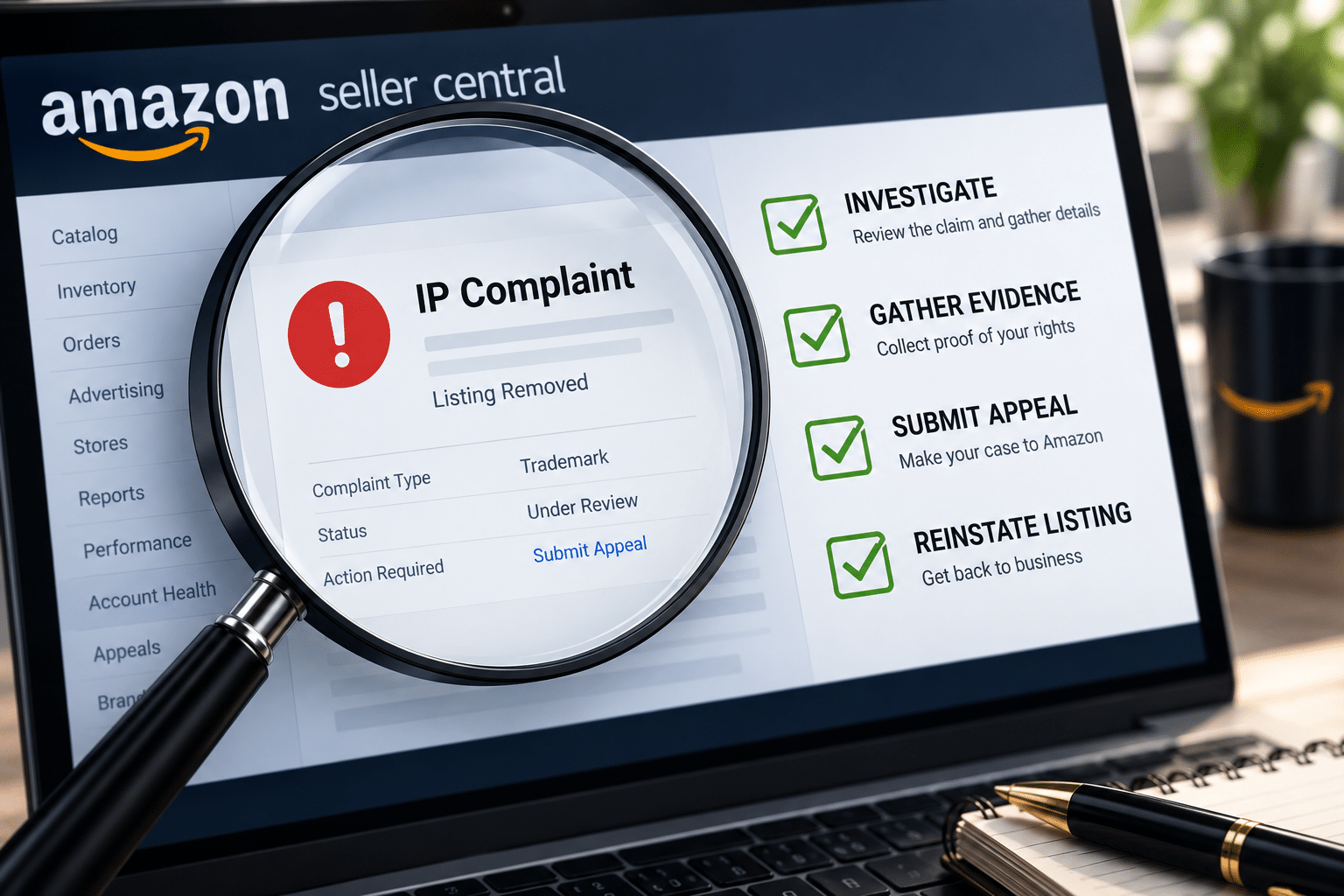



You hold an issued utility patent. An Amazon seller is clearly infringing it. You have the evidence, the registration, and the legal standing to act. The question is not whether you can enforce your patent. The question is how.
Two paths sit in front of you. The first is Amazon’s Patent Evaluation Express (APEX) program, which can remove the infringing listing from the marketplace entirely. The second is a licensing agreement, which keeps the seller on the platform but puts money in your pocket for every unit they sell. Each approach has real advantages. Each carries real trade-offs. And the right choice depends on factors that most patent owners do not consider carefully enough before pulling the trigger.
A Quick Refresher on How APEX Works
APEX is Amazon’s streamlined dispute resolution process for utility patents. The patent owner files a complaint identifying the infringing ASIN, both parties pay a $4,000 deposit, and a neutral evaluator (a patent attorney selected by Amazon) reviews claim charts and written arguments from each side. The evaluator issues a decision in roughly seven weeks. If infringement is found, the listing comes down and the patent owner’s deposit is refunded. If not, the seller keeps their listing and gets their money back. For a detailed walkthrough of the mechanics, see our full APEX guide.
The appeal of APEX is obvious: speed, low cost relative to litigation, and a concrete outcome. But removal is not the only way to win. And sometimes, it is not even the best way.
The Case for Removing Infringing Sellers Through APEX
Total Market Control
Removal gives you something licensing never can: exclusivity. When an infringing listing disappears, those customers flow back to you. Your Buy Box share recovers, your advertising efficiency improves, and your pricing power returns. For patent owners who manufacture and sell their own products on Amazon, this is often the most direct path to maximizing revenue. Every infringing seller removed is a competitor eliminated, and on a marketplace where Buy Box share directly correlates to sales, that math is straightforward.
Sending a Signal to the Market
APEX victories are not public rulings, but the Amazon seller community talks. Sellers who get removed from a listing share that information. Manufacturers who supplied the infringing product take notice. A track record of successful APEX enforcement creates a deterrent effect that discourages future infringers from targeting your patents. That reputational value compounds over time and reduces the total cost of enforcement as fewer sellers are willing to test you.
Simplicity of Execution
Removal is binary. The listing is either up or down. There are no ongoing contractual relationships to manage, no royalty payments to track, no compliance to monitor. For patent owners who want a clean outcome and do not have the infrastructure to manage licensing relationships, APEX removal is the simpler path. If you have recently won an APEX proceeding, you already know how clean that resolution feels.
The Case for Licensing Your Patent Instead
Revenue You Did Not Have to Build
Here is the math that changes the conversation for many patent owners: an infringing seller who is generating $500,000 in annual revenue on your patented product is already doing the manufacturing, inventory management, advertising, and customer service. A licensing agreement that captures 5 to 10 percent of that revenue puts $25,000 to $50,000 in your pocket annually, and you do not have to ship a single unit. Scale that across multiple licensees, and the income stream can exceed what you would earn selling the product yourself, especially if you lack the operational capacity to capture the full market.
Leverage That Only Exists Right Now
A seller who just lost an APEX proceeding (or is facing an imminent one) is in the weakest negotiating position they will ever be in. Their listing is gone or about to be gone. Their inventory is sitting in Amazon warehouses. Their customer base is evaporating. That moment of maximum pressure is the ideal time to offer a licensing deal. The seller gets to resume selling, and you get a royalty stream without lifting a finger on enforcement again. Waiting too long after an APEX win to approach the defeated seller reduces that leverage significantly.
Expanding Your Reach Without Expanding Your Operation
Not every patent owner wants to be an Amazon seller. Some are inventors or R&D companies whose core competency is innovation, not e-commerce operations. Licensing allows these patent owners to monetize their IP through the sellers who are already good at the Amazon game. Multiple licensees competing on the same patented technology can actually expand the overall market for that product category, generating more total royalty income than a single-seller strategy would produce.
The Hidden Costs Most Patent Owners Overlook
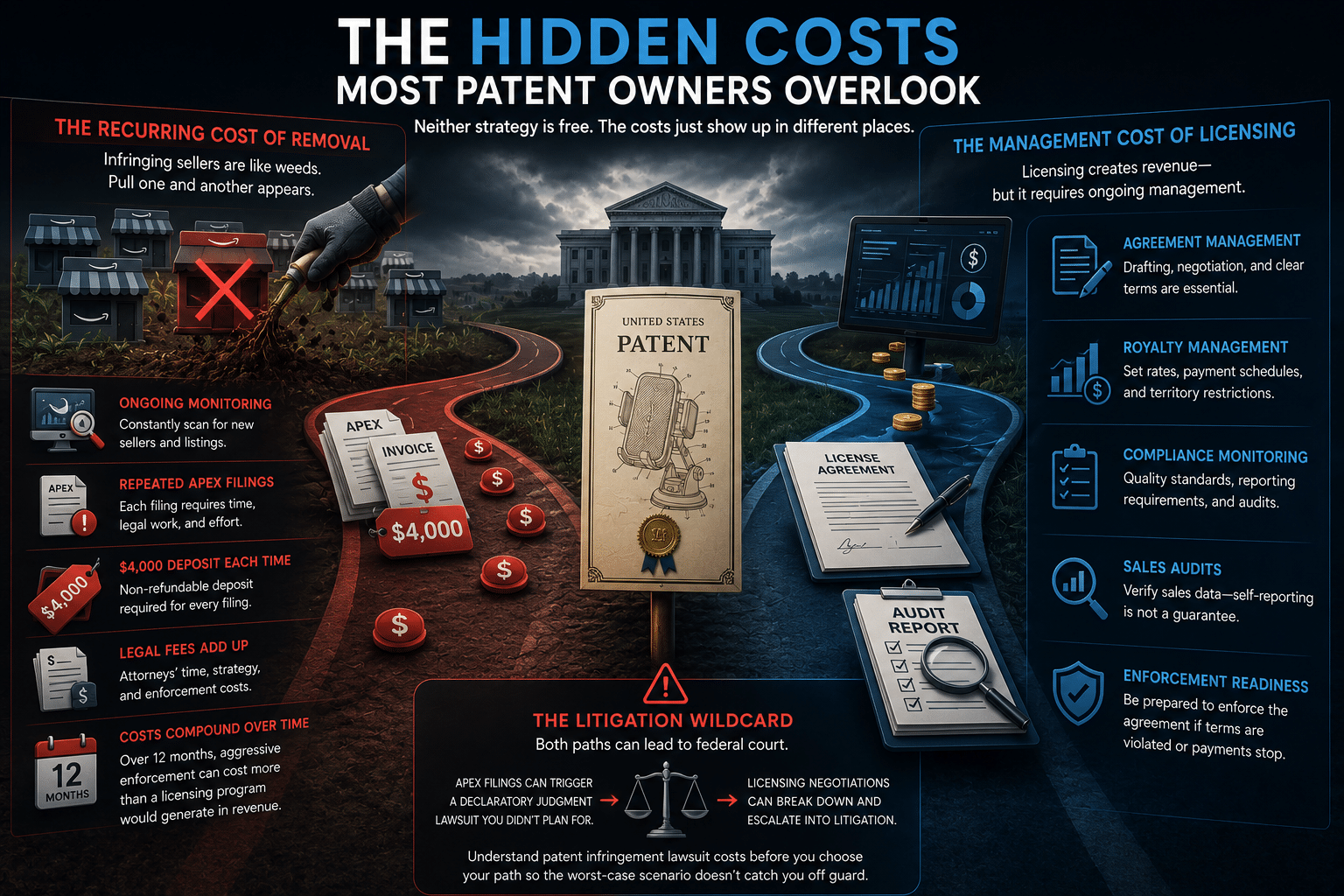
Neither strategy is free. The costs just show up in different places.
The Recurring Cost of Removal
Removing one seller does not end enforcement. Infringing sellers on Amazon are like weeds. Pull one and another appears, sometimes the same seller under a new storefront name, sometimes a different seller sourcing from the same manufacturer. Patent owners who choose the removal path need to commit to ongoing monitoring and repeated APEX filings, each requiring time, legal fees, and the $4,000 deposit. Over twelve months, aggressive enforcement against multiple sellers can cost more than a well-structured licensing program would have generated in revenue.
The Management Cost of Licensing
Licensing agreements require drafting, negotiation, and ongoing compliance monitoring. You need clear terms around royalty rates, payment schedules, quality standards, territory restrictions, and termination clauses. You need a mechanism to audit the licensee’s sales data, because self-reported royalties are only as honest as the seller paying them. And you need to be prepared to enforce the license agreement if a licensee stops paying or violates its terms. None of this is prohibitively complex, but it is not passive income in the way that many patent owners imagine. Our detailed comparison of patent licensing versus product removal on Amazon breaks down these operational realities.
The Litigation Wildcard
Both strategies carry litigation risk. An APEX filing can prompt the accused seller to file a declaratory judgment action in federal court, pulling you into a lawsuit you may not have anticipated. A licensing negotiation can break down and escalate into litigation if the seller decides to challenge your patent’s validity rather than pay royalties. Understanding patent infringement lawsuit costs before choosing either path helps you budget for the worst-case scenario so it does not catch you off guard.
The Hybrid Approach: Why You Do Not Have to Choose Just One
The most sophisticated patent owners do not treat APEX and licensing as an either-or decision. They use both, strategically, depending on the seller and the circumstances.
A common pattern looks like this: the patent owner identifies multiple infringing sellers on Amazon. They file APEX against the most egregious infringers, the ones selling low-quality knockoffs that damage the brand or create safety concerns. Removal is the right call for those sellers because their presence on the platform does more harm than any licensing fee could offset.
For the remaining sellers, particularly those offering a quality product at a reasonable price point, the patent owner extends a licensing offer. These sellers become paying partners rather than enforcement targets. The revenue from their royalties funds ongoing monitoring and enforcement against new infringers, creating a self-sustaining enforcement ecosystem.
This hybrid model requires more strategic planning upfront, but it maximizes both market control and revenue generation. It is the approach we most often recommend to patent owners navigating Amazon IP enforcement and defense.
Five Questions to Ask Before You Decide
Before committing to either strategy, work through these questions with your IP counsel:
First, are you an active seller on Amazon? If yes, removal probably delivers more direct value because every infringing listing removed sends customers back to you.
Second, how many infringing sellers are there? If the number is small, removal is manageable. If you are facing dozens of infringers, licensing a few while removing the worst offenders is more sustainable.
Third, what is the quality of the infringing products? Low-quality knockoffs that generate negative reviews and safety complaints should always be removed. Higher-quality products from established sellers are better candidates for licensing.
Fourth, do you have the operational capacity to capture the full market? If you cannot meet the total demand for your patented product, licensing other sellers to fill that gap ensures the market is served while you collect royalties.
Fifth, what is your risk tolerance for litigation? Both paths carry litigation exposure, but APEX filings are slightly more likely to trigger declaratory judgment actions. If you are not prepared for federal court, factor that into your decision. For sellers on the other side of these complaints, our guide on facing patent infringement accusations on Amazon covers the defense perspective.
Make the Right Enforcement Call with Gallium Law
The decision between APEX removal and patent licensing is not purely legal. It is a business decision that shapes your revenue, your competitive position, and your long-term IP strategy on Amazon. Getting it right requires an honest assessment of your goals, your resources, and the specific infringement landscape you are facing.
At Gallium Law, we advise patent owners on both sides of this equation every day. Whether you need to build an aggressive APEX enforcement campaign, structure a licensing program that generates recurring revenue, or design a hybrid strategy that does both, our team has the Amazon IP experience to guide the decision. Reach out to start the conversation.