


Amazon is the most powerful product launch platform in the world. It gives inventors and small brands instant access to hundreds of millions of shoppers, handles fulfillment, and creates a level of marketplace visibility that would have been unthinkable a generation ago. For product-based businesses, the temptation to list as soon as possible is real. Every day off the platform feels like lost revenue.
But that urgency can be devastating. Amazon is also the most efficient copycat engine ever built. The same marketplace that amplifies your product’s reach also broadcasts every detail of your design to competitors, manufacturers, and opportunistic sellers who specialize in replicating successful products at lower price points. If you launch on Amazon without an issued utility patent, you are handing your competitors a blueprint and stripping yourself of the most powerful tools available to stop them.
This blog explains why the timing of your Amazon launch relative to your patent status matters more than most inventors realize, and what happens when you get it wrong.
What Makes Amazon a Double-Edged Sword for Inventors
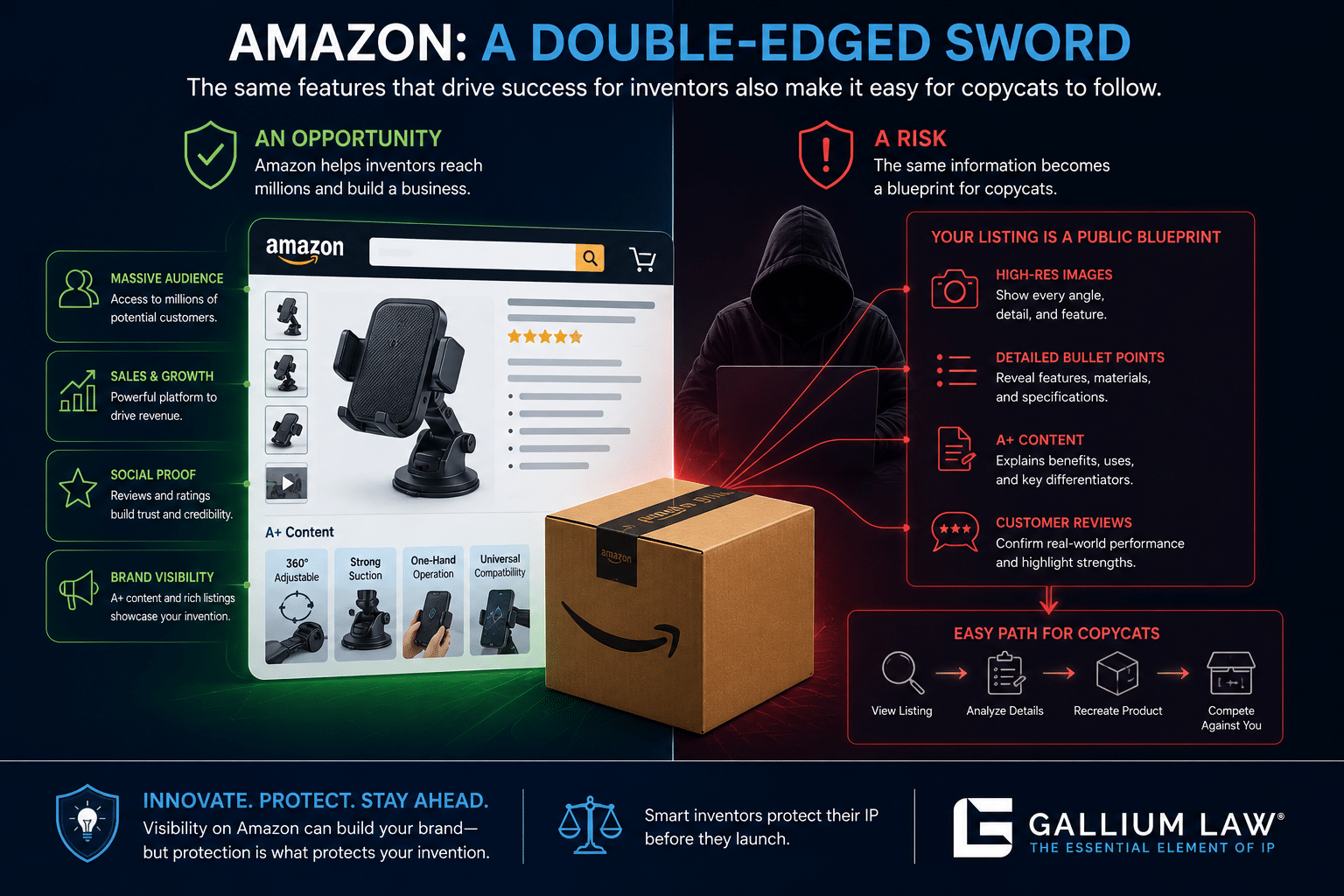
The same features that make Amazon attractive to inventors make it equally attractive to copycats. Your product listing is a public showcase of your invention. High-resolution images, detailed bullet points, A+ content, and customer reviews collectively describe your product’s features, materials, and selling points with a level of detail that a competitor would typically need to reverse-engineer through physical examination.
Speed Favors the Copier
Amazon’s marketplace moves fast. A successful product listing can generate enough sales data and review velocity within weeks to attract the attention of overseas manufacturers who monitor trending ASINs. Within 60 to 90 days of a strong product launch, knockoff versions can appear on the same marketplace, often at a fraction of the price. That timeline is important because the average utility patent takes two to three years from filing to issuance. If you launch before your patent issues, you may be spending the most vulnerable period of your product’s commercial life without any enforceable patent protection.
Visibility Without Protection Is Exposure
There is a fundamental tension between visibility and vulnerability. Every sale you make on Amazon validates your product concept to the market. Your Best Sellers Rank climbs. Your reviews accumulate. Your advertising spend drives traffic. All of that market validation is visible to anyone watching, and on Amazon, plenty of people are watching. Without an issued patent, that visibility becomes exposure. You are proving the market for a product that anyone can copy without legal consequences. Our overview of trademark risks and strategy on Amazon highlights how Amazon’s ecosystem can work against sellers who are unprepared.
Why a Utility Patent Specifically
Not all patents offer the same level of protection, and the distinction matters enormously on Amazon. Utility patents protect how a product works, including its function, structure, and composition. Design patents protect a product’s appearance, covering only its ornamental features. Both have value, but when it comes to stopping copycats on Amazon, utility patents are in a different league.
Design Patents Are Easier to Work Around
A design patent protects a specific visual appearance. A competitor who changes the shape of a handle, adjusts proportions, or modifies surface ornamentation can often avoid infringing a design patent while still copying the core functionality that makes your product valuable. Design patents have their place in a broader IP strategy, but relying on them as your primary defense against Amazon copycats is risky. Our breakdown of how design patents differ from utility patents explains where each type fits.
Utility Patents Protect What Actually Matters
A utility patent protects the functional innovation. If your product’s competitive advantage comes from a unique mechanism, a novel material combination, a specific manufacturing process, or a functional configuration that delivers better results than existing products, a utility patent covers that advantage regardless of how the product looks. Competitors cannot design around a well-drafted utility patent simply by changing colors, shapes, or superficial features. They have to change how the product works, which is a fundamentally harder problem to solve.
APEX Only Works with Issued Utility Patents
Here is the practical reality that many sellers learn too late: Amazon’s primary patent enforcement tool, the Amazon APEX program, only accepts issued U.S. utility patents. Design patents, foreign patents, and pending patent applications do not qualify. If you launch on Amazon with a pending utility patent application, you cannot use APEX to remove infringing listings. You are locked out of the single most efficient enforcement mechanism available on the platform until your patent actually issues.
What Happens When You Launch on Amazon Without an Issued Patent
The consequences of launching prematurely are not hypothetical. They follow a predictable pattern that plays out across product categories every day.
Copycats Appear, and You Cannot Remove Them
Within weeks or months of a successful launch, knockoff products appear on Amazon. They use similar images, comparable titles, and competing feature descriptions. Some sellers source the same product from the same overseas manufacturer you used and simply undercut your price. Without an issued utility patent, you cannot file an APEX complaint. You cannot report the listing through Brand Registry as a patent violation. You can send cease-and-desist letters, but without an enforceable patent behind them, those letters carry no teeth. The copycats know this. Our guide to Amazon’s intellectual property enforcement explains the available tools, but nearly all require an issued patent to be effective.
Price Erosion Destroys Your Margins
When knockoff sellers enter your listing or create competing ASINs, price competition follows immediately. Copycats operating with lower overhead, no R&D costs, and no patent prosecution expenses can afford to sell at razor-thin margins. Your original product, priced to reflect the investment in development, testing, and IP protection, starts losing the Buy Box to sellers offering a cheaper version of the same product. Over time, the price floor drops, and your margins compress until the product is no longer profitable.
You Lose the First-Mover Advantage You Thought You Had
Many inventors assume that being first to market is enough. It is not. On Amazon, first-mover advantage lasts only as long as it takes for a competitor to source a similar product and create a listing. Without patent protection, your head start is measured in weeks, not years. The reviews you accumulated, the brand equity you built, and the advertising spend you invested all become less valuable as the marketplace fills with lower-priced alternatives that borrowed your innovation without consequence.
The Provisional Patent Trap
Provisional patent applications create a dangerous false sense of security for Amazon sellers. A provisional application establishes a filing date and gives you twelve months to file a non-provisional application, but it does not grant any enforceable rights. It does not become a patent. It is not examined by the USPTO. And it does not qualify for APEX or any other Amazon enforcement mechanism.
Too many inventors file a provisional, launch on Amazon the next day, and assume they are protected. They are not. The provisional simply holds your place in line while you prepare the non-provisional utility patent application. If you launch on Amazon during that window, you are operating with a filing date but no enforceable rights, which means you are just as vulnerable as someone with no patent application at all. Understanding the real differences between provisional and non-provisional patents is critical before making any launch decisions.
The Smarter Path: Aligning Your Patent Timeline with Your Launch
The goal is not to avoid Amazon entirely. It is to time your launch so that your issued utility patent is in hand before your product hits the marketplace. This requires planning, patience, and a clear understanding of the patent prosecution timeline.
File Early and Prosecute Aggressively
The average utility patent takes two to three years from filing to issuance, but that timeline is not fixed. Strategic prosecution decisions, including the use of prioritized examination programs like Track One, can significantly accelerate the process. Track One examination can reduce the timeline to six to twelve months for an additional fee. If you know you want to launch on Amazon, building that acceleration into your patent strategy from the start is one of the highest-return investments you can make. Work with experienced patent services counsel who understands the urgency of aligning prosecution timelines with commercial launch windows.
Use the Waiting Period to Build, Not to Sell
The time between filing your patent application and receiving your issued patent is not wasted time. Use it to refine your product, build inventory, develop your brand assets, create optimized listing content, and set up your advertising strategy. Conduct a freedom to operate analysis to make sure you are not infringing someone else’s patents. When your utility patent issues and you are ready to launch, you want to hit the ground running with a polished listing and the legal firepower to protect it from day one.
Consider a Controlled Soft Launch Off Amazon
If you need early revenue or market validation before your patent issues, consider selling through your own website or a smaller marketplace where your product will attract less attention from professional copycats. A direct-to-consumer channel gives you valuable customer feedback and initial sales data without broadcasting your product to the entire Amazon ecosystem. Once your utility patent issues, you move to Amazon with confidence, knowing you have the enforcement tools to defend your position.
Already on Amazon Without a Patent? What to Do Next
If you are already selling on Amazon without an issued utility patent, the situation is not hopeless, but it does require immediate attention. First, review the status of your patent application. If you filed a provisional, make sure you are on track to file the non-provisional before the twelve-month deadline. If your non-provisional is pending, talk to your patent attorney about whether Track One or another acceleration strategy makes sense.
Second, make sure you are not relying solely on a patent for protection. Register your trademark and enroll in Amazon Brand Registry to access other enforcement tools. Build a brand identity that is harder to replicate than a product design. And document everything about your product’s development, sourcing, and sales history, because that documentation becomes valuable if and when you need to enforce your rights. Do not wait to patent your product before it is too late.
Protect Your Invention Before You Put It on the World’s Biggest Shelf
Amazon rewards speed, but patent law rewards patience. The conflict between those two realities is the double-edged sword every product inventor faces. Launching too early feels like capitalizing on momentum. In reality, it often means surrendering your most valuable asset, your innovation, to a marketplace full of competitors who are watching, waiting, and ready to copy anything that sells.
An issued utility patent changes the equation entirely. It gives you access to APEX, creates a credible deterrent against copycats, and provides the legal foundation for every enforcement action you might need to take. At Gallium Law, we help inventors align their patent prosecution strategy with their commercial launch plans so that when their product goes live on Amazon, they are ready to defend it. Contact us to talk through your timeline.