
Buc-ee’s, Beaver’s Mini Mart, and the Line Between Trademark Enforcement and Trademark Bullying

On July 26, 2026, comedian John Oliver dedicated a segment of Last Week Tonight to Buc-ee’s, the Texas-based gas station and travel center chain known for its massive locations and cartoon beaver mascot. Oliver highlighted something that had been quietly brewing in courtrooms across the country: Buc-ee’s has filed roughly a dozen trademark infringement lawsuits against small businesses, many targeting companies that use animal mascots or beaver-related branding that Buc-ee’s claims is too similar to its own.
Oliver’s response was characteristically provocative. He launched “Buc-Off” parody merchandise featuring a beaver logo that was, by design, more similar to Buc-ee’s branding than most of the businesses Buc-ee’s had actually sued. He dared them to take legal action. Buc-ee’s general counsel responded publicly that the company had no plans to sue Oliver or HBO.
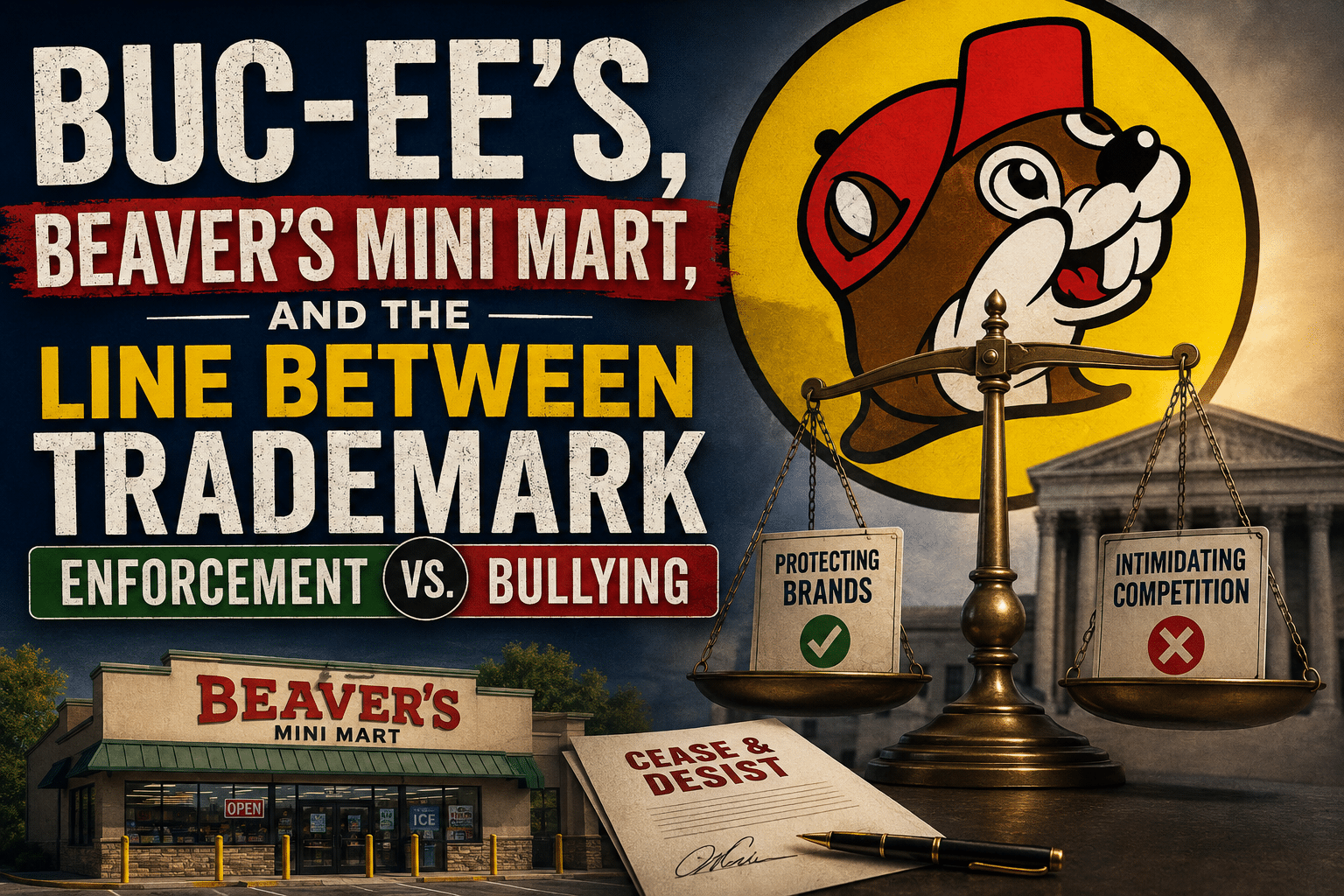
Two days later, on July 28, 2026, Buc-ee’s filed a trademark infringement lawsuit in the U.S. District Court for the Southern District of Ohio against Hanes Road Carryout, a family-owned convenience store doing business as Beaver’s Mini Mart in Beavercreek, Ohio. The nine-page complaint alleges that the store’s cartoon beaver mascot, its use of red as a predominant color, and the name “Beaver’s” create a likelihood of confusion with Buc-ee’s trademarks.
The timing, the target, and the contrast with the Oliver situation have turned this into a national story about where legitimate trademark enforcement ends and trademark bullying begins. At Gallium Law, we work with both brand owners who need to protect their marks and businesses that find themselves on the receiving end of aggressive enforcement actions. This case sits at the intersection of several important trademark principles that every business owner should understand.
The Case Against Beaver’s Mini Mart
Buc-ee’s complaint against Beaver’s Mini Mart rests on the theory that three elements of the store’s branding, taken together, create consumer confusion with Buc-ee’s: a cartoon beaver mascot with wide eyes and a smile, the use of red as a predominant branding color, and the word “Beaver’s” in the store name. Buc-ee’s holds federal trademark registrations on its beaver logo and wordmarks, and the company argues that Beaver’s Mini Mart is free-riding on the goodwill Buc-ee’s has built in those marks.
The facts on the ground complicate that theory considerably. Beaver’s Mini Mart is a small, family-owned convenience store operated by Vik Boparai’s family. The store has used beaver-related branding for years. It sits in Beavercreek, Ohio, a city whose identity is deeply tied to beavers. The local high school mascot is “Bucky the Beaver,” the football team is the “Battling Beavers,” and six-to eight-foot beaver statues are scattered throughout the town. Buc-ee’s, by contrast, opened its first Ohio location in Huber Heights, roughly 16 miles from Beaver’s Mini Mart, in April 2026.
Ohio Governor Mike DeWine responded publicly: “They need to dismiss this lawsuit. This is ridiculous. It is Beavercreek for heaven’s sake.” A GoFundMe campaign for Beaver’s Mini Mart’s legal defense raised more than $48,000, and the local community organized “cash mobs” to support the store.
What Trademark Bullying Looks Like in Practice
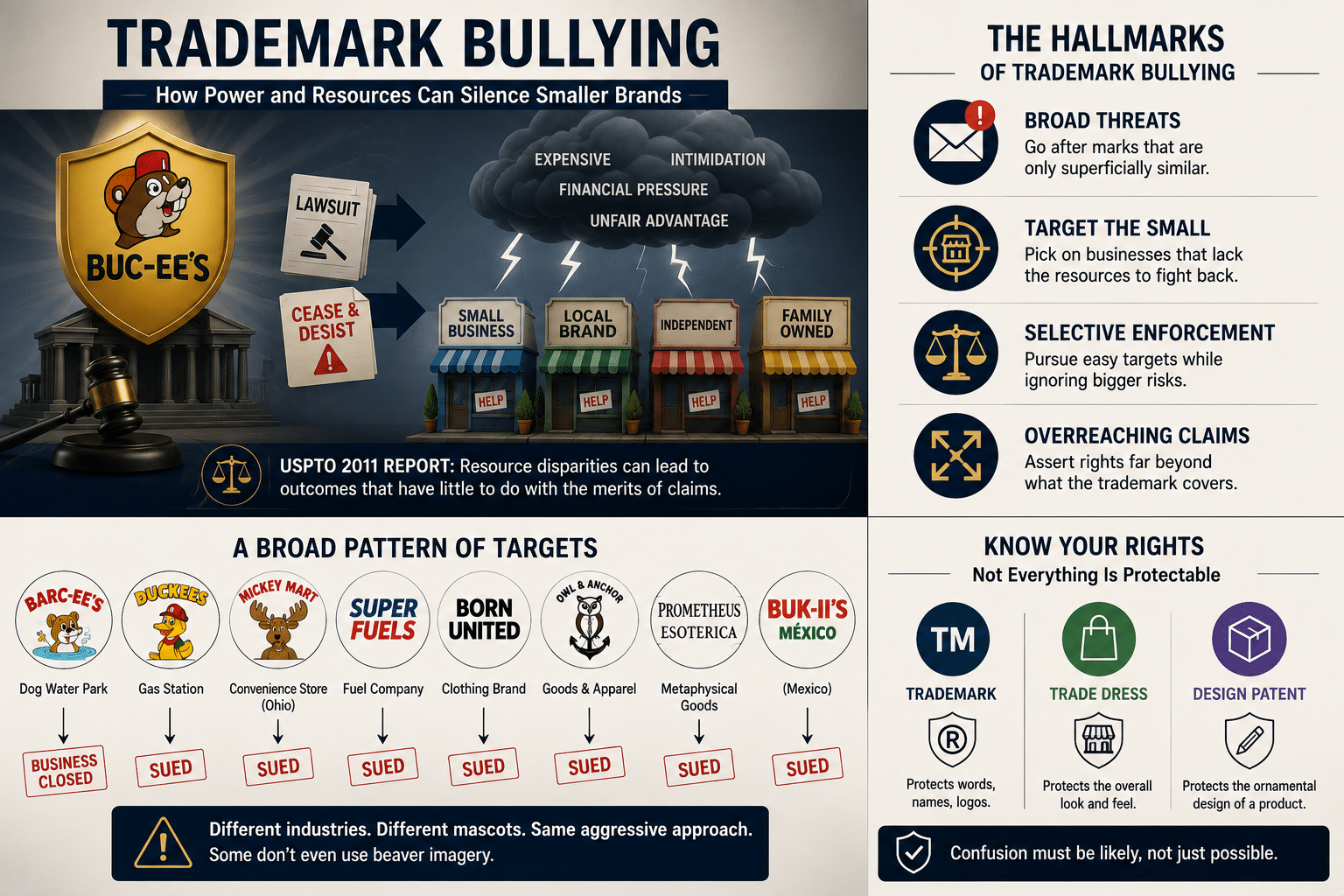
Trademark bullying is not a formal legal term, but it describes a recognized pattern of behavior: a large trademark holder uses its resources and litigation budget to pressure smaller businesses into abandoning their branding, regardless of whether a genuine likelihood of confusion exists. The U.S. Patent and Trademark Office studied this issue in a 2011 report and acknowledged that the disparity in litigation resources between large and small trademark holders can lead to outcomes that have little to do with the merits of the underlying claims.
The hallmarks of trademark bullying typically include filing lawsuits or sending cease-and-desist letters against businesses whose marks are only superficially similar, targeting businesses that lack the financial resources to mount a defense, pursuing enforcement selectively against easy targets while ignoring larger companies that present the same or greater risk of confusion, and asserting rights that extend well beyond what the trademark registration actually covers.
Buc-ee’s enforcement history raises questions on several of these fronts. The company has targeted Barc-ee’s, a dog water park that eventually closed. It has sued Duckees, a gas station using a duck mascot. It filed against Mickey Mart in Ohio, a convenience store chain whose mascot is a moose, not a beaver. It has pursued Super Fuels, Born United, Owl & Anchor, Prometheus Esoterica, and Buk-ii’s in Mexico. The breadth of these targets, some of which do not even use beaver imagery, is what drew Oliver’s attention in the first place. Understanding how trademarks, trade dress, and design patents differ is essential context here, because the strength of any infringement claim depends on whether the elements at issue are actually protectable and whether the accused mark genuinely creates confusion.
The Prior Use Problem Buc-ee’s Cannot Ignore
One of the most significant legal issues in the Beaver’s Mini Mart case is prior use. Under U.S. trademark law, rights are generally acquired through use in commerce, not solely through federal registration. If Beaver’s Mini Mart has been using its beaver branding continuously in the Beavercreek area since before Buc-ee’s entered the Ohio market, it may have a strong prior use defense.
The prior use doctrine allows a party that was first to use a mark in a particular geographic area to continue using it in that area, even if a different party later obtains a federal registration for a similar mark. The rationale is straightforward: the first user built goodwill in that mark in that community. Forcing them to rebrand because a larger company later expanded into the area would punish the business that established the association in consumers’ minds first.
Buc-ee’s opened its first Ohio location in Huber Heights in April 2026, just months before filing this lawsuit. Beaver’s Mini Mart, operating in a town literally named for beavers, has been there far longer. If the store can document its continuous use of beaver-themed branding predating Buc-ee’s Ohio presence, the prior use defense could significantly undercut Buc-ee’s claims. This is one of many reasons why understanding where and how to register a trademark matters for small businesses. Federal registration strengthens your position enormously, but the absence of one does not mean the absence of rights.
Likelihood of Confusion: Why This Case May Be Weaker Than It Looks
Every trademark infringement claim ultimately turns on whether there is a likelihood of confusion between the two marks. Courts evaluate this using a multi-factor test that considers the strength of the plaintiff’s mark, the similarity of the marks, the proximity of the goods or services, evidence of actual confusion, the sophistication of consumers, and several other factors.
In the Beaver’s Mini Mart case, Buc-ee’s faces challenges on multiple fronts. The stores are fundamentally different in scale, format, and consumer perception. Buc-ee’s locations are massive, purpose-built travel centers spanning 50,000 to 75,000 square feet, with dozens of fuel pumps and destination-style retail. Beaver’s Mini Mart is a small, neighborhood convenience store. The question of whether a reasonable consumer would walk into Beaver’s Mini Mart and believe they were in a Buc-ee’s facility, or that the two are affiliated, seems difficult to answer in the affirmative.
The geographic context adds another layer. In a town called Beavercreek, where beaver imagery is woven into the local identity from the high school mascot to public art, a small store calling itself “Beaver’s” and using a beaver image carries a fundamentally different connotation than it would in a city with no beaver connection. The mark is arguably descriptive of the store’s geographic setting, which weakens Buc-ee’s argument that the name and imagery are being used to trade on Buc-ee’s reputation. Building a brand that is making a trademark inherently distinctive is critical precisely because marks that are descriptive or geographically common face steeper hurdles in enforcement.
The Selective Enforcement Paradox
Perhaps the most damaging element of this story for Buc-ee’s is the contrast between its response to John Oliver and its treatment of Beaver’s Mini Mart. Oliver created merchandise with a beaver logo deliberately designed to be more similar to Buc-ee’s mark than most of the businesses Buc-ee’s has sued. He broadcast it to millions of viewers and explicitly dared the company to take action. Buc-ee’s declined.
Two days later, it sued a family-owned convenience store. The optics are devastating, and the legal implications may be equally significant. Selective enforcement can undermine a trademark holder’s position in several ways. First, it suggests that the enforcement decisions are driven by the target’s ability to fight back rather than by the actual risk of consumer confusion. Second, it can be used by defendants to argue that the plaintiff does not genuinely believe its mark is being harmed, because it tolerates far more prominent uses by parties with deeper pockets. We analyzed a similar dynamic in the Patagonia v. Pattie Gonia trademark dispute, where a major brand’s enforcement actions against a smaller party raised questions about proportionality and the scope of trademark rights.
Trademark law does impose a duty to police your marks. Failure to enforce against known infringers can weaken your rights over time through a theory called acquiescence or, in extreme cases, contribute to a finding that the mark has become generic. But this duty does not require filing lawsuits against every business that uses a vaguely similar concept. It requires reasonable, consistent enforcement against uses that genuinely create a likelihood of confusion. The key word is consistent. When a company sues small shops but publicly declines to challenge a nationally televised parody that is objectively more similar to its mark, the consistency argument falls apart.
What Oliver’s Parody Defense Reveals About Trademark Scope
Oliver’s “Buc-Off” merchandise also introduces the parody defense into this broader conversation. Parody is a recognized defense to trademark infringement because parody, by its nature, requires the audience to recognize the original mark while simultaneously understanding that the new use is a commentary on or joke about it. The audience is not confused about the source of the goods. They know exactly what is being referenced and that the parody is not affiliated with the original brand.
Buc-ee’s likely understood that suing Oliver would invoke the parody defense and create even more negative publicity. The First Amendment protections for parody and commentary are well established, and courts have consistently held that trademark rights do not extend to silencing criticism or humor directed at a brand. The practical takeaway is that trademark rights have real limits, and understanding those limits is essential for both enforcement and defense. A thorough understanding of your intellectual property rights and enforcement options helps clarify where those boundaries fall and what remedies are actually available when a dispute arises.
What Small Businesses Should Do When Facing a Trademark Threat
The Beaver’s Mini Mart situation is not unusual. Small businesses across the country often receive cease-and-desist letters and face trademark infringement lawsuits from larger companies. The instinct to simply comply and rebrand, to avoid the cost and stress of litigation, is understandable. But compliance is not always the right move, and it is certainly not the only option.
Document Your History of Use
If your branding predates the plaintiff’s use in your geographic area, gather every piece of evidence that establishes your timeline: business registration records, marketing materials, signage photos, customer receipts, social media posts, local press coverage, and anything else that shows when and where you began using the mark. This documentation is the foundation of a prior use defense and can be decisive in negotiations before a case ever reaches a courtroom.
Evaluate the Actual Likelihood of Confusion
Not every similarity between marks creates actionable confusion. The analysis requires looking at the full context: the nature of the goods and services, the sophistication of the customers, the channels of trade, the strength of the plaintiff’s mark in your area, and the overall commercial impression of both marks. A family convenience store in Beavercreek using a beaver image may be a fundamentally different proposition than a competitor gas station chain adopting a nearly identical beaver mascot to capture highway traffic. Understanding trade dress protection and how it interacts with trademark rights helps businesses evaluate the strength of the claims against them.
Understand That Registration Is Not a Guarantee of Enforcement
A federal trademark registration gives the holder a presumption of validity and nationwide constructive notice of the mark. It does not guarantee that every enforcement action will succeed. The registration must still be weighed against fair use defenses, prior use rights, the actual likelihood of confusion, and the scope of the goods and services covered. Knowing how international trademark classifications work and what your registration actually covers is important for both offensive and defensive trademark strategy.
Get Legal Counsel Before Responding
The worst thing a small business can do is ignore a cease-and-desist letter or, conversely, agree to demands without understanding the legal landscape. An experienced trademark enforcement strategies attorney can evaluate the strength of the claims, identify available defenses, and help you decide whether to negotiate, fight, or make strategic modifications to your branding that preserve your rights without conceding the entire dispute.
Enforcement Requires Judgment, Not Just Resources
The Buc-ee’s v. Beaver’s Mini Mart lawsuit, set against the backdrop of John Oliver’s very public dare, is a case study in what happens when trademark enforcement loses its connection to the purpose of trademark law. The Lanham Act exists to prevent consumer confusion, not to give large brands a tool for eliminating any business that happens to share a thematic element with their branding.
Buc-ee’s has legitimate trademarks and a legitimate interest in protecting them. But trademark enforcement requires proportionality and consistency. Filing suit against a family store in a town called Beavercreek while publicly declining to challenge a nationally televised parody that is deliberately more similar to its mark does not reflect proportional enforcement. It reflects a strategic calculation about who can afford to fight back.
At Gallium Law, we help both brand owners and businesses on the receiving end of enforcement actions navigate these situations with clear strategy and a firm understanding of the law. Whether you need to protect your trademarks against genuine infringement or defend your business against claims that overreach the scope of someone else’s rights, the legal analysis is the same: what does the law actually protect, and where does your position stand? If you are dealing with a trademark dispute on either side, contact our intellectual property team so we can evaluate your options.