
Van Leeuwen v. Rebel Creamery: What a $23.8 Million Trade Dress Verdict Means for Every Brand Owner

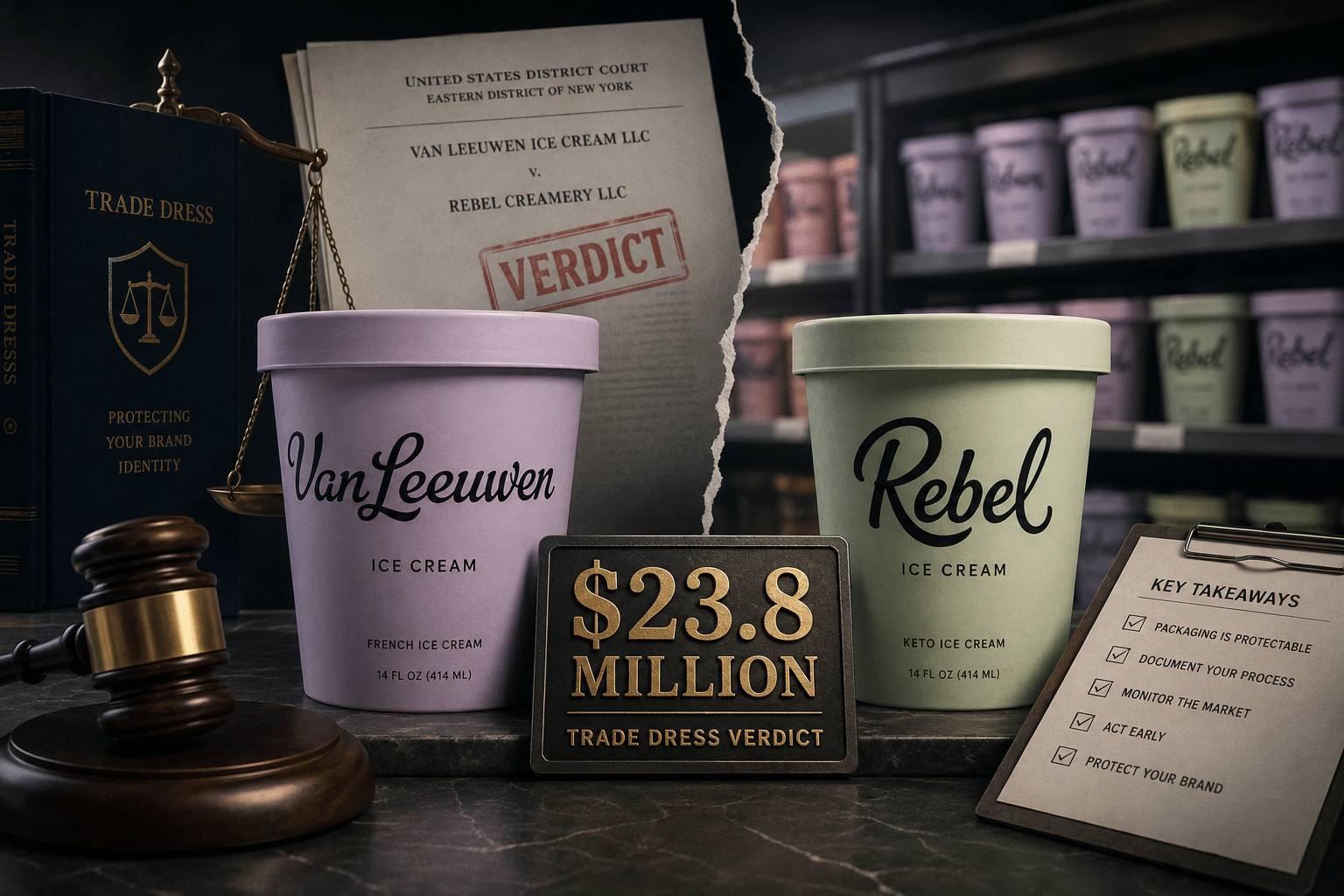
A federal judge just ordered a Utah-based ice cream company to hand over nearly $23.8 million in profits and completely redesign its product packaging after finding that it deliberately copied a competitor’s look. The case is Van Leeuwen Ice Cream LLC v. Rebel Creamery LLC, and the July 16, 2026, ruling from Judge Eric Komitee in the Eastern District of New York is one of the largest trade dress verdicts in recent consumer products history.
The decision is significant not because two ice cream brands went to war over pastel-colored cartons. It is significant because the court articulated, with unusual clarity, how product packaging becomes a protectable asset, what happens when a competitor copies that packaging, and how severely a court can punish intentional copying. For any business that relies on its product’s visual identity to compete on shelves or in online listings, this case is required reading.
At Gallium Law, we frequently work with brand owners who face exactly the situation Van Leeuwen confronted: a competitor launches a product with packaging or branding that is uncomfortably similar to theirs, and they need to understand whether they have enforceable rights and what enforcement looks like in practice. This case provides a clear roadmap for both sides of that equation.
The Five-Year Fight Over a Pint of Ice Cream
Van Leeuwen started as a Brooklyn ice cream truck in 2008 and grew into a nationally distributed brand known for its premium, artisanal positioning. In 2016, the founders hired Pentagram, one of the world’s most prominent design firms, to create packaging for national wholesale distribution. The design team researched competing brands, presented seven concepts, and the founders selected a final look defined by four specific elements: monochromatic cartons with matching lids, pastel color palettes, oversized black script lettering, and a minimalist overall layout.
Within six months of adopting the new packaging, Van Leeuwen’s sales velocity increased by nearly 50%, according to a report by QZ. The design became closely associated with the brand and was widely covered in the press as a case study in premium food branding.
Rebel Creamery launched in late 2017 via Kickstarter, positioning itself as a keto-friendly, low-sugar ice cream. When its products hit shelves, they featured monochromatic cartons with matching lids, pastel colors, large black script lettering, and minimalist layouts. The similarities were striking enough that a Wegmans buyer warned Rebel’s co-founder, Austin Archibald, before the brand’s first retail launch that the palckaging resembled Van Leeuwen’s. Rebel made no changes.
Van Leeuwen filed suit in 2021, and the case went to a bench trial before Judge Komitee. As Inc. reported, the judge found Rebel’s founders’ claim that they independently arrived at the same design choices to be “clearly fabricated,” calling the probability of an innocent coincidence “infinitesimal.”
Trade Dress: The Legal Framework Behind Packaging Protection
This case was not a trademark dispute in the traditional sense. Van Leeuwen did not allege that Rebel copied its name or logo. The claim was that Rebel copied the overall commercial impression of its packaging. That type of protection falls under trade dress law, a branch of trademark law that protects the total visual image and overall appearance of a product or its packaging.
Trade dress is one of the most powerful and least understood forms of intellectual property protection. Unlike a registered trademark that protects a specific word or symbol, trade dress protects the combination of design elements that, taken together, identify the source of a product in the minds of consumers. Our detailed explanation of what trade dress is and how it functions breaks down the core concepts, but the Van Leeuwen case puts them into action in a way that is worth examining closely.
Individual Elements Do Not Need to Be Unique
Rebel’s primary defense was that each individual element of Van Leeuwen’s packaging was commonplace in the food industry. Pastel colors are everywhere. Black script lettering is not novel. Minimalist design is a widespread aesthetic trend. The court rejected this argument directly. As Loeb & Loeb’s analysis noted, trade dress protection extends to the overall combination of design elements and the commercial impression they create, not to any single element in isolation. The fact that individual components appear elsewhere in the marketplace does not defeat protection when the specific combination has acquired distinctiveness and identifies a particular source to consumers.
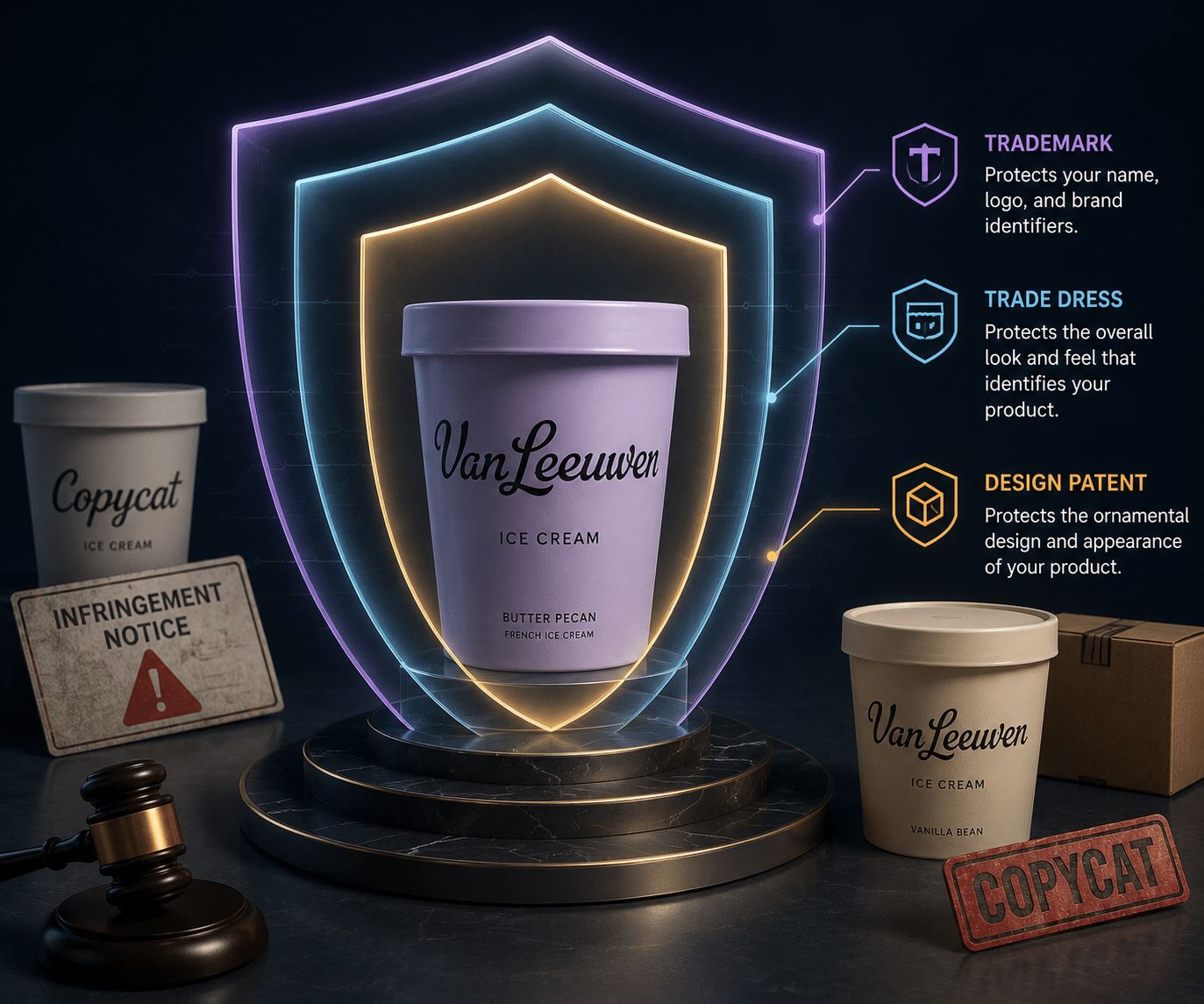
This is a critical distinction for brand owners to understand. You do not need to invent a color or a typeface to have protectable trade dress. You need a distinctive combination that consumers associate with your brand. Understanding how trademarks, trade dress, and design patents overlap and differ helps clarify where these forms of protection apply and where they complement each other.
Distinctiveness Must Be Earned (and Documented)
For product packaging trade dress, the owner must demonstrate that the design has acquired “secondary meaning,” an assertion that consumers have come to associate that specific trade dress with a particular source. Van Leeuwen proved this through testimony from industry participants, press coverage of the packaging as a brand identifier, the sales increase following the redesign, and a consumer survey showing a 34.3% net confusion rate between the two brands’ packaging.
The Pentagram design process was equally important. Van Leeuwen arrived in court with the original creative brief, all seven design concepts that were presented, records of the decision-making process, and testimony from the lead designer, Natasha Jen. That documentation created an unassailable timeline of originality. Natasha Jen put it plainly: “Save what was presented. Save what was rejected. The process is part of the evidence.” Ensuring your brand identity is making your trademark inherently distinctive from the start creates a foundation for this kind of protection.
What Destroyed Rebel’s Defense: The Missing Paper Trail
If Van Leeuwen’s documentation was a case study in preparation, Rebel Creamery’s was a cautionary tale. The Archibalds testified that they designed their packaging in Adobe Illustrator. They produced no sketches. No mockups. No earlier drafts. No rejected concepts. No internal emails discussing design direction. Only the finished product.
That absence of process documentation, combined with the Wegmans buyer’s pre-launch warning and the overwhelming visual similarity between the two brands’ packaging, led Judge Komitee to conclude that Rebel’s story of independent creation was fabricated. The court also rejected Rebel’s “good faith remote user” defense, which requires proving both that the trade dress was adopted innocently and that the use was geographically remote from the plaintiff’s market. Rebel could not establish either element.
The practical takeaway here is urgent for every brand owner and every product development team: your design process is evidence. If you are ever challenged on trade dress, you will need to prove how and why you arrived at your design choices. Companies that maintain that documentation are in a fundamentally different litigation position than companies that do not. This applies equally to the offensive side. If you plan to enforce your own trade dress rights, thorough documentation of your original design process is what transforms a strong argument into an airtight one. Our overview of trade dress protection explains the legal elements you need to satisfy and why this documentation matters.
Reverse Confusion: When the Bigger Competitor Makes You Look Like the Copycat
One of the most interesting aspects of this case is the court’s finding of “reverse confusion.” In a typical trademark infringement case, the concern is that a smaller or newer brand will confuse consumers into thinking it is affiliated with the larger, established brand. Reverse confusion works the other way: a larger brand’s extensive marketing and distribution saturates the market to the point where consumers start to think the original brand is the imitator.
Rebel Creamery expanded aggressively into major national retailers while Van Leeuwen was still building its wholesale presence. The court found evidence that this expansion created real-world consequences: a Publix buyer raised concerns about the similarity between the two brands’ packaging before declining to stock Van Leeuwen. The original brand was losing shelf placement because the retailer saw it as a copycat. That is reverse confusion in action, and it is exactly the kind of competitive harm that trade dress law is designed to prevent.
This dynamic is not limited to ice cream. Any brand that builds a distinctive visual identity and then watches a better-funded competitor adopt a similar look faces the same risk. The competitor’s larger marketing budget and broader distribution can flip the narrative in the consumer’s mind. Understanding your full range of intellectual property enforcement options is essential for catching and responding to this type of infringement before the narrative is already reversed.
How the Court Calculated $23.8 Million in Damages
The damages award in this case is worth understanding because it reflects a powerful but often overlooked remedy under the Lanham Act: disgorgement of the infringer’s profits. Unlike compensatory damages, which attempt to measure what the plaintiff lost, disgorgement measures what the defendant gained from the infringing conduct. Once the plaintiff establishes the defendant’s gross revenue from the infringing products, the burden shifts to the defendant to prove which portion of those profits was attributable to factors other than the infringement.
The court calculated Rebel’s total profits from the affected sales at $35.5 million. Rebel argued that its keto-friendly positioning, not its packaging, drove consumer purchases. The court agreed that some portion of the demand stemmed from Rebel’s “better-for-you” positioning and reduced the award by one-third, resulting in a final judgment of $23.785 million. Rebel failed to carry its burden of proving a greater apportionment.
This framework matters because it puts the burden of proof in the right place. The brand that did the copying has to prove how much of its success came from something other than the copied design. If it cannot, the full profit figure stands. That is a massive financial exposure for any company that launches with packaging inspired a little too closely by a competitor’s look.
What Brand Owners Should Do Right Now
At Gallium Law, we’ve handled numerous trade dress disputes, and this ruling reinforces the principles we continue to advise our clients to follow from day one. The brands that win these cases are the ones that treated their visual identity as protectable intellectual property from the moment they created it. The brands that lose are the ones that treated packaging as marketing collateral rather than a legal asset.
Invest in a Documented Design Process
Whether you work with a design agency or develop packaging in-house, maintain a complete record of the creative process. Save the brief, the research, the concepts that were explored and rejected, and the rationale behind the final choice. This documentation serves two purposes: it proves originality if you need to enforce your trade dress, and it demonstrates good faith if your design is ever challenged as infringing someone else’s. The difference between Van Leeuwen’s position and Rebel’s position in this case came down to who could show their work.
Build Layered IP Protection Around Your Brand Identity
Trade dress protection is powerful, but it is strongest when it is part of a broader intellectual property portfolio. A registered trademark protects your brand name and logo. A design patent can protect specific ornamental features of your product. Trade dress protects the overall commercial impression. These protections work together, and our analysis of pursuing trademark, trade dress, and design patent protection simultaneously explains how brand owners can layer these rights for maximum coverage. Understanding trademark protection services from a strategic perspective means considering all available protections, not just the most obvious.
Monitor the Market and Act Early
Van Leeuwen noticed Rebel’s packaging years before filing suit and initially hesitated because the company had limited capital and had never litigated. That delay allowed Rebel to expand into major retailers and build the kind of market presence that made reverse confusion possible. The lesson is not that every similarity warrants a lawsuit, but that documented awareness and early action, even if it starts with a cease-and-desist letter rather than litigation, preserves your enforcement options and limits the damage. Knowing where and how to register a trademark and having your registrations in place before a conflict arises is the foundation that makes enforcement possible.
Your Packaging Is More Than a Marketing Decision
The Van Leeuwen v. Rebel Creamery ruling is a landmark trade dress case because of its size, its clarity, and the direct line it draws between design documentation, intentional copying, and financial consequences. A $23.8 million disgorgement award and a permanent injunction requiring a complete packaging redesign send an unmistakable message to every brand in every product category: the visual identity you create for your product is a legal asset, and copying someone else’s can be one of the most expensive mistakes a business makes.
At Gallium Law, we help brand owners protect their visual identities through trade dress strategy, trademark registration, and design patent filings that create enforceable rights before a competitor ever shows up with a similar look. If you are launching a new product, rebranding an existing one, or watching a competitor’s packaging creep uncomfortably close to yours, reach out to build a protection strategy that holds up in court.