
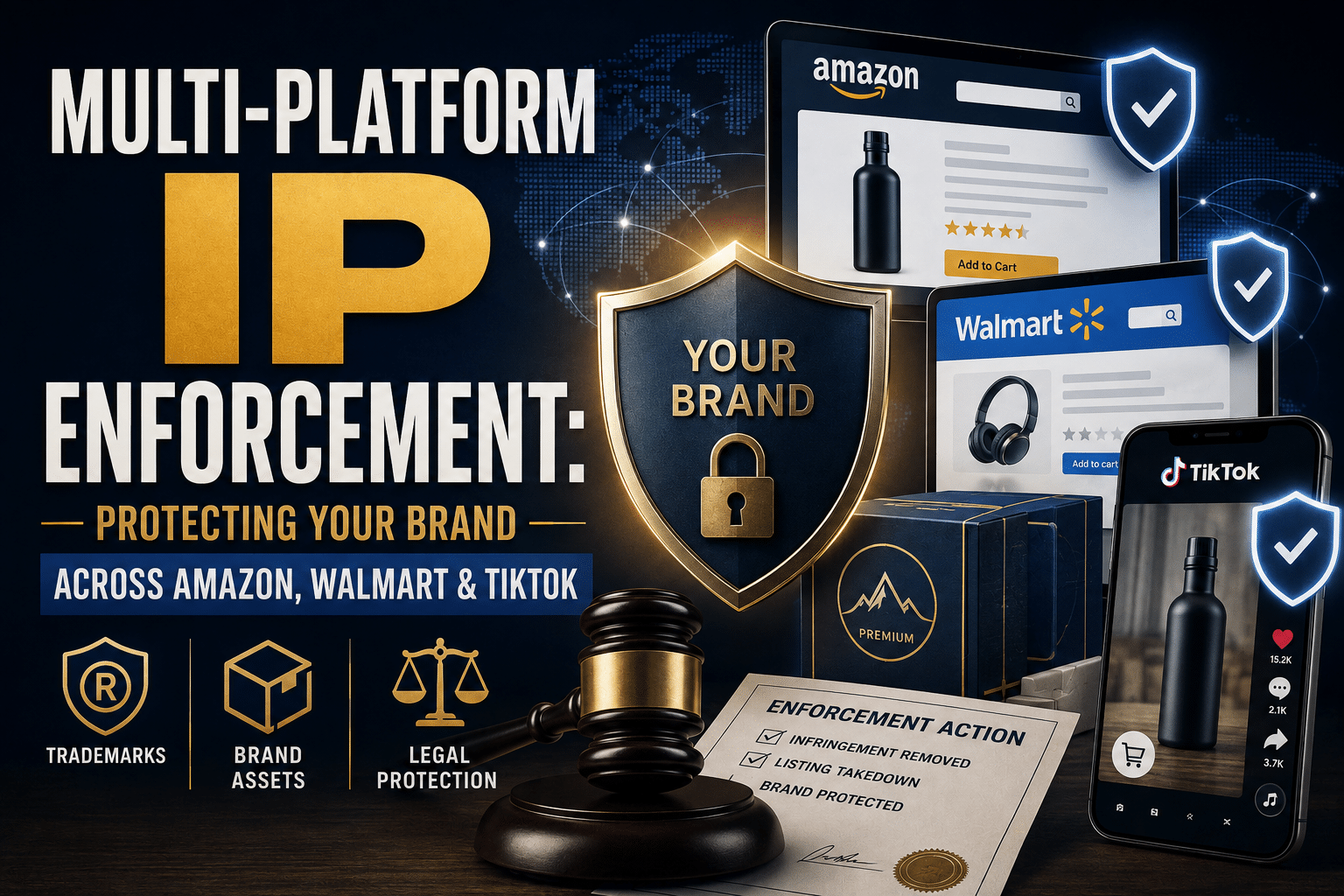
Multi-Platform IP Enforcement: Protecting Your Brand Across Amazon, Walmart & TikTok

If you sell on Amazon, you are probably also on Walmart Marketplace. And if your products appeal to a younger consumer base, the TikTok Shop is either already on your radar or it should be. That is the reality of e-commerce in 2026: brands sell across multiple platforms. Unfortunately, however, counterfeiters follow them everywhere they go.
Here is the problem. Each marketplace has built its own intellectual property (IP) enforcement system. Amazon’s is deep and layered. Walmart’s is functional but limited. TikTok’s is young and facing threats that traditional marketplace tools were never designed to handle. A brand that has Amazon’s enforcement ecosystem dialed-in can still be completely exposed on Walmart or TikTok, simply because the enforcement tools work differently, the filing requirements are different, and the gaps are in different places.
We see this constantly at Gallium Law. A client comes in with a sophisticated Amazon enforcement strategy, but zero protection on the other platforms where their products are being sold and knocked off. This guide is about closing those gaps. We break down how each platform’s enforcement tools actually work, where they fall short, and how to build a strategy that covers all three without treating each marketplace as a separate, unrelated problem.
Start with a Registered Trademark or You Are Fighting Uphill
Every platform we cover requires some form of trademark documentation before it gives you access to its enforcement tools. Amazon needs an active or pending registration with the USPTO (or an equivalent international office) for Brand Registry enrollment. Walmart’s Brand Portal requires a USPTO registration. TikTok’s IP Protection Center accepts trademarks, copyrights, and patents, but registered trademarks carry the most weight and get faster results.
Without registration, you are limited to filing individual copyright complaints for stolen images or copied listing text. That is reactive, slow, and does not give you access to any of the proactive or automated tools these platforms offer to registered brands. If you have not started the registration process, that is step one. Our guide on where and how to register a trademark walks through the decision points: which trademark office to use, which classes to select, and what the timeline looks like.
One thing sellers overlook: the strength of your mark affects how platforms handle your complaints. Descriptive or generic marks get weaker enforcement outcomes across the board. Spending time on making your trademark inherently distinctive before filing pays dividends on every platform, not just with the USPTO.
Amazon: Deep Tools, but You Have to Earn Access to the Best Ones
Amazon has been building its brand protection infrastructure for nearly a decade, and it shows. No other marketplace comes close in terms of the depth and sophistication of what is available. But here is what trips sellers up: not everything is available on day one. Amazon layers its tools based on your enrollment status, reporting accuracy, and sales volume.
“Brand Registry” is the foundation. Once enrolled, you get access to “Report a Violation”, which lets you file trademark, patent, copyright, and counterfeit complaints across the catalog. Standard processing runs 7 to 14 days. Most one-off infringement issues get handled here. Our breakdown of Amazon intellectual property enforcement covers how to use these tools effectively and what makes a “Report” of a violation more likely to succeed.
The tools get more powerful from there. “Project Zero” is invitation-only and lets you remove counterfeit listings yourself, typically in 24 to 48 hours. You earn access by maintaining a clean, accurate reporting track record through Report a Violation. File bad reports, and you lose it. “Transparency” is another tool offered by Amazon that goes a step further by putting unique serialized codes on every unit of your product, so counterfeits get caught at the fulfillment center before they ever ship. And Amazon’s APEX program gives patent holders a streamlined evaluation process for resolving infringement disputes without going to federal court.
The bottom line with Amazon: protecting your IP on Amazon starts with trademark registration. That gets you into Brand Registry. Brand Registry gets you into everything else. Skip that step, and you are locked out of the entire ecosystem.
Walmart: Solid Basics, but the Advanced Layers Do Not Exist Yet
Walmart Marketplace now hosts over 700 million SKUs with a rapidly growing third-party seller base. Its IP enforcement tool is the “Brand Portal”, and to Walmart’s credit, it works. You can file trademark, copyright, patent, and counterfeit claims. The process is structured: submit your contact information, pick the relevant IP category, provide the appropriate listing URLs and supporting documentation, and Walmart’s Trust and Safety team reviews it. Straightforward claims process in one to three business days.
Where Walmart falls short is everything beyond that baseline. There is no self-service removal tool like Project Zero. No serialized authentication program like Transparency. No automated counterfeit detection scanning of the catalog in the background. Every enforcement action is manual, one claim at a time. For a seller dealing with a single infringement listing, the Brand Portal handles it fine. For a seller facing dozens of counterfeit listings from a network of bad actors, the manual process creates a bottleneck that grows faster than you can clear it.
The other gap is post-takedown tracking. When you get a seller removed from Walmart, there is no mechanism to flag that seller if they re-register under a different account name and relist the same products the following week. On Amazon, Brand Registry provides some continuity. On Walmart, each removal is a standalone event. You have to start from scratch every time.
TikTok Shop: A Different Kind of Threat Entirely
Selling on the TikTok Shop is not like selling on Amazon or Walmart, and neither is the infringement problem. On a traditional marketplace, counterfeits show up in product listings. On TikTok, they show up in listings, but also in livestream selling sessions, short-form video content, and affiliate promotions by creators who may have no direct relationship with the counterfeiter. A single viral video showing a knockoff product can generate thousands of sales before you even know it exists.
TikTok’s answer to this is the “Intellectual Property Protection Center”, or IPPC. It lets rights holders register their IP assets, search for infringing products and content, and file complaints. Our comprehensive walkthrough of TikTok’s Intellectual Property Protection Center covers the registration process and how to file complaints effectively. Essentially, you can upload your trademark certificates, copyright registrations, or patent filings once, and the pre-verified documentation speeds up every complaint you file afterward.
TikTok has also launched TikTok Real, an anti-counterfeiting program that gives enrolled brands access to a verification module where they can review seller-submitted brand authorizations and flag unauthorized sellers. The platform is investing heavily here. Between January and June in 2025, TikTok proactively rejected more than 40 million products from being listed for IP violations and removed over 2 million after they went live.
But the structural challenge remains. Counterfeit goods on TikTok get promoted through video content that may never mention the brand name, making keyword-based detection largely useless. Enforcement has to be visual and behavioral, not just text-based. Our guide on stopping copycats and counterfeiters on TikTok Shop lays out the practical strategies brand owners are using to catch these less obvious forms of infringement.
Three Platforms, Three Very Different Levels of Maturity
Amazon gives you the most tools. Brand Registry, Report a Violation, Project Zero, Transparency, and APEX form a layered system that rewards accurate enforcement with access to increasingly powerful capabilities. The system is not perfect, but it is the deepest IP enforcement ecosystem in e-commerce. If you sell internationally on Amazon, our guide on international IP enforcement on Amazon explains how to extend that protection across global storefronts.
Walmart gives you a solid baseline that handles straightforward claims competently. But without the automated detection, self-service removals, and post-takedown tracking that Amazon offers, brands bear a heavier manual burden on Walmart. More infringement volume means more staff hours and slower response.
TikTok is investing aggressively in enforcement infrastructure, and programs like TikTok Real represent real progress (pun intended). The platform is still catching up, though, and the fundamental challenge of content-driven infringement through video and livestream creates enforcement problems that neither Amazon nor Walmart has had to solve.
How to Build a Strategy That Actually Covers All Three
Treating each platform as a separate, isolated enforcement problem is the most common mistake we see. Bad actors migrate. A seller you get removed from Amazon will resurface on Walmart or TikTok, because enforcement is lighter there and monitoring is less consistent. If your strategy only works on one platform at a time, you are not solving the problem. You are moving it around.
Keep Your IP Documentation in One Place
Every platform wants trademark certificates, patent filings, or copyright registrations as part of the complaint process, but the formats and submission requirements differ. Build a single repository with copies prepared for each platform’s intake process. When you spot an infringement, you should be able to file on any platform within hours, not days. And keep your registrations current. A lapsed registration will stall your enforcement on every platform at the same time.
Allocate Resources by Threat Level, Not Platform Size
Your biggest sales channel is not necessarily your biggest infringement problem. Counterfeiters gravitate toward the platforms with the weakest enforcement, and right now that often means Walmart and TikTok. Weight your monitoring accordingly. Heavy, consistent coverage on your primary platforms. Regular sweeps on the secondary ones. Ignoring a smaller channel because your sales there are low is exactly what counterfeit operations are counting on.
Document Everything, Every Time
Screenshots, filing dates, platform responses, and resolution outcomes. Log every enforcement action across every platform. This habit builds credibility with enforcement teams, which matters for access to programs like Project Zero. It creates a litigation-ready record if you ever need to take a dispute to federal court. And it reveals patterns in how infringers operate, which helps you anticipate where the next violation will appear before it does.
When Platform Complaints Stop Being Enough
Every marketplace enforcement tool has the same fundamental limitation: it only works within that marketplace. Amazon cannot see what is happening on Walmart. Walmart has no visibility into TikTok. None of them catch infringement happening on standalone websites, social media storefronts, or overseas marketplaces. When the same counterfeiter is selling across multiple platforms and adapting to takedowns by rotating seller accounts and product listings, platform-level complaints alone cannot keep up.
That is when legal enforcement becomes necessary. Federal trademark and patent litigation, customs recordation with U.S. Customs and Border Protection, and direct coordination with platform trust and safety teams through legal channels can target the source of the problem instead of chasing individual listings. These are not first-resort measures. They are what you turn to when the scale of infringement has outgrown what platform tools can handle.
At Gallium Law, we build enforcement programs that layer platform tools with legal strategy. We handle Brand Registry enrollments, Brand Portal filings, IPPC complaints, and the trademark and patent work that gives those platform tools real teeth. Whether you are dealing with organized counterfeiting across all three platforms, a seller network that migrates between marketplaces after takedowns, or a new e-commerce launch that needs protection built right from the start, reach out, and we will build a strategy that works everywhere you sell.