
Defending Against False IP Complaints on Amazon: What Sellers Actually Need to Know

Someone filed an intellectual property complaint against your Amazon listing. Your product got pulled. Maybe your account is under review. And the complaint might be completely baseless.
This happens constantly. Amazon does not always investigate IP complaints before acting on them. A rights holder can click a few buttons in the Report a Violation tool, and your listing may go down. Whether the claim has merit is a question Amazon often leaves for later, if it addresses it at all. That system exists because Amazon needs to respond quickly to legitimate infringement. But it also means the system gets abused. Competitors file false trademark claims to knock rival listings offline during peak sales periods. Brand owners misunderstand the First Sale Doctrine and submit complaints against resellers who are doing nothing illegal. Disgruntled parties use the reporting tools as leverage in disputes unrelated to intellectual property.
At Gallium Law, we handle both sides of Amazon IP disputes. We enforce IP rights for brand owners and defend sellers against unfounded complaints. Our Amazon IP enforcement and defense services cover the full range of situations Amazon sellers face. This guide focuses on the defense side: how to recognize a baseless complaint, what your options are, and how to get your listings back.
What a False IP Complaint Actually Looks Like
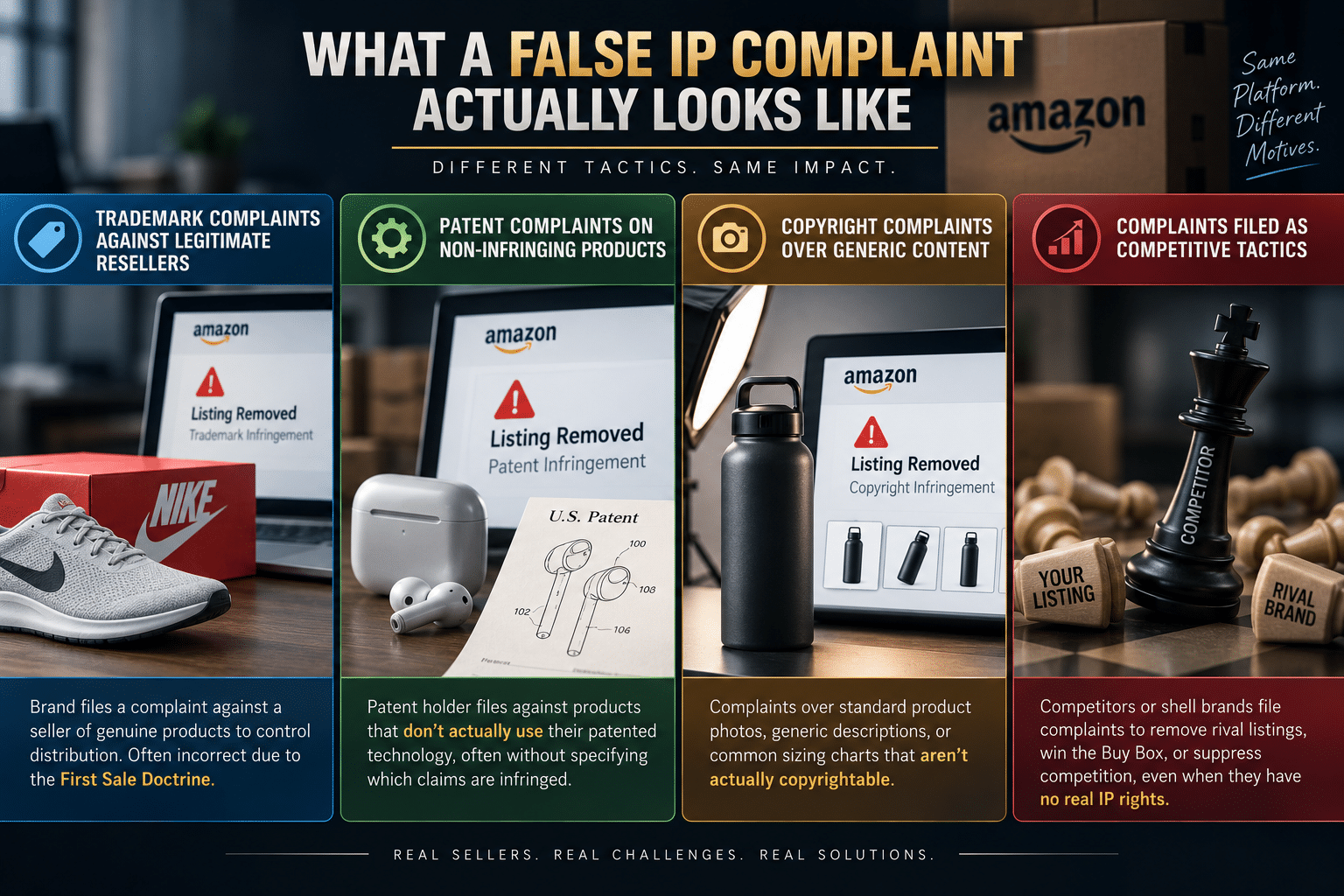
Not every wrong IP complaint is malicious. Some are filed by brand owners who genuinely believe their rights are being violated, but are legally incorrect. Others are filed strategically to suppress competition. The distinction matters because your response should be different for each.
Trademark Complaints Against Legitimate Resellers
This is the most common category. A brand owner files a trademark infringement complaint against a third-party seller listing genuine products. The brand owner wants to control who sells their products on Amazon, which is understandable from a business perspective. But wanting to control distribution and having the legal right to do it are two different things. Under the First Sale Doctrine, once a brand sells a product into the market, the buyer has the legal right to resell that product, including using the brand’s name and images to accurately describe what they are selling. The brand’s trademark rights are “exhausted” at the point of first sale. If the product is genuine, not materially different from what the brand sells directly, and accurately described, the reseller is not infringing.
The exception is a material difference. If the product you are selling differs from the authorized version in a way consumers would care about, such as a different warranty, altered packaging, a missing component, or parallel import with different specifications, the First Sale Doctrine may not protect you. Brand owners and their law firms know this, which is why many enforcement campaigns focus on establishing material differences, even minor ones, to get around the doctrine.
Patent Complaints on Non-Infringing Products
Patent complaints on Amazon tend to be broader than trademark complaints. A patent holder may file against every listing that looks remotely similar to their patented product, regardless of whether those products actually use the patented technology. We have seen patent holders file complaints against dozens of sellers for products that do not practice a single claim of the patent. The complaint form does not require the filer to explain which claims are allegedly infringed, so there is no built-in check on overbroad filings. Our walkthrough of monitoring Amazon for patent infringement explains how the enforcement tools work on the brand side, giving sellers useful context for understanding the complaint they just received.
Copyright Complaints Over Generic Photos or Descriptions
Some rights holders file copyright complaints over product images or listing copy that are standard across the category. Stock-style product photos, generic bullet points describing product features, or commonly used sizing charts are not protectable by copyright. But Amazon will still take down a listing based on a copyright complaint, even if the content in question is not copyrightable. These complaints are often the easiest to defeat on the merits, but they can still cause significant revenue loss while the listing is down.
Complaints Filed as Competitive Tactics
Then there are the plainly bad-faith complaints. A competitor creates a shell brand, files a trademark application, and uses the pending application to file IP complaints against rival listings. Or an existing brand files complaints against a seller who won the Buy Box, knowing the listing removal will redirect sales to the brand’s own listing. These are abuse-of-process situations, and they happen more than Amazon acknowledges. Understanding the risks and strategy behind Amazon trademarks helps sellers recognize when a complaint is part of a strategic play rather than a legitimate IP dispute.
What Amazon Does When a Complaint Lands
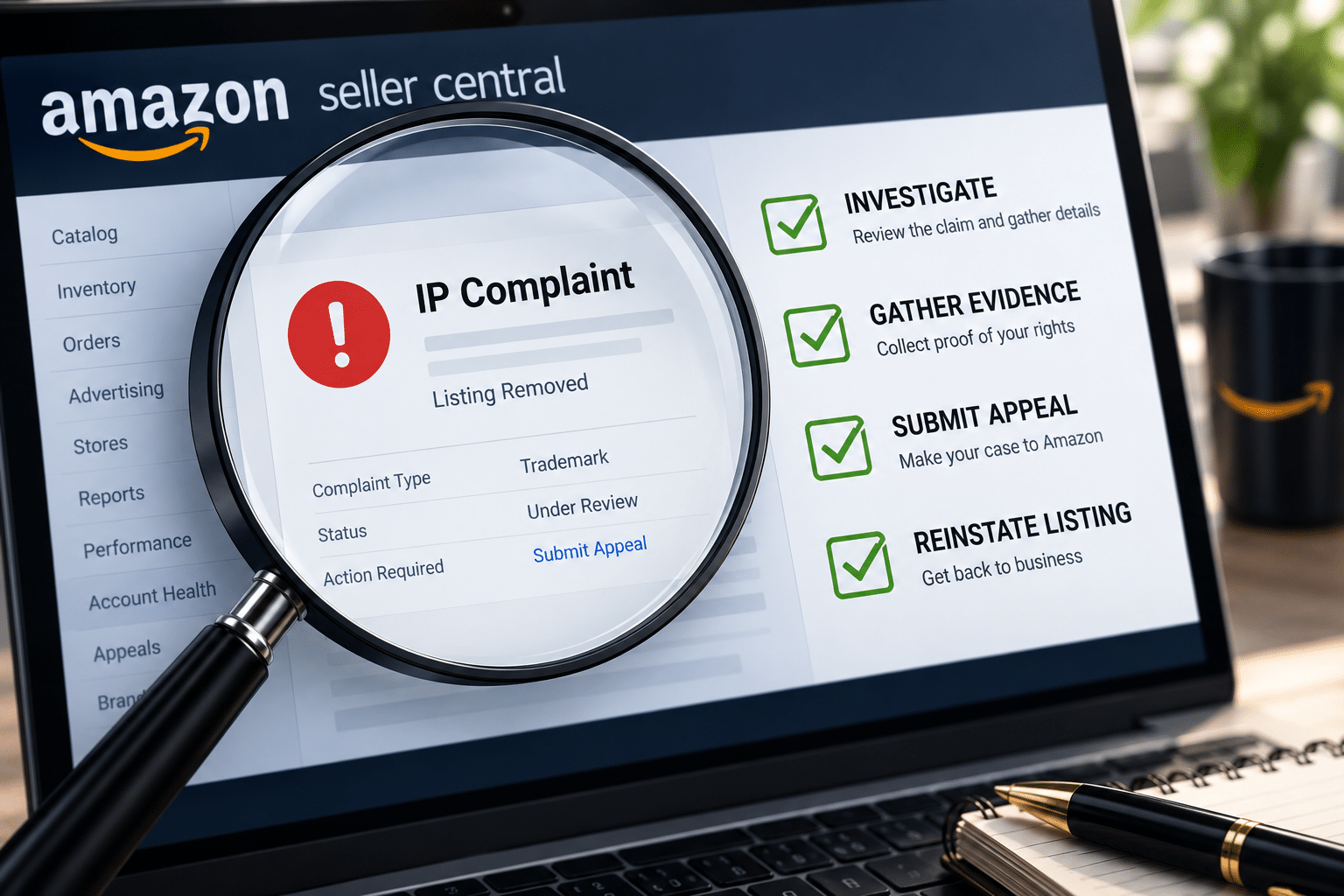
Amazon’s process is fast and heavily tilted toward the complainant. When a rights holder files a complaint through Report a Violation or the direct reporting form, Amazon typically removes the listing or suppresses it within hours. The seller gets a notification in Seller Central with the rights holder’s (or their representative’s) contact information, the type of IP right allegedly infringed, and a case ID. That notification is your starting point.
If the complaint is not resolved, Amazon adds it to your Account Health metrics. Multiple unresolved complaints put your selling privileges at risk. Enough of them will trigger an account suspension, at which point you need a Plan of Action to get reinstated. Our Amazon account reinstatement guide walks through the reinstatement process step by step.
One thing sellers get wrong: assuming the complaint will just go away. It will not. Unresolved IP complaints sit on your account permanently. Even if the listing gets reinstated through other means, the complaint itself remains unless the rights holder retracts it or you successfully appeal it. Those unresolved complaints accumulate, and they weigh against you in every future account health review.
How to Actually Fight a False IP Complaint
Your response options depend on the type of complaint and the strength of your position. Here is the practical breakdown.
Step One: Figure Out What You Are Dealing With
Read the complaint notice carefully. Determine whether it is a trademark, copyright, or patent complaint. Check the registration number cited, if any, and verify that the registration is active, that it covers the goods you are selling, and that the person filing is the actual rights holder or their authorized representative. This is where a surprising number of false complaints fall apart. The filer does not own the mark. The registration has expired. The goods class does not cover your product. The patent claims do not read on what you sell. Start there.
Step Two: Contact the Rights Holder for a Retraction
Amazon provides the complainant’s contact information in the notice. Reach out directly. If the complaint is based on a misunderstanding, such as a brand owner who did not realize you are selling a genuine product, a straightforward conversation can resolve it. Ask the rights holder to submit a retraction to notice-dispute@amazon.com referencing the case ID. A retraction is the fastest path to reinstatement. It clears the complaint from your account health record entirely.
Document everything. Save all emails, record the dates of every communication, and keep copies of any invoices or purchase orders that prove the authenticity and sourcing of your products. If the rights holder refuses to retract despite clear evidence that the complaint is unfounded, that documentation becomes the foundation for your appeal and potentially for legal action.
Step Three: File an Appeal or Counter-Notice
If the rights holder will not retract, you have two options depending on the complaint type. For copyright complaints, you can file a DMCA counter-notice through Seller Central. A counter-notice is a legal statement made under penalty of perjury asserting that the material was removed due to mistake or misidentification. If the rights holder does not file a federal lawsuit within 10 business days of receiving the counter-notice, Amazon is required to reinstate the content.
For trademark and patent complaints, there is no statutory counter-notice process. Instead, you file an appeal through Seller Central explaining why the complaint is invalid. Include supporting documentation: invoices proving product authenticity, evidence that the patent claims do not cover your product, or legal arguments for why the complaint fails. The quality of this appeal matters enormously. A well-documented, legally grounded appeal gets results. A vague denial gets ignored.
Step Four: Escalate When Amazon’s Internal Process Stalls
Amazon’s internal appeals process does not always produce a resolution. If your appeal is denied or ignored, escalation options include requesting seller support management review, filing an arbitration claim under Amazon’s Business Solutions Agreement, or, in the case of patent disputes, pursuing the APEX program. What to do after winning an APEX dispute as a seller covers how the APEX evaluation works from the seller’s perspective and what happens after a favorable decision.
When You Should Go on Offense
Defending against a false complaint is one thing. Going after the person who filed it is another. But in some situations, offense is the right move.
If a competitor or brand owner has knowingly filed false IP complaints, they may be liable for tortious interference with your business relationships, unfair competition, abuse of process, or violations of the Lanham Act if the complaint involves a false designation of origin. These are real claims with real damages, particularly if you can document the revenue you lost while your listing was down. The filing itself can serve as evidence of bad faith, especially if the filer has a pattern of filing complaints that get retracted or overturned.
Schedule A lawsuits are also relevant here, though from the other direction. Some brand owners file multi-defendant federal lawsuits against large numbers of Amazon sellers simultaneously. Our breakdown of Schedule A lawsuits in multi-defendant IP cases explains how these cases work and what sellers can do if they find themselves named in one.
The Special Problem of Counterfeit Accusations
Counterfeit complaints are the most dangerous category on Amazon. A single counterfeit complaint can result in an immediate account suspension, and reinstatement is harder than for any other type of IP complaint. Amazon treats counterfeit allegations with zero tolerance because of its liability exposure to brands and consumers.
If you are a legitimate reseller accused of selling counterfeits, your response must be immediate and thorough. You need invoices from authorized suppliers, proof of the supply chain, and if possible, documentation from the manufacturer confirming the products are genuine. Our guide for sellers accused of selling counterfeits on Amazon covers the specific steps and documentation you need to clear a counterfeit accusation. The stakes are higher here than with a patent or copyright complaint. A counterfeit finding on your account is extremely difficult to reverse, and the longer you wait to respond, the harder it gets.
How to Reduce Your Exposure to False Claims
You cannot prevent someone from filing a complaint against you. But you can build a business that is harder to hit and easier to defend.
Keep meticulous sourcing records. Every product you sell should have a clear paper trail back to a legitimate supplier. Invoices should show the brand name, product identifier, quantity, date, and supplier information. If you are a reseller, purchase from authorized distributors whenever possible and keep the documentation that proves it. If you cannot document the origin of a product, you cannot defend against a complaint alleging it is counterfeit or unauthorized.
Register your own trademarks. If you sell private-label products, trademark registration and Brand Registry enrollment give you access to the same enforcement tools that are being used against you. They also signal to Amazon that you are a serious brand owner, which can affect how your appeals are weighted. And if you hold patents on your products, register them in Brand Registry as well. Our IP litigation services are available when the situation escalates beyond what platform tools can resolve.
Monitor your account health proactively. Do not wait for a suspension to discover you have unresolved complaints. Check your Account Health dashboard regularly. Address complaints immediately, even ones you believe are baseless. A fast response, whether it is a retraction request, an appeal, or a counter-notice, limits the damage a false complaint can do.
When Platform Tools Are Not Enough, Legal Strategy Takes Over
Amazon’s internal processes handle many IP disputes. But they are not designed to be fair to sellers, nor are they equipped to deal with bad-faith filers who are exploiting the system strategically. When appeals stall, when retractions are refused, when a pattern of baseless complaints is costing you significant revenue, that is when legal strategy replaces platform strategy.
At Gallium Law, we represent Amazon sellers facing false IP complaints, account suspensions, and competitive abuse through Amazon’s reporting tools. We also represent brand owners enforcing legitimate IP rights, which means we understand exactly how enforcement works and where its weaknesses lie. If you are dealing with a false complaint that Amazon’s internal processes cannot resolve, or if you are seeing a pattern of abusive filings by a competitor, reach out and let us help determine the right response.