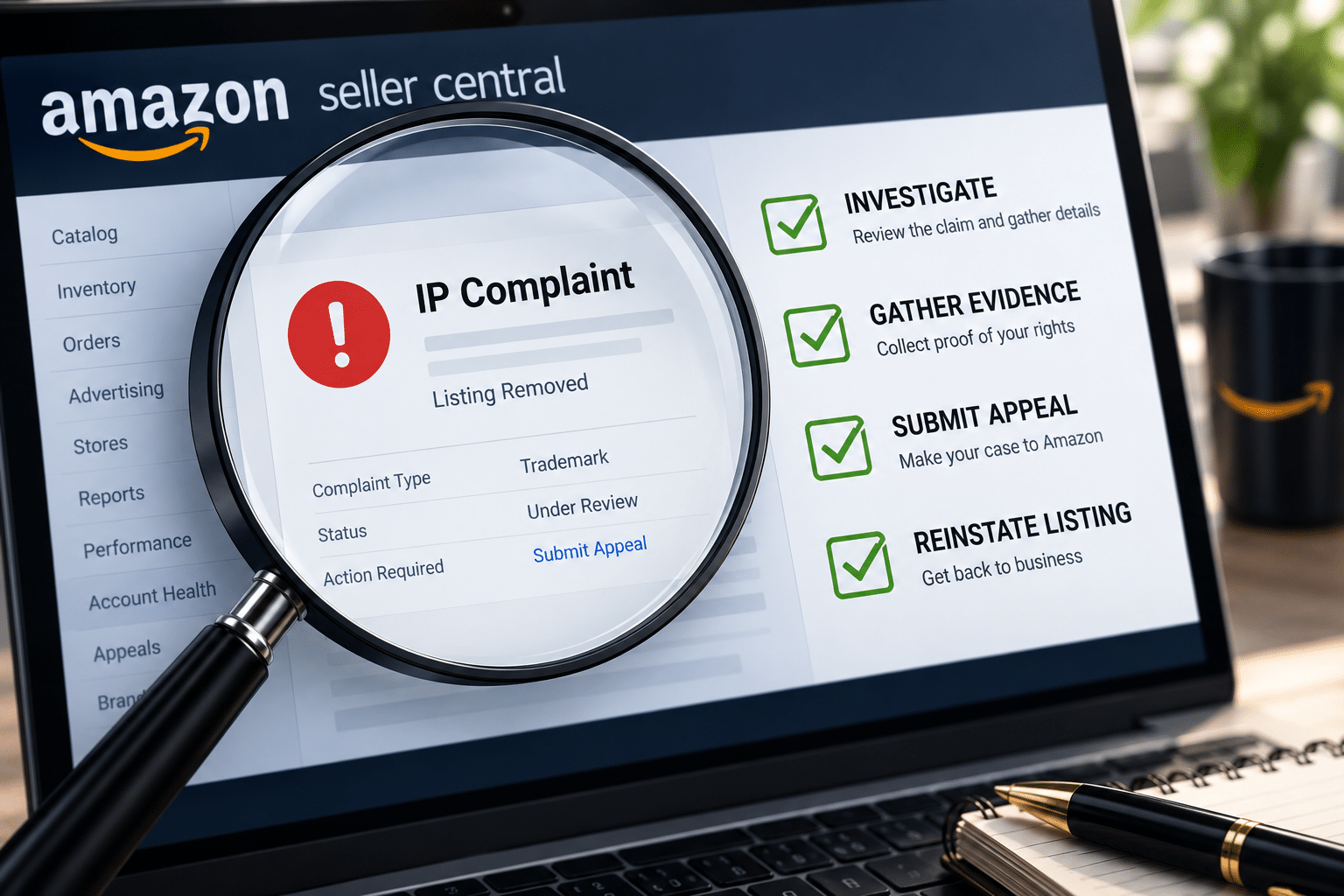


You open your email, and there it is. A letter from a law firm telling you to stop selling a product on Amazon, remove your listing immediately, and preserve all records related to your sales. The tone is aggressive. The legal citations are dense. And the implied threat is clear: comply or we will escalate.
Cease and desist letters have become one of the most common weapons in Amazon marketplace disputes. Brands use them to push unauthorized resellers off their listings. Competitors use them to rattle sellers into voluntarily pulling products. Law firms have built entire practice areas around sending these letters to Amazon sellers in volume, sometimes targeting dozens of resellers for a single brand client.
But a cease and desist letter is not a court order. It is not a lawsuit. It is a letter. And how you respond to it matters far more than most sellers realize. Panic and pull your listing, and you may be giving up revenue you had every legal right to earn. Ignore it entirely, and you may be walking into a lawsuit or an Amazon complaint you did not see coming. The right response sits in between, and it depends on the specifics of what the letter actually says.
What a Cease and Desist Letter Is and What It Is Not
A cease and desist letter is a formal demand from a rights holder or their attorney telling you to stop an activity they believe infringes their intellectual property. It is a private communication. It carries no legal force on its own. You are not required by law to comply with it, and receiving one does not mean you have done anything wrong.
What it does mean is that someone with or without legal representation has identified your listing, decided it conflicts with their rights, and has taken the step of notifying you about it. If you didn’t know about their intellectual property before, now you do. That signals intent. It tells you the brand is willing to spend money to control its distribution on Amazon, and if you do not respond or do not stop, the next step could be an Amazon IP complaint, a federal lawsuit, or both.
The letter itself typically includes: a description of the intellectual property rights the sender claims to hold, an assertion that your Amazon activity infringes those rights, a demand that you stop selling the product and remove your listing, a request that you preserve records and provide an accounting of your sales, and a deadline to respond. Some letters include all of these. Others are vague and rely on intimidation more than substance. The specificity of the letter tells you a lot about how serious the threat actually is.
The Vorys Letters and Why They Keep Showing Up
If you sell on Amazon as a third-party reseller and you have received a cease and desist letter, there is a decent chance the letter you received came from the law firm Vorys, Sater, Seymour and Pease. Vorys has become the dominant law firm in the Amazon cease-and-desist space, representing major brands that want to restrict third-party reselling of their products. Their standard letter typically includes eight claims: trademark infringement, copyright infringement, unfair competition, false designation of origin, common law trademark infringement, state law violations, conversion, and interference with contract.
That list sounds overwhelming. It is designed to. But if you are selling genuine products that you purchased through legitimate channels, most of those claims do not hold up. The First Sale Doctrine allows the resale of genuine trademarked goods, and it has been settled law for decades. The Supreme Court reinforced this in Kirtsaeng v. John Wiley & Sons. If the product is authentic and not materially different from what the brand sells directly, the trademark and copyright claims typically fail.
The argument Vorys and similar firms usually rely on is material difference. They claim the products you sell are materially different from the authorized versions because of warranty differences, packaging variations, or quality control gaps. Whether that argument has teeth depends on the actual facts. A genuine product with identical specifications, sold in original packaging, with no quality issues, is hard to be labelled as “materially different” no matter how creatively the letter is drafted. Our overview of the risks and strategy behind Amazon trademarks covers the broader strategic landscape behind these trademark enforcement campaigns.
How to Respond: The Step-by-Step Approach
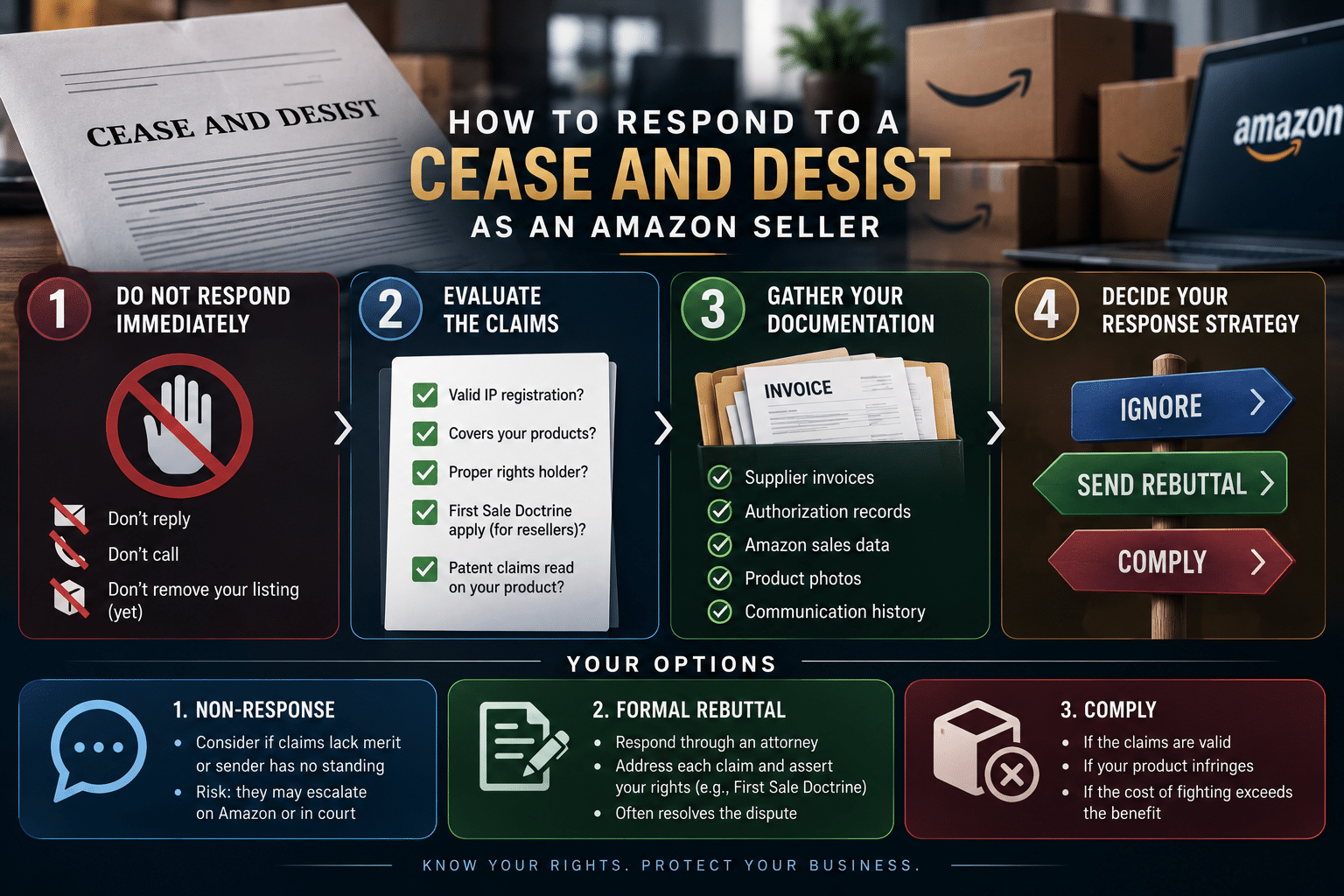
Do Not Respond Immediately
The letter wants you to act fast. That is by design. A panicked seller who pulls their listing within 24 hours is a win for the brand without any legal expense beyond the cost of sending the letter. Do not respond to the letter, do not call the law firm, and do not change your listing until you have evaluated the claims. There is almost never a legitimate reason to comply with a cease and desist letter within the 48- or 72-hour deadline they typically impose. Those deadlines are artificial pressure.
Evaluate the Claims
Pull the letter apart. Is the trademark registration cited in the letter actually active? Does it cover the goods you are selling? Is the person or entity sending the letter the actual rights holder, or an assignee, or just a licensee with no enforcement authority? If a patent is cited, do the claims of that patent actually read on your product? These are threshold questions that determine whether the letter has any legal substance or is just noise.
For resellers of genuine goods, the central question is always the First Sale Doctrine. Did you buy the product from a legitimate source? Is the product genuine and unaltered? Is it materially identical to what the brand sells through its own authorized channels? If the answers are yes, you likely have a strong defense regardless of what the letter says.
Gather Your Documentation
Before you respond to anyone, assemble your records: invoices from your supplier showing the product name, brand, quantity, price, and date; communications with the supplier confirming their authorization or the legitimacy of the supply chain; your Amazon sales records for the product; photos showing the product in its original, unaltered packaging. If you are a private-label seller and the complaint involves a different brand’s trademark, gather evidence showing that your product does not infringe. These examples of documentation are your defense on whether the dispute stays on Amazon or moves to court.
Decide Your Response Strategy
You have three options, and the right one depends on your situation.
Option one: non-response. If the letter is vague, unsupported by valid IP registrations, or comes from a party with no standing to enforce, you may choose not to respond at all. This carries risk. The brand may file an Amazon IP complaint or escalate to litigation. But if the claims have no merit, a non-response sometimes signals that you are not easily intimidated, and some brands do not follow through.
Option two: a formal rebuttal. Respond through your own attorney with a letter that addresses each claim, asserts your rights under the First Sale Doctrine or other applicable defenses, and puts the brand on notice that you will defend your position. A well-drafted response from competent counsel often resolves the dispute. It signals that pursuing you further will cost the brand money and they may not succeed. Our IP litigation practice handles exactly this kind of response.
Option three: compliance. If the claims are valid, if you are selling a product that actually infringes a registered trademark or patent, or if the cost of fighting exceeds the value of continuing to sell the product, pulling the listing and moving on may be the smartest business decision. Not every fight is worth having.
What Happens If You Ignore the Letter
Two things can happen, and both can hit at the same time. The brand files an IP complaint through Amazon’s Report a Violation tool, which takes down your listing and puts a mark on your account health. Or the brand files a federal lawsuit, which brings an entirely different level of cost and complexity. Some brands do both simultaneously.
The Amazon complaint is the more immediate threat for most sellers. A listing removal during a peak sales period can cost thousands in lost revenue, and if multiple complaints accumulate, your entire account is at risk. Our guide relating to an Amazon account suspended for IP complaints covers the reinstatement process. The lawsuit threat is more expensive but less common. Federal trademark and patent litigation could costs hundreds of thousands of dollars to defend, and most brands are not willing to spend that unless the stakes justify it. But Schedule A lawsuits in multi-defendant IP cases are an exception. In these cases, a brand files a single lawsuit against dozens of sellers at once, driving down the per-defendant cost of litigation and increasing pressure to settle.
Building a Business That Can Withstand These Letters
The sellers who handle cease and desist letters best are the ones who were prepared before the letter arrived. Preparation means documentation, legal relationships, and brand investment.
Documentation comes first. If every product you sell has a clear, verifiable chain of custody back to a legitimate source, you can respond to any letter or complaint from a position of strength. Invoices, supplier agreements, and proof of authenticity are not just good business practices. They are your defense.
If you sell private-label products, investing in your own trademark registration and Brand Registry enrollment gives you standing to use the same tools that brands use against resellers. You go from being a seller defending against complaints to a brand owner with enforcement tools of your own. Our guide on where and how to register a trademark covers the registration process and what to consider when choosing your mark and classes.
Build a relationship with an IP attorney before you need one. The worst time to find a lawyer is the day you receive a cease and desist letter with a 72-hour deadline. Having counsel who already understands your business, your sourcing, and your product line means you can respond quickly and effectively instead of scrambling.
When the Cease and Desist Becomes an Amazon Complaint
Many cease and desist letters are followed by an Amazon IP complaint if the seller does not comply. When that happens, you are dealing with two problems: the legal dispute with the brand and the platform-level consequences on your Amazon account. Your response to the Amazon complaint needs to be separate from your response to the letter. The complaint requires either a retraction from the rights holder, a successful appeal to Amazon, or in the case of copyright, a DMCA counter-notice.
If the brand filed both a cease and desist and an Amazon complaint for the same issue, the platform complaint gives you something the letter did not: a structured process for disputing the claim directly with Amazon. That process has limitations, and it favors complainants over sellers, but it is a defined path to reinstatement. For patent disputes that reach Amazon, our guide relating to Amazon’s APEX program explains the streamlined evaluation process that can resolve patent infringement claims without federal litigation.
If you are facing counterfeit accusations specifically, the stakes jump considerably. Counterfeit complaints trigger faster and more severe account actions than trademark or copyright complaints. Our guide on what to do when you are accused of selling counterfeits walks through the documentation and response strategy for that specific situation.
A Letter Is Not a Verdict
A cease and desist letter is the beginning of a conversation, not the end of one. Some of those conversations resolve quickly once the brand sees you have documentation, legal counsel, and a defensible position. Others escalate to Amazon complaints or litigation. The outcome depends almost entirely on how you respond in the first few days.
At Gallium Law, we represent Amazon sellers responding to cease and desist letters, defending against IP complaints, and fighting account suspensions. We also represent brands sending those letters, which means we understand the enforcement strategy behind them and where it breaks down. If you have received a cease and desist letter and need to figure out whether the claims are real, whether you should fight or comply, and how to protect your account through whatever comes next, reach out and let us work through it with you.