Table of Contents
Switched to Gallium from a larger firm and the difference has been massive. They offer much better service at much more manageable prices. If you are looking for fast efficient help with anything IP related, these are the guys for the job. Trademarks, Patents, Copyrights, these guys know what they are doing. They are my third lawyers I have worked with and the experience has been substantially better than the prior two.

Connor Hance
August 2025
Gallium law has been amazing to work with for our legal needs! They make things easy to understand, do a great job at keeping us informed, and are calm and confident in their communication. Highly recommend!!

Anna Wengreen
August 2025
I have worked with other firms and this is a rare one. It has truly been a pleasure working with Wes, Michael, and Jacob. They are the experts in IP Law and patent applications. I am grateful that they help me to understand things at my level. On top of that they are true gentlemen! It's been an amazing experience!

Nelson Lim
August 2025
Wes and the Gallium Law team have been a pleasure to work with. They guided us seamlessly through the provisional patent process for our product, providing expert advice and prompt communication at every step. I highly recommend them to any startup or business looking for strategic, dependable IP counsel. Looking forward to continuing our partnership!

Mike Lee
May 2025
I called several firms about assisting me with developing my patent and the Gallium Law firm was only one, nationwide, to return my phone call and consult with me. That is respect no matter what IP you have, or who you are. They are very professional and takes care of their customers. The work was thorough and detailed. I am very satisfied with the work they have done for me. I would recommend this law firm to anyone reading.

Shawn
May 2025
I highly recommend Gallium Law for your company's patent needs. Wes and crew are a stellar team that helped us get our product design utility patent successfully patented with the USPTO. After they drafted the patent application and materials, it was clear that having expert professionals craft the application was absolutely necessary. There are countless details in how they executed the application that we never would have been able to do ourselves. They did a tremendous job in taking the patent to the finish line.

Robert Paul
August 2024
The Gallium team have been and continue to be phenomenal partners to work with. They have been the most responsive, creative, engaging, and innovative IP counsel I have ever collaborated with. Gallium is happy to support early stage start-ups and provide the same attention and support you would typically only receive when working for large multi-nationals. I would recommend their team to anyone looking to generate and expand their IP portfolio.

Ryan Balko
September 2024
Great experience! The Gallium team did a great job filing my patent. They also did a great job of clearly explaining my options to protect my IP, and that made a big difference to me as a new inventor.

Daniel Bakke
August 2024
I have worked with Gallium law for many years. In my opinion they are unique in their approach of "winning" patents for customers like myself. I worked very close with their professional patent law attorneys, and turned obstacles and initial rejections to complete successful patent allowances. They are very reasonable with their budgets and willing to accommodate your personal needs and requests. It is the best patent law company I ever dealt with.

Gideon Eden
July 2023
Our publicly traded company has worked with Wes and his team at Gallium Law for about a decade. They are consummate IP professionals and highly organized - which is essential for coordinating dates, fees, etc. We trust Gallium Law with our most highly prized assets - our IP. You should, too.

David Morse
March 2024
Gallium Law is an incredible Intellectual Property Legal team! I am continually blown away with their ability to translate our medical device design ideas into patent claims and diagrams. They are very experienced in the interventional (catheters and generators) medical device space. My customers have had great experiences working with Gallium and I recommend them to all medical device innovators.

Brady Hatcher
April 2023
I have always been very happy with the great work of the Gallium team. They are patent experts who really take an interest in helping their clients succeed. Wes is particularly talented and results oriented. Not only is Wes an excellent patent attorney, he's also a great engineer with an MBA, so he understands legal issues from many useful perspectives.

Eric Wengreen
December 2022
I thoroughly enjoyed working with the Gallium Law team on my provisional patent application and intend to work with them on future filings. Wes and Isabel were knowledgeable and cared about understanding my intellectual property. I appreciated their advice on filing timelines and drafting strategy. I highly recommend their firm.

Ashley Mooneyham
February 2022
Brain-computer interfaces (BCI) used to be the kind of technology you read about in research papers and forgot about by lunch. Not anymore. In 2025 alone, over 1,650 BCI-related patents were granted, and companies like Neuralink, Synchron, and Blackrock Neurotech are racing to bring implantable neural interfaces into clinical use. The global BCI medical device market is projected to grow at a 16% compound annual rate through 2035.
This growth is making the patent landscape increasingly crowded. For anyone who has developed a new electrode design, a signal-decoding algorithm, or a new method for processing neural data, the time to protect it is shrinking. Even waiting a year might see someone else file first.
We work with BCI developers and medical device innovators to secure patent protection for neural interface technology. Here is how the process works and what makes BCI patents different from other tech patents.
What Makes BCI Technology Patentable
Brain-computer interfaces lie at the point where hardware engineering, neuroscience, signal processing, and software meet; because of their complexity, they are at an advantage when it comes to patent applications, since unlike purely software inventions, which are usually seen as abstract ideas, BCI inventions generally involve physical components interacting with biological systems in measurable and concrete ways.
Yet that does not mean all advances in BCI are eligible for patent protection. Just as the Section 101 eligibility rules applied to AI and software patent challenges apply here, a claim that involves ‘processing neural signals with a computer’ will be rejected as an abstract idea, just like other software-related inventions.
The point is that BCI patents generally have a built-in advantage: physical hardware that interacts with the human body. For example, an electrode array implanted in brain tissue, a signal amplifier worn on the scalp, or a wireless transmitter embedded under the skin. The presence of these physical components attaches your claims to a specific and tangible invention in a manner that pure software claims cannot. If you’re unsure whether your particular innovation meets the requirements, our patentability guide provides a detailed analysis.
Categories of BCI Inventions Worth Protecting
The BCI patent landscape covers a wide range of technologies. Knowing where your invention fits helps you choose the right filing strategy and the types of claims that will hold up under examination.
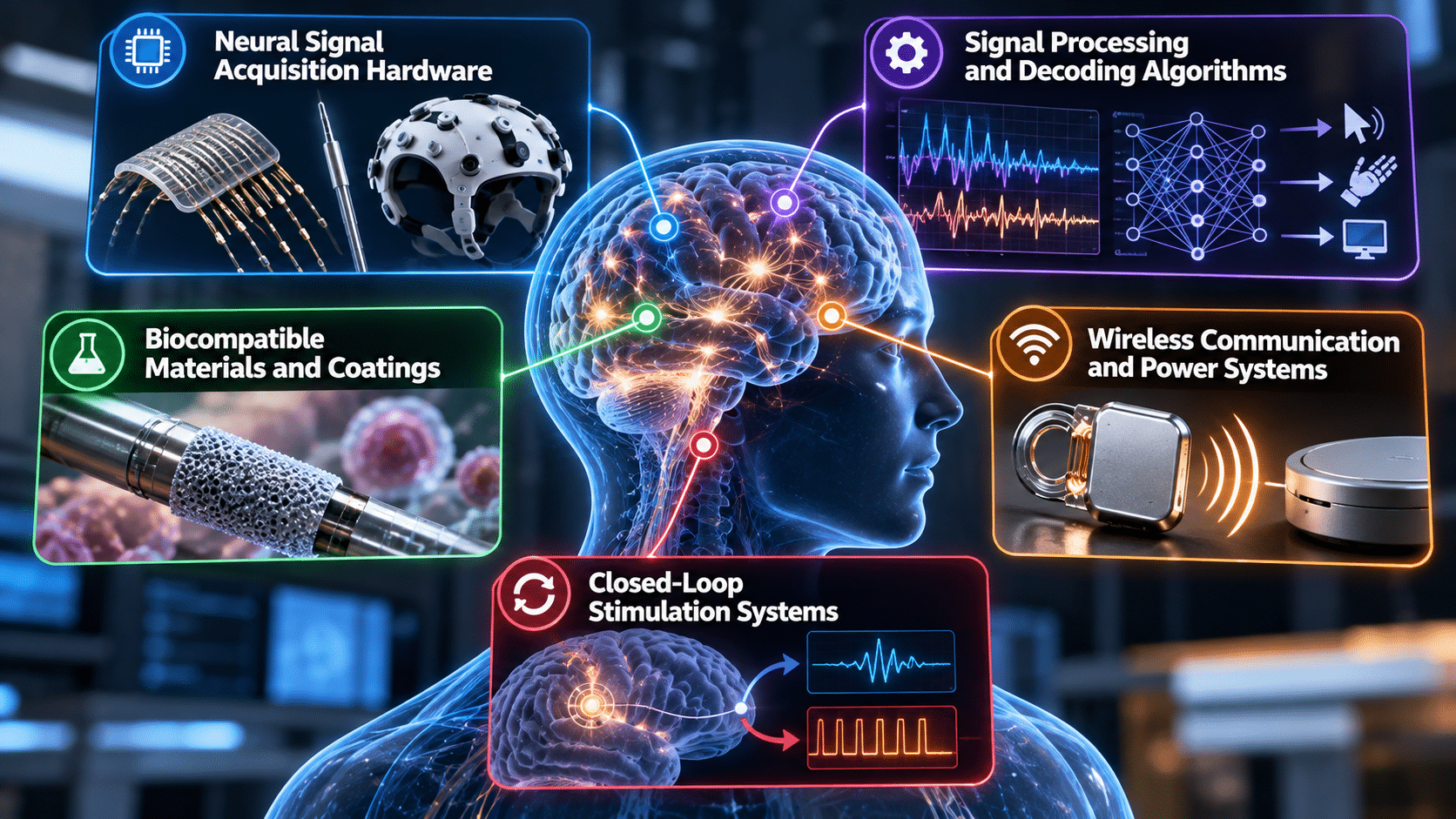
Neural Signal Acquisition Hardware
This covers electrode arrays, implantable probes, EEG headsets, and electrocorticography (ECoG) grids. Advances in electrode materials, channel density, form factor, and implantation techniques are well-suited for patenting because they involve new physical structures that solve specific engineering problems. An example of hardware innovation that fits easily into patent claims is Neuralink’s ultra-thin polymer threads featuring more than 1,000 electrodes.
Signal Processing and Decoding Algorithms
The software that interprets raw neural signals and converts them into device commands is where the true intelligence resides. Although novel decoding algorithms, noise-filtering techniques, and methods for real-time signal classification can be patented, the claims had better describe the technical implementation rather than give an abstract account of the concept; they should be linked to the particular signal processing pipeline, the hardware on which the algorithm operates, and the measurable improvements it achieves.
Biocompatible Materials and Coatings
A basic problem facing implantable brain-computer interfaces is that the body views them as foreign bodies. Advances in biocompatible materials, anti-inflammatory coatings, and encapsulation methods that extend device lifetime are highly valuable for intellectual property. Research by the American Chemical Society’s CAS Division points to biodegradable metals such as molybdenum and zinc, along with polymers such as PDMS and PEDOT: PSS, as promising materials for next-generation neural interfaces.
Wireless Communication and Power Systems
Getting data out of an implanted device and keeping it powered without bulky batteries are major engineering challenges. Novel wireless telemetry designs, energy-harvesting systems, inductive-charging solutions, and miniaturized antenna configurations for neural implants all represent patentable innovations.
Closed-Loop Stimulation Systems
Some BCIs do not merely read brain signals; they also generate them by providing targeted electrical stimulation in response to detected neural patterns. Closed-loop systems, used in applications such as epilepsy management and depression treatment, include complex feedback mechanisms that combine sensing, processing, and stimulation in real time; the interaction between these components creates a wide range of patent opportunities.
Navigating the Patent-FDA Intersection
One thing that catches many BCI developers off guard: the patent process and the FDA regulatory process overlap more than you might think, and mismanaging that overlap can hurt you in both arenas.
Most implantable BCIs will require FDA clearance or approval before they can be marketed. The FDA published its guidance on implanted BCI devices in 2021, covering nonclinical testing and clinical study design for patients with paralysis or amputation. Synchron received FDA Breakthrough Device designation for its Stentrode in 2020 and has been advancing through clinical trials. Neuralink is conducting first-in-human studies. Both will likely pursue a De Novo classification pathway since permanently implanted motor BCIs have no predicate device.
There is a genuine timing dilemma here: you want to file patents as early as possible to establish early priority dates, but at that stage the clinical trial data that could support your patent claims may not have been obtained yet. Conversely, releasing the clinical results before filing patents could compromise novelty.
It is advised that you file provisional patent applications before you submit your clinical trial results or give presentations at conferences. The provisional application provides you with 12 months of protection as you collect further data, which can then be included in the full non-provisional application. This lets you pursue FDA approval and patent prosecution simultaneously, without one process negatively affecting the other.
For a deeper look at how medical technology patents interact with regulatory considerations, check our medical technology guides hub.
Drafting BCI Patent Claims That Hold Up
BCI patents require a different drafting approach than standard software or medical device patents. The combination of hardware, software, and biological interaction creates both opportunities and traps.
Lead With the Hardware-Biology Interface
The most substantial assertions should concern the way your device interacts physically with neural tissue; for example, aspects such as electrode geometry, insertion depth, contact surface area, and material composition. Since these structural details are difficult to design around and therefore stand up to objections based on abstract ideas, begin your independent claims with these and then move outwards to the various processing and application layers.
Specify the Signal Processing Chain
For algorithm-related claims, describe the complete signal processing pipeline from raw neural input to decoded output. Include specific filter configurations, sampling rates, feature extraction methods, and classification architectures. A claim reciting “processing neural signals to determine user intent” will be rejected. A claim reciting “filtering electrocorticographic signals using a bandpass filter between 70 and 200 Hz, extracting high-gamma band power features, and classifying motor intent using a recurrent neural network trained on labeled movement data” has a much better chance of allowance.
Cover Both Invasive and Non-Invasive Embodiments
If the core innovation you have developed applies to both implantable and wearable BCI configurations, then you should draft claims for each of these. For example, a new electrode material could be used in both a cortical implant and a dry EEG headband. By including both versions in your specification, you can secure protection without filing separate patent applications.
Do Not Forget the Manufacturing Method
How you make your device can be just as patentable as what it does. Individual inventions, such as new microfabrication processes, electrode deposition techniques, or methods for assembling miniaturized neural interfaces, have value in their own right as intellectual property, and claims relating to manufacturing methods can target competitors that build a functionally similar device using your proprietary fabrication process.
Prior Art Challenges in the BCI Space
The BCI patent landscape is more crowded than most applicants realize. A Nature Biotechnology analysis found over 5,000 individual patent applications across more than 2,160 patent families in the brain-machine interface space, and that number has only grown since. Major filings come from consumer electronics companies (Sony holds over 20% of some BCI patent datasets), established neurotech firms, university research labs, and the wave of new startups entering the field.
A thorough prior art and due diligence search before filing is not optional here. It is essential. You need to know what has already been claimed so your application carves out a defensible position rather than running headfirst into an examiner’s rejection based on existing patents.
Pay special attention to academic publications. BCI research has been active in universities for decades, and published papers count as prior art even if they were never patented. A 2015 conference paper describing the same signal processing technique you want to claim will sink your application just as effectively as an existing patent.
Building a BCI Patent Portfolio
One patent protecting your electrode design does not protect your decoding algorithm. And neither protects your wireless telemetry system. BCI technology is inherently multi-layered, and your patent strategy should reflect that.
We usually suggest filing a core patent for the main innovation and then exploring related inventions, which will help establish a protective moat around it. If your core patent relates to a novel electrode array, consider separate patents for the insertion tool, the signal-processing firmware, the wireless communication protocol, and the materials science behind the biocompatible coating.
For BCI, filing continuation applications is especially valuable because the technology is constantly evolving through clinical trials; continuation claims can capture unexpected advantages or new uses discovered in human studies while retaining the original priority date.
International filing deserves attention too. China and South Korea are investing heavily in BCI research, and European companies are entering the market. A PCT application within 12 months of your US filing preserves your option to pursue protection in these jurisdictions. Our patent services team can help you prioritize which countries are most relevant to your specific technology and market.
Timeline and What to Budget For
BCI patents generally follow the same timeline as other complex medical device patents, with some additional considerations.
Expect two to four months for preparing a thorough provisional application that captures your core innovation and supporting embodiments. The non-provisional filing, due within 12 months, requires complete formal claims and a detailed specification that could support both patent prosecution and potential FDA submissions.
Examination at the USPTO typically takes 18 to 30 months from the non-provisional filing. Given the technical complexity of BCI applications, plan for two or three rounds of office actions. Section 101 rejections are less common for BCI patents that include hardware claims, but Section 102 (novelty) and Section 103 (obviousness) rejections are frequent given the dense prior art landscape.
Track One prioritized examination is worth considering if you are in a competitive race to market or need issued patents for licensing or fundraising purposes. It can compress the examination timeline to roughly six months.
Browse our patent guides for more detail on what each phase involves and how to prepare.
Protecting Your Neural Interface Innovation
Brain-computer interface technology is moving from research labs into the real world. Patent filings reflect that shift, and competitive dynamics intensify every quarter. Protecting your BCI innovation is not just about checking a legal box. It is about securing the foundation for your company’s commercial future.
At Gallium Law, we understand both the technology and the legal landscape. We have worked with medical device and surgical robotics innovators, and we bring that same technical depth to brain-computer interface patents. Whether you are developing an invasive implant, a non-invasive headset, or the software that makes either one work, we can help you build a patent position that protects your technology and supports your business goals.
Ready to talk about your BCI invention? Get in touch with our team and let’s figure out the right strategy together.