
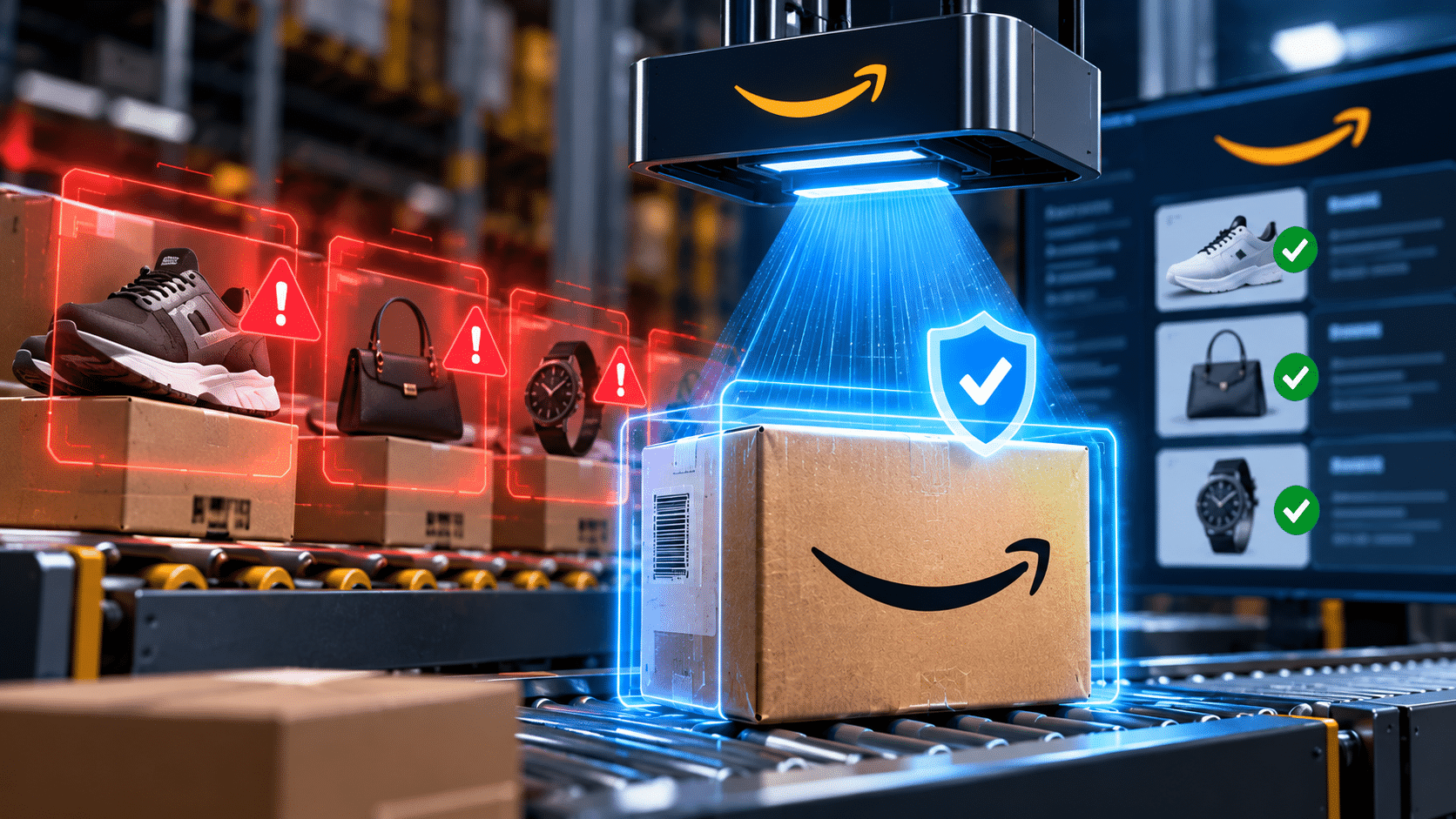

Amazon seized more than 15 million counterfeit products in 2025. That’s a big number. But here’s the more interesting one: Amazon’s proactive controls blocked more than 99.9% of suspected infringing listings before a brand owner ever had to find and report them.
Read that again. Ninety-nine point nine percent. Before a single brand filed a complaint.
That stat comes from Amazon’s 2026 Trustworthy Shopping Experience Report, published April 2026. It’s the clearest signal yet that Amazon has shifted from reactive IP enforcement to something much more aggressive: AI-driven, predictive, and operating at a scale no human team could match. For brand owners, this changes the playbook. For sellers, it changes the risk calculus. At Gallium Law, our Amazon intellectual property services deal with the consequences of this shift every day.
What’s Actually Running Under the Hood
Amazon doesn’t publish its source code, obviously. But the Trustworthy Shopping report and filings with various regulators give us a solid picture of what’s happening. It’s not one AI system. It’s a stack of them, layered on top of each other, all feeding data back and forth.
Multimodal Large Language Models
Amazon is employing multimodal large language models that examine text, images, and pricing patterns together. To understand what this means in practice, consider the following: the system isn’t merely scanning your listing title for trademark keywords. It also looks at your product photographs, compares them with officially registered brand images, analyzes your price relative to the genuine product, and assesses your seller behavior patterns. All of this happens at the same time, in just a few milliseconds. A well-hidden counterfeit that changes just one letter in a brand name and uses slightly different product photography often slipped past previous keyword-matching systems, whereas multimodal analysis can address this gap by looking at the full context rather than assessing each piece of information separately.
Knowledge Graph Technology
Amazon has developed knowledge graphs that show the relationships between accounts, listings, transactions, and behavioral patterns. Just as social networks show connections between people, these graphs can expose coordinated abuse even when each data point appears legitimate. Although a single review might seem genuine on its own, comparing it with information from other accounts, purchase histories, and behavioral signals can reveal a group of fake reviews. Amazon uses the same approach to detect counterfeit networks: when several seller accounts share addresses, bank details, IP addresses, or supply chain links, it identifies them as part of the same operation.
Predictive IP Protection
This is where things become genuinely interesting for brands. Amazon’s systems currently monitor products that go viral on social media and can predict surges in counterfeiting before they appear on the platform. The Trustworthy Shopping report describes an “Early Warning System” that flags threats before a brand even shares its intellectual property with Amazon. In one recorded instance, the system stopped a counterfeiting threat eight days before the brand itself reported it. That isn’t enforcement; that’s prediction.
The Brand Protection Stack You Should Actually Be Using
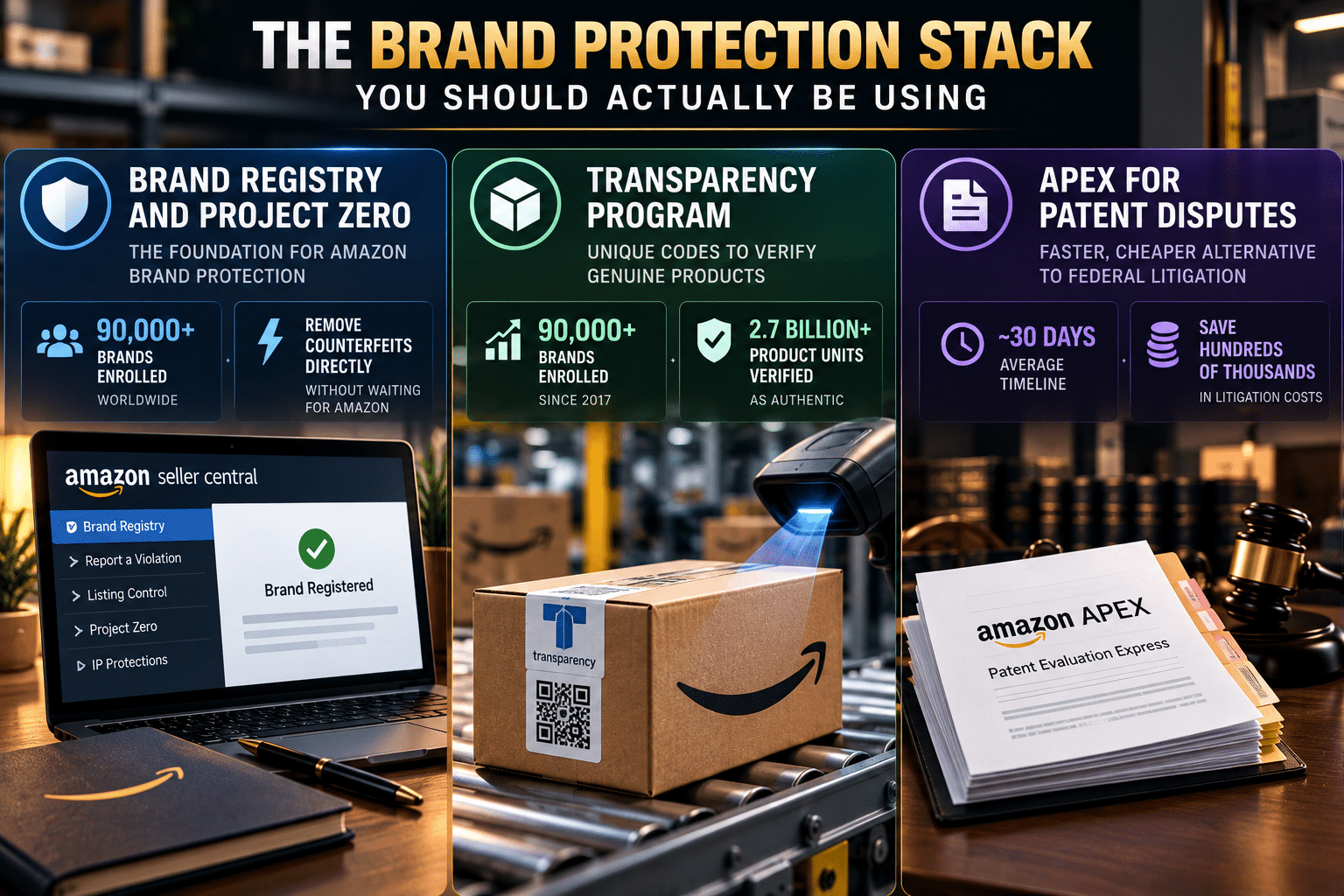
Amazon’s AI doesn’t work in a vacuum. It feeds off the data that brand owners provide through a set of programs that, frankly, too many brands still aren’t using. Here’s what’s available and what the latest numbers look like:
Brand Registry and Project Zero
Brand Registry is the foundation. Register your trademarks with Amazon to unlock access to the Report a Violation tool, listing control, and proactive protections that unregistered brands don’t get. Flipflow’s analysis of the program notes that Project Zero, which builds on Brand Registry, now enrolls over 90,000 brands worldwide. Project Zero lets brands remove counterfeit listings directly, without waiting for Amazon to investigate. This means brands with clean IP portfolios can act immediately when they spot infringement. Our guide on Amazon IP Accelerator and Brand Registry covers how to get registered quickly if you haven’t already.
Transparency Program
The system uses special codes on each product unit to verify that the item is genuine. Amazon scans these codes in its fulfillment centers and when it delivers the products. Since 2017, the program has enrolled more than 90,000 brands and has verified over 2.7 billion product units as authentic. For a brand suffering from counterfeiting, this is one of the most effective measures available: it makes each product unit a point where authenticity can be verified, and counterfeits cannot get through the system because they lack valid codes.
APEX for Patent Disputes
Amazon Patent Evaluation Express (APEX) handles utility patent disputes through a neutral evaluator process that runs in about 30 days. Compare that to two-plus years for a federal patent lawsuit. And it saves patent owners hundreds of thousands of dollars in litigation costs. Our Amazon APEX program guide breaks down how to use it. If you’re a patent holder dealing with infringers on Amazon, APEX is faster and cheaper than any other option.
If You’re a Seller, This Should Keep You Up at Night
The shift to AI-driven enforcement doesn’t just help brands. It creates a serious risk for legitimate sellers who aren’t running clean operations. Here’s why.
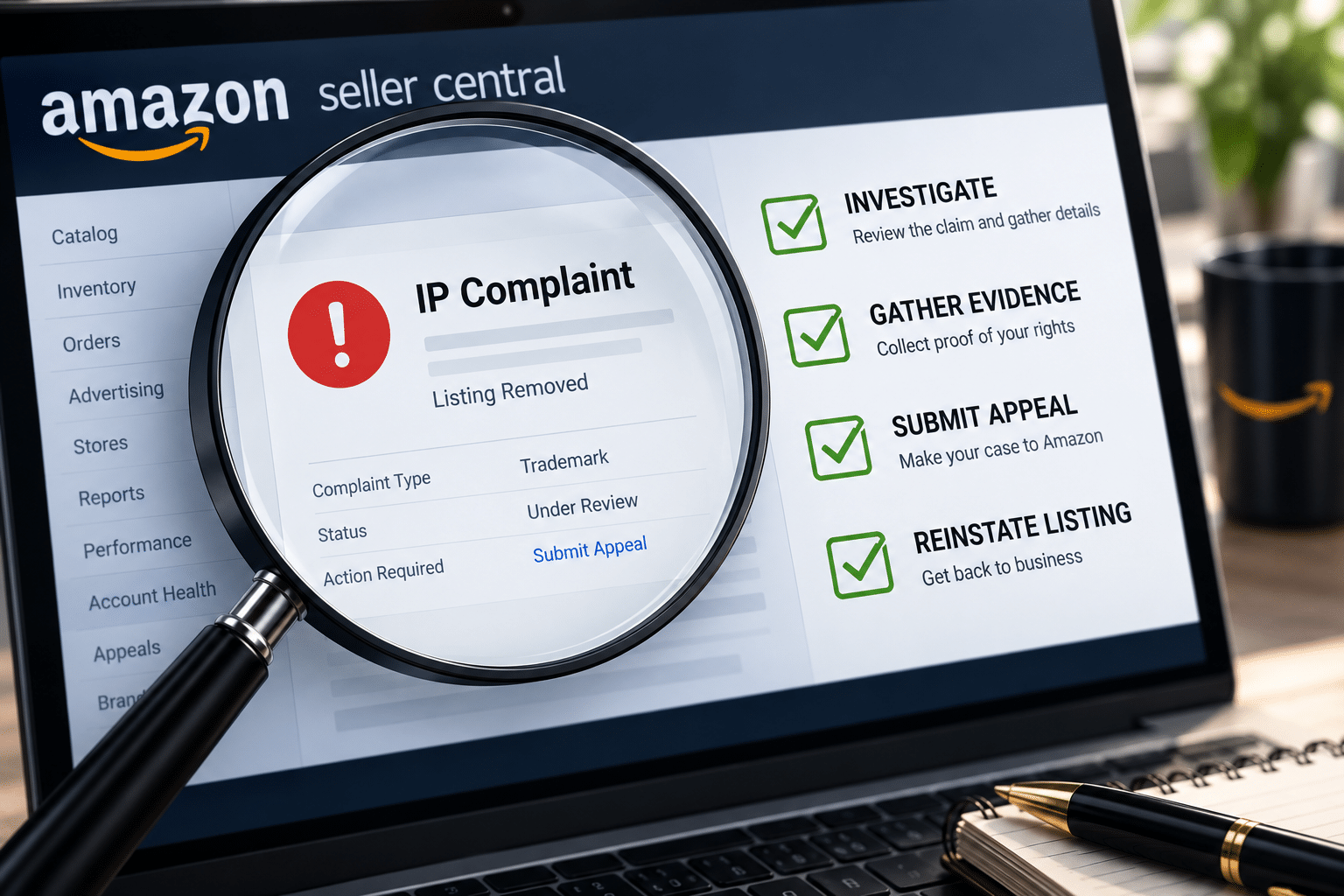
False positives do occur. If an AI system blocks 99.9% of suspected infringements, some of those blocks will affect legitimate sellers, such as authorized resellers, grey market sellers, and those with valid licenses. The system isn’t aware of your distribution agreement; it only looks for pattern matches and then takes action. And as a result, your listing is taken down first.
We’ve seen this play out more often. A seller with legitimate supply chain documentation gets flagged because their pricing looks “off” relative to the brand’s Minimum Advertised Price (MAP) policy. A private label seller gets hit because their packaging triggers a visual similarity match with a registered brand. An authorized reseller loses their listing because the brand itself filed a complaint without checking its own distribution list. Our defending against false IP complaints guide covers how to respond when this happens.
What Legitimate Sellers Should Do Right Now
Make sure that all supply chain documentation is accurate, including invoices, authorization letters, and purchase orders. Since Amazon’s AI system will flag your products, having evidence that shows that the products are genuine during the appeal process is key. If you can’t produce that evidence quickly, you will lose.
Register your own brand if you have one. Unregistered brands get zero benefit from the proactive AI protections. They’re on the wrong side of every automated enforcement action. Get into Brand Registry through the Amazon IP Accelerator and Brand Registry program or through your own trademark registration.
Monitor your listings actively. Don’t wait for the suspension notice. Our guide on monitoring Amazon for patent infringement walks through how to set up ongoing monitoring for infringement issues that could trigger enforcement actions against your account.
If You’re a Brand Owner, Stop Relying on AI Alone
Yes, Amazon’s AI system can detect 99.9% of suspected infringement cases beforehand. That fact would suggest the problem is over. It isn’t.
First, even though only 0.1% of cases evade Amazon’s AI system, when you scale that across a very large volume, it still lets a significant number of infringement cases slip through. Since Amazon handles billions of listing changes each day, a small failure rate can still mean thousands of infringing listings are online at any one time. Second, the AI learns from the data brands supply; if you haven’t joined Brand Registry, submitted your intellectual property to Project Zero, or enrolled your products in Transparency, the AI has less data to work with, and your protections are weaker.
Third, Amazon’s AI only covers Amazon. Counterfeiters operate across platforms. They’re on Walmart, TikTok Shop, eBay, Shopify storefronts, and their own direct-to-consumer sites. An enforcement strategy that only covers Amazon is incomplete. Our multi-platform IP enforcement guide covers how to build protection across all major e-commerce channels.
The Review Problem Hasn’t Gone Away Either
In 2025, Amazon blocked hundreds of millions of suspected fake reviews. The company’s knowledge graph and deep graph neural networks can identify review rings that older detection methods missed. But the arms race continues. Review manipulation has shifted to encrypted messaging platforms, where scammers recruit verified buyers to leave reviews that look authentic in return for refunds via alternative channels. AI detects these patterns, only for scammers to change them.
For brands, fake reviews are an IP issue even though they don’t look like one. A competitor flooding your product with one-star reviews tanks your ranking, which is a competitive injury. A counterfeit seller buying five-star reviews for their knockoff steals your market share through deception. Both undermine your brand’s value on the platform. As Business Standard reported, the scale of counterfeit seizures alone shows how aggressively bad actors operate.
Amazon Is Getting More Aggressive on Prosecution
The figures in the Trustworthy Shopping report tell a story: since 2020, the Amazon Counterfeit Crimes Unit has taken more than 32,000 bad actors to court or made criminal referrals in 14 countries, with over 290 people receiving prison sentences, averaging 29 months. In 2025, Amazon worked with Chinese law enforcement on more than 70 raid operations targeting counterfeit manufacturers, detaining 151 brokers who registered fake sellers and closing more than 100 websites used to run fake reviews and scams.
According to the World Trademark Review’s 2026 guide, Amazon is investing in enforcement infrastructure that goes well beyond what any marketplace has attempted. The Counterfeit Crimes Unit (CCU) is expanding to India in 2026 with a dedicated team of attorneys, investigators, and data analysts. The message is clear: Amazon wants counterfeiting to carry real criminal consequences, not just account suspensions.
For brand owners, this is actionable. Amazon’s CCU works with brands to build cases. If you have evidence of organized counterfeiting affecting your products on Amazon, reach out to their team. And if you need help with the IP enforcement side before or alongside a criminal referral, our guide to combating copycat products on Amazon covers the legal strategy for brands dealing with knockoff sellers.
Where This Goes Next
Amazon is not going to slow down; the Business Solutions Agreement (BSA) updates in March 2026 included new provisions on AI agent policies, which indicate the direction the platform is taking. Amazon currently uses agentic AI to verify product safety in fulfillment centers. Project PI uses computer vision to examine billions of product images for defects, damage, and compliance issues before they ship.
The aim is to fully automate enforcement so human inspection becomes the exception rather than the norm; this improves efficiency but also risks sellers falling into the system’s blind spots. Anyone doing business on the platform needs to understand how these systems work, what triggers them, and how to respond when they err.
At Gallium Law, we work with both brand owners building enforcement strategies and sellers defending against IP complaints. Whether you need to enroll in Brand Registry, respond to a wrongful takedown, or build a cross-platform IP enforcement program, we’re here.